Matthias Stork coined a new phrase to term the contemporary action films “chaos cinema,” where the striking visual effects overwhelm the story’s narrative with a series of “excessive “action movements. Chaotic cinema pursues a powerful sense of visual impact. In light of that, scenes switched fastidiously, vertiginously, with jumpy editing and discrete sound. Then, developing on Stock, Steven Shaviro concluded the chaotic characteristics as “post-continuity” because, for such films, “continuity has ceased to be important or at least has ceased to be important as it used to be.” In Shaviro’s book, Post-Cinema: Theorizing 21st-Century Film, he stands that post-continuity intensifies the audience’s sensory experience on a determinedly constructed complex spatiotemporal matrix rather than leading in the storytelling or following the story. However, which I think deserves further discussion is the author employed the notion of “post-continuity” in a broader cultural scope, mainly because he provides an insightful perspective on the recent horror film realism.
Mockumentary or Paranormal activity themed series constituted of exaggerated physical body movements with intricate cuts, a simple storyline (equivalent examples to the Superhero series tone- brotherhood, saving the world, and so forth easily to understand narrations), fragmented sound weave altogether to create an immersive and overloaded thrilling to audiences. In the following part, I am inclined to examine Shaviro’s argument in the Korean mockumentary, Gonjiam: Haunted Asylum, whose image setting and film techniques determinately refer to Paranormal Activity, The Blair Witch Project.
The film background sets a vogue YouTube online-streaming horror reality show that recruits bold people take an adventure to the “Kunchi Rock Asylum” CNN ranked it as 7 of the freakiest places in the world. A bulk of shaky scenes, close-ups shot by GoPro, camera monitors, laptop screens, or fixed location of video cameras. The first-person perspective significantly provoked the audience’s curiosity and then escalated these feelings to the brink of collapse with chaotic aural effects. With regard to helping the sense of reeling and, more even, fear to intrude viewer’s minds, the sound yield to be slight asynchrony and, moreover, the blurring spatial orientation. Since the adventurous groups were assigned into three teams went to different floors and rooms, which inevitably involved entangled spatiotemporal relations construction issues. Due to the shooting, the style is designed as a mockumentary, which means the third-person view shoots only a few clips, and audiences lack a standard referee to restore an ideal space the same as the forger attempted to build.
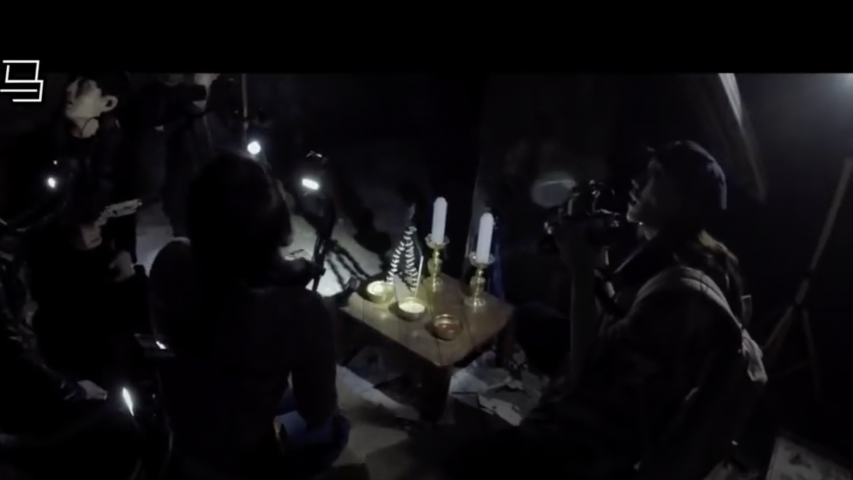
Besides, quick scenes shift (three teams’ video footage constantly switching accompanied by little dialogues), wobbly screen, and the violence of traditional continuity editing rules aggravate “spatial confusion.” Although these clips recording stories take place simultaneously, they seem like they were randomly stitched on, reducing the immersive viewing experience. The spatial confusion may come either from restricted locations(room, corridor, camp) or fixed camera devices.

The aesthetic of disorder is imprinted in post-continuity cinema, but how to devise it appropriately also bothers film producers. In my view, Gonjiam makes every effort how to balance the post-continuity editing rules and classical editing techniques to strengthen viewing experiences. Although it falls, we still have access to learn from the case.
Reference
- Denson, S. and Leyda, J. (2016) Post-cinema: Theorizing 21st-Century film. Falmer: REFRAME Books. 51-64
- Stork, M. (2013). Chaos cinema: Assaultive action aesthetics. Media fields journal, 6, 2-16.
Duan Huaijiang 02/11/2022
 Digital Audiovisual Media Class Blog
Leave a comment