Denson and Leyda (2016) argued the meaningful interpretation of the term “post-cinema”. This is because simply using the term “post-cinema” is not without its dangers. For instance, this term might be too blunt to be used to characterise our present media landscape where the previous cinematic terms are still being used, yet we openly call it post-cinematic. Cinema took its first breath in the 20th century; however, it is no longer able to hold its position in the 21st. Fredric Jameson used the term “cultural dominant”: a notion which permits the presence and coexistence of a broad number of extremely dissimilar yet subordinate features (Durham, 2014). The question arises whether this notion is also applicable to “post-cinema” because the new digital computer-based media has way exceeded the old cinematic technology.
Considering one post-cinematic movie clip of blade runner https://www.youtube.com/watch?v=-fu7jN2_2pE&t=86s, it can be inferred that post-cinematic digital movies have engaged us with different kinds of latest images and sounds that we never experienced before.

Figure 1
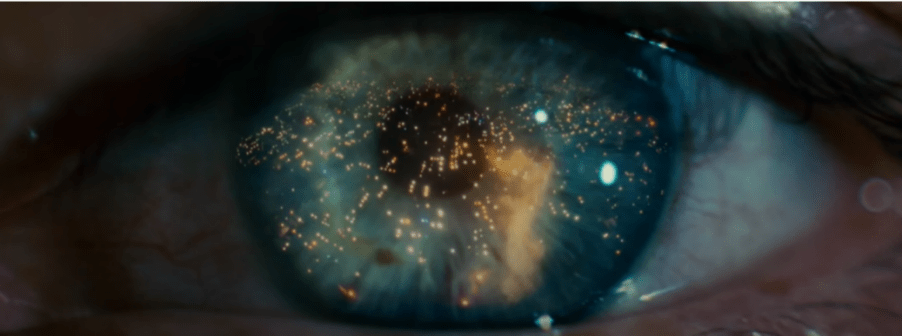
Figure 2
The blast effect in figure-1 and showing outer visuals inside the lens of a human eye in figure-2 differentiate digital technology being used in new cinema. These audio-visuals show that analogue technologies (comprising of analogue forms of transmission, storage, coding and transmission) in the past have been replaced by digital ones. Figure 1 shows the new manners of hearing and watching film scenes. On one side, digital cinematic technologies have considerably raised our expectations of entertainment, it has clearly superseded the old cinematic films. Post-cinema seems to be the cinema of the past because the new digital cinema has brought new patterns of reality, perception and clarity to our senses. The term “cultural dominant” given by Fredric Jameson might be irrelevant in comparing post-cinema and digital cinema because the older audio-visuals have vanished thanks to the new digital media. A reordering of our senses has been established by this transition.
References:
Denson, S. and Leyda, J. (2016). Perspectives on Post-Cinema: An Introduction.
Durham, S. (2014). Fredric Jameson. In Film, Theory and Philosophy (pp. 233-242). Routledge.
Written by Yihan Xu (33675720) 7/11/22
 Digital Audiovisual Media Class Blog
Leave a comment