According to Steven Shaviro (2016), continuity, in a narrow sense, refers to the editing of the narrative structure of classic Hollywood films. In a broader sense, continuity implies “the homogeneity of space and time”. The structure of continuity provides a norm of time flow and variation, not only embodied in a conventional, linear narrative structure but also in a sense of “spatial orientation”.
Post-continuity, in terms of its audiovisual effects, seems to be expressed as a fragmented, incoherent, messy, and glitchy collection of frame cuts. In essence, post-continuity as a cinematic style is more concerned with immediate effects than with broader continuity, both at the single-shot and narrative levels. In the post-continuity style, the rules of continuity are only occasionally used, rather than being considered crucial. Time and space are not represented within a classical structure and order, and post-continuity is not an abandonment of narrative. (Shaviro,2016)
Based on technological transformations in digital media and the Internet, post-continuity takes on many forms and technical expressions on a digital level. Examples include CGI, simulation techniques, photorealistic morphing, glitches, etc. In the film Gravity(2013), the hyper-architecture of space is constructed to convey an immersive audiovisual experience.
In Sandra Bullock’s article “GRAVITY, Part 1: Two characters adrift in an experimental film”, she states that “Arguably Cuarón had constructed nearly the most sparse narrative that can sustain the experimental style and motivate that style enough to hold the attention of a popular audience.”
From the narrative level, Gravity (2013) lacks a cohesive narrative thread. The protagonist, Stone, is constantly reacting to rapidly changing circumstances and crises, and the film also creates these crisis scenes through extensive CGI and digital effects, such as 360-degree camera shots, to give the viewer immediate sensual stimulation. Editing-wise, the film also develops a rhythm that is sometimes thrilling and sometimes quiet, allowing the audience to be affected by the pace of the film instantly.
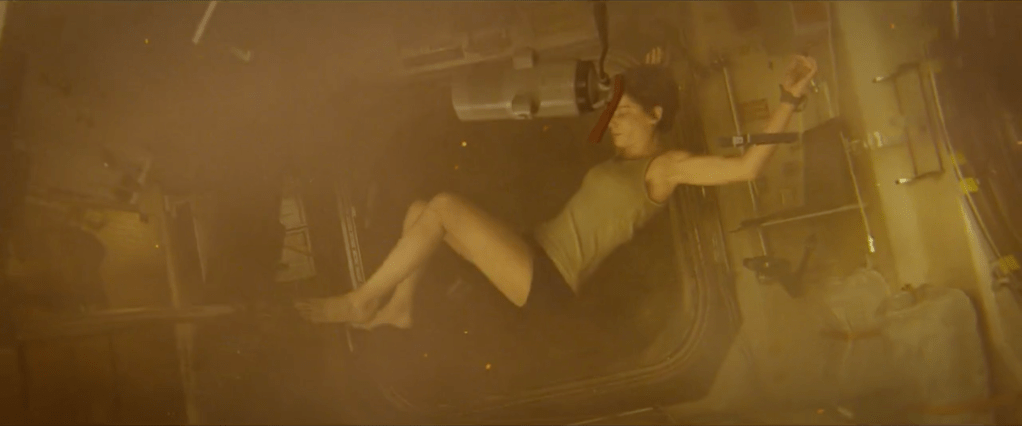
image 1

image 2
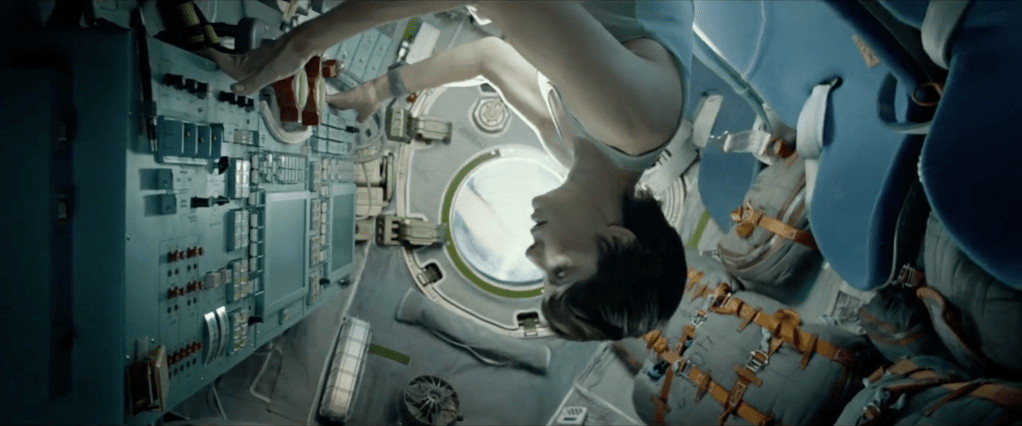
image 3
For example, when Stone encounters a sudden fire on the International Space Station, the CGI effect fills a short period with dramatic visual effects shots. Stone floats and escapes in various orientations, and the sense of space and orientation is blurred and weakened, so that the viewer may experience spun around.
References:
Bullock, S. (2013) GRAVITY, Part 1: Two characters adrift in an experimental film. Available at: http://www.davidbordwell.net/blog/2013/11/07/gravity-part-1-two-characters-adrift-in-an-experimental-film/ (Accessed on: 12 November 2022).
Shaviro, S. (2016). Post-continuity: an introduction.
By YiXi Zhao (33659283) Written on 12/11/2022
 Digital Audiovisual Media Class Blog
Leave a comment