Post-Cinematic Affect (Shaviro and John Hunt Publishing, 2010) is derived from Massumi’s theory of affective movement (Massumi, 1995), loosely describing works in the context of an audiovisual control society, and attempts to move beyond Rodowick’s (2007) pessimism to construct a Noys-style accelerationist aesthetic. The first two chapters are on the organ-less body + Afrofuturism of Corporate Cannibal and how Assayas’ Boarding Gate presents an aesthetic in the delirious flow of capital, while the last two are on the politics of Southland Tale and Gamer’s mimetic playfulness.
These works are very different from each other in terms of form to content, with Corporate Cannibal being a digital product that has little in common with traditional cinema. Boarding Gate, on the other hand, is not a digital product; it is a decidedly cinematic work, both in terms of technical and narrative development or character expression. The Southland Tale falls somewhat between the two, based on the formal techniques of television, video and digital media rather than on those of cinema, but aiming in essence to be a big screen film. Escape from Gamer is, for its part, a digital film that mimics a computer game. Despite their obvious differences, all four works express and exemplify the “structure of the feeling” (Shaviro, 2016).
Post-cinematic portrays the fast-changing nature of our reality through non-linear narrative and editing, visual effects, intense action and chaotic scenes. Shaviro has also drawn icons about the affective flow using four dimensions(Control, Flow, Ecologies, Game) (Shaviro and John Hunt Publishing, 2010). The narratives in much of post-cinematic are new ways of making and expressing real-life experiences and emotions.
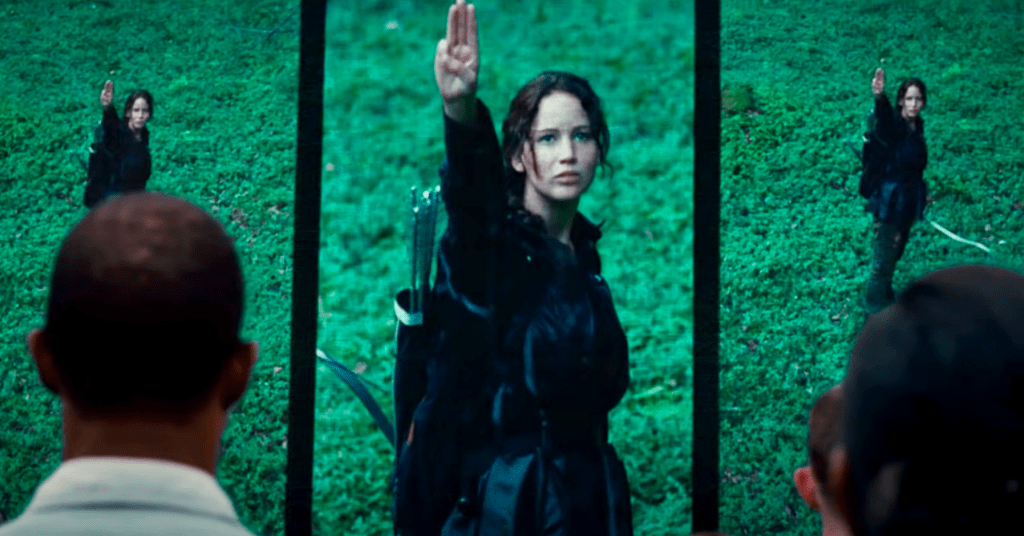
The Hunger Games is a good example of this. In the film, humans are classified as rich and poor, with the poor participating by lottery and the rich simply watching and sponsoring the contestants. With a total of 24 participants, the competition is called “The Hunger Games”, in which the participants not only have to fight against various wild animals and harsh conditions, but also have to kill other competitors. The winner gets a huge prize and access to the rich.

First of all the film is set in a game of life and death, where only the strongest survive and gain wealth and glory. In a way, the film reflects the “gamification” of Shaviro – ´life to be imagined as a competitive game (Shaviro and John Hunt Publishing, 2010). Also, in this series of films, every word spoken by the protagonist represents the political interests of a certain group and embodies a rebellion against political oppression. In addition to the game of discourse between the various groups in relation to political propaganda, the possibility of resistance in the public area is also highlighted. This perhaps leads the audience to some rational reflection on society in real life, rather than indulging in rules. I think that this point also holds up Shaviro’s so-called “control” – This is a new model of social power based on modulation and incitement rather than traditional power structures based on confinement or prohibition. Additionally, in this film, the protagonist’s every move is watched, suggesting that surveillance and digital computers are as ubiquitous as our real lives. The audience may become more convinced of the story of what is happening in the film because of this quasi-objective scenario, and more vicariously, to reflect on the point the director is trying to make.

References
Massumi, B. (1995). The Autonomy of Affect. Cultural Critique, (31), p.83. doi:10.2307/1354446.
Rodowick, D.N. (2007). The Virtual Life of Film. Harvard University Press.
Shaviro, S. and John Hunt Publishing (2010). Post-cinematic affect. Winchester ; Washington: O Books.
Images references
diaryofanaspiringloser (2020). How Does the Reaping System Work in the Hunger Games? diaryofanaspiringloser. Available at: https://www.diaryofanaspiringloser.com/how-does-the-reaping-system-work-in-the-hunger-games/.
The Hunger Games Wiki (n.d.). The Reaping. The Hunger Games Wiki. Available at: https://thehungergames.fandom.com/wiki/The_Reaping.
Zakharenko, H.Z. (2022). Students reminisce during 10-year anniversary screening of ‘The Hunger Games’. dbknews. Available at: https://dbknews.com/2022/04/07/hunger-games-10-year-anniversary/.
Video reference
Lionsgate Movies (2011). The Hunger Games (2012 Movie) – Official Theatrical Trailer – Jennifer Lawrence & Liam Hemsworth. YouTube. Available at: https://www.youtube.com/watch?v=mfmrPu43DF8.
YARUI XIAO
 Digital Audiovisual Media Class Blog
Leave a comment