Carol Vernallis (2013) argues that music video has entered a new aesthetic, characterized by new digital technologies, new cross-media authorship and expanding transmedia potentials for expression which she coins the “mixing board aesthetic” (p.5-6). Grimes’ music video Shinigami Eyes (2022) encapsulates Vernallis’ concept of this aesthetic through its jarring use of digitally-generated colours, heavily AI-based visuals and futuristic imagery; perhaps signalling the digitalized future of music video creation.
Shinigami Eyes invigorates the viewer with dystopian choreographed backgrounds and performers who look like otherworldly entities through the use of digital special effects and technologies. In digital music videos there is a “short-circuiting of the visual” (Chion, 1993, cited in Shaviro, 2016, p.158) in which narrative time is displaced in favour of spatial explorations of a virtual environment. The music video encapsulates this idea through its use of an XR Stage which renders special effects and virtual environments in-camera, allowing the performers to interact with the effects in real time. This breaks the boundaries between augmented reality, mixed reality and virtual reality, thus showing the mixing board aesthetic of the music video.
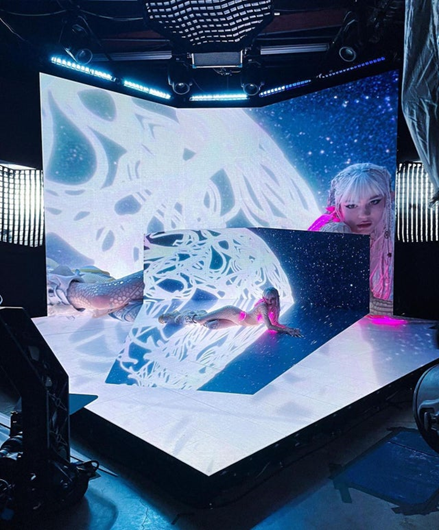
The video -drenched in dream-like visuals and kaleidoscopic effects- complicates not only time and space but makes Shinigami Eyes feel like a “cyber-tech hallucination” (Wang, 2022). It also shows how music videos are not always narrative-based and instead offer a space for artistic expression, self-reflexivity and experimentation. This embodies the idea of the complex emerging video culture (Cubitt, 1991, cited in Arnold et al, 2017) consisting of video art and avant-garde music videos, where artists are more anarchic, controversial and openly expressive through exploring digital technologies.

As digital technologies constitute an extension beyond ourselves (McLuhan, Fiore & Agel, 2001), this mixing board aesthetic could therefore offer the potential for different kinds of expressions and a gateway to more vivid, virtual articulations of what the artist is trying to convey.
References:
Arnold, G. et al. (2017) ‘Introduction: The Persistence of the Music Video Form from MTV to Twenty-First-Century Social Media’, Music/Video Histories, Aesthetics, Media. New York: Bloomsbury Academic.
McLuhan, M., Fiore, Q. and Agel, J. (2001) The Medium is the Massage: An Inventory of Effects. Corte Madera, CA: Gingko Press.
Shaviro, S. ‘Splitting the Atom: Post-Cinematic Articulations of Sound and Vision,’ in Denson, S. and Leyda, J. (eds), Post-Cinema: Theorizing 21st-Century Film. REFRAME Books (2016).
Vernallis, C. (2013) ‘Music Video’s Second Aesthetic?’, The Oxford Handbook of New Audiovisual Aesthetics. Oxford: Oxford University Press.
Braithwaite, A. (2022) Grimes goes behind the scenes of “Shinigami eyes” music video exclusively for vevo footnotes. Music Talkers – Latest Music News & Artist Exposure. Available at: https://musictalkers.com/latest-news/8318-grimes-goes-behind-the-scenes-of-%E2%80%9Cshinigami-eyes%E2%80%9D-music-video-exclusively-for-vevo-footnotes (Accessed: November 18, 2022).
Fuse (2022) What is an XR stage? Fuse. Available at: https://fuse-tg.com/projects/extended+reality+%28xr%29 (Accessed: November 18, 2022).
Wang, S. (2022) Grimes’ “Shinigami eyes” lyrics are her interpretation of this famous manga. Nylon. Available at: https://www.nylon.com/entertainment/grimes-shinigami-eyes-lyrics-death-note-explained (Accessed: November 18, 2022).
Written by Mariella Del Federico (33652293) 18/11/22
 Digital Audiovisual Media Class Blog
Leave a comment