Written by: Kaja Sunde
The popularity of binge-watching has increased in sync with the emergence of Netflix as a dominant streaming platform. It is defined as the behaviour of watching between two and six episodes of a show in one sitting (Starosta 2020: 1), and has been a much mentioned term after the lock downs during Covid-19. With the increased popularity of Netflix the past years, so too has video-on-demand (VOD) platforms such as Amazon Prime and HBO contributed to the widespread phenomenon of bingeing a TV show. Considering this from the perspective of an audience member, the different VOD platforms allow for a broader spectrum of choices and personal autonomy, empowering the users to choose content tailored for their own preferences (Ort et al. 2021: 1). Although the great amount of choices allow for a person alteration, one should also consider the behaviours that follows in terms of the psychological matters of the issue: problematic use, according to Addictive Behaviors Reports 13 of 2021, ‘involves the consumption of an uncontrolled amount of series content, risky use.’ In this report, a comparison between gambling and binge-watching is being made, and although it may be a drastic one, there are certain traits between the two ‘addictions’ that correlate with each other. Furthermore, the study states that there is a negative connotation in the fact that ‘binge’ often implies a connection with other disorders, such as binge-drinking or binge-eating, all portraying problematic and hazardous behaviours (Ort et al. 2021: 3-4).
An example of binge-watching, and also a personal favourite, is the famous U.S. version of The Office. With all 9 seasons available to watch at any time, one can spend their weeks binge-watching the series throughout the hours of the night. As seen in the collage below, there is a simple set design and aesthetic to the show, in company with easy-to-follow episodes of 20-25 minutes, with the typical ending of the episode, as often found in sitcoms. The audience gets to know the characters as though they were friends, allowing for an important relationship between the characters and the viewer.
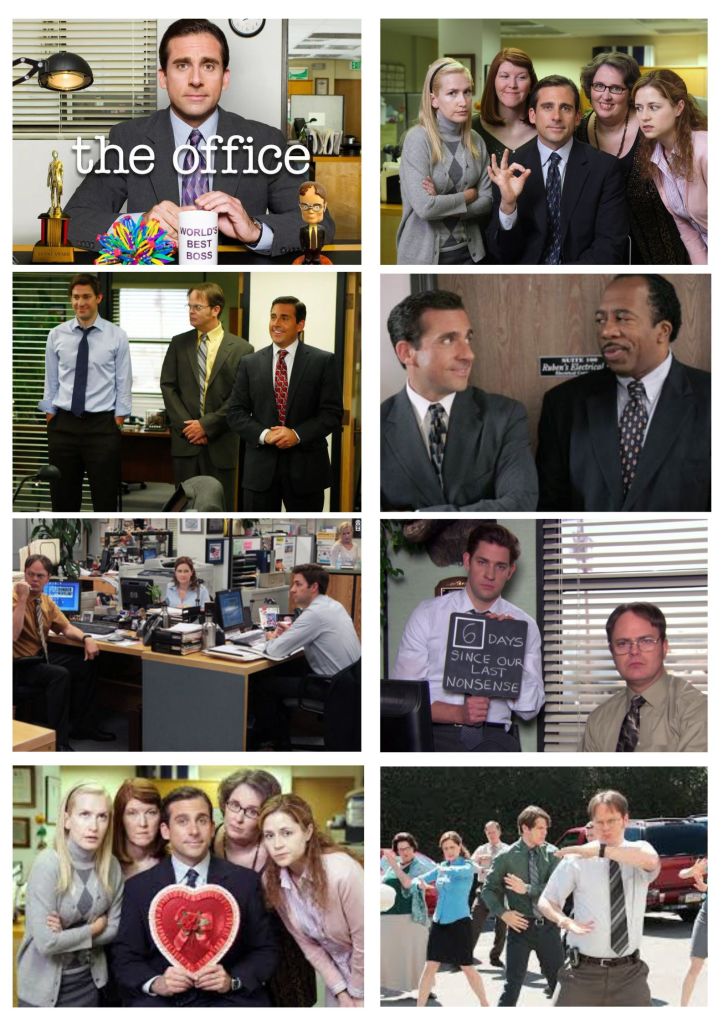
My personal take on bingeing VOD: Binge-watching, although both popular and most often mentioned in a jokingly manner, allows for a necessary investigation of the psychological effects of the term and behaviour. Compared to bingeing in different contexts, these most often being negative ones, there should be a careful approach to the activity.
References:
Ort, A., Wirz, D.S., Fahr, A. (2021): Is binge-watching addictive? Effects of motives for TV series use on the relationship between excessive media consumption and problematic viewing habits
Department of Public Health and Medicine, University of Luzern
https://reader.elsevier.com/reader/sd/pii/S2352853220301401?token=9A858C340E889E7F194601F764E0F5DF78571781368FAC4184255F069A2730F6FA01E204B3DB682975CDA5D8CBF70C0B&originRegion=eu-west-1&originCreation=20221122141936 Retrieved 22nd of November 2022 (Online)
Spangler, T. (2021): The Office’ Was by Far the Most-Streamed TV Show in 2020, Nielsen Says
https://variety.com/2021/digital/news/the-office-most-streamed-tv-show-2020-nielsen-1234883822/ Retrieved 22nd of November 2022 (Online)
Starosta, J. A. (2020): Understanding the Phenomenon of Binge-Watching – A Systematic Review
Institute of Applied Psychology, Faculty of Management and Social Communication, Jagiellonian University.
https://www.ncbi.nlm.nih.gov/pmc/articles/PMC7344932/pdf/ijerph-17-04469.pdf Retrieved 22nd of November 2022 (Online)
 Digital Audiovisual Media Class Blog
Leave a comment