
“But that’s not cinema. Honestly, the closest I can think of them, as well-made as they are, with actors doing the best they can under the circumstances, is theme parks.”
I agree. It looks like a theme park.
The films are reverting to the early cinematic style of spectacle.
According to Elsesser in Film History as Media Archaeology(2017), the spectacle of early cinema and modern cinema have much in common. And Lef Manovich, in “What is Digital Cinema?” (2016), Digital cinema ‘represents a return to pre-19th century cinematic conventions, when images were hand-drawn or hand-animated. Essentially, digital cinema is a return to the spectacle of early cinema, reconstructed through digital technology, and a return to animated conventions.
Marvel Studios is crossing the borders between film and television.
MCU films are a typical series with exactly those elements. (The fact that they are based on comic books is another animated element.) In addition, the MCU is focusing on the integration of ‘film + streaming’, not only with its film series but also with the launch of Disney+.
Marieke Jenner(2018) used the concept of ‘TVIV’, stating that television has entered a new era, including streaming. In particular, NETFLIX’s “Stranger Things” practices a cinematic approach. In contrast, Disney’s move is an approach from a film to the TVIV stream; it could be said that each stream is melting down and entering a new era.
The post-cinematic aspect of Marvel Studios’ works.
Looking at another angle, the aspect ratio varies from scene to scene in several films, as mentioned in the wired article (2021), such as “Doctor Strange” and “Black Panther”. The use of IMAX in action scenes suggests that Marvel is conscious of the experience in the theatre.
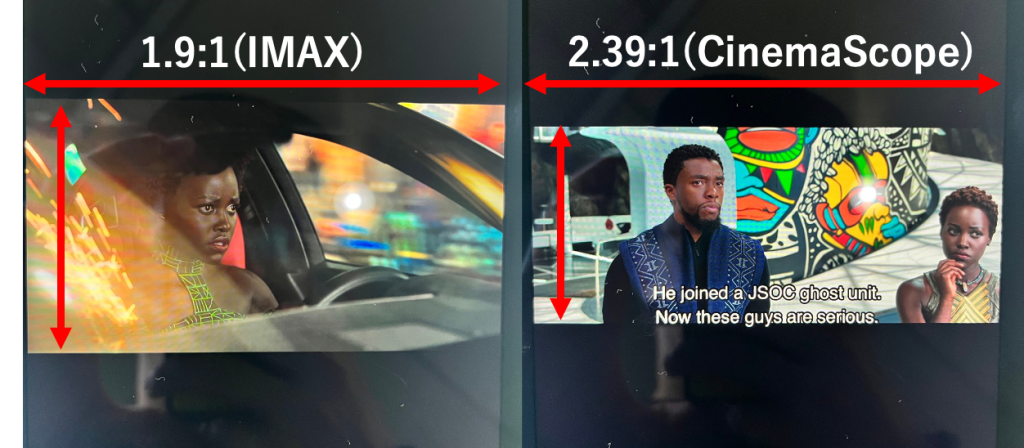
Some representative scenes are also noted. In the car chase scene in the first half of the “Black Panther” film, post-cinematic elements can be seen, such as the music video-like fusion with the Kendrick Lamar track and the camera work from various positions.
Theme park-like structure.
The structure of the series, where the series is diverse in both content and platform, and the more you watch the series, the more you enjoy it, is the very strategy that ‘Disneyland’ is using by having elements in its parks that make you want to go back again and again. Marvel is not offering users a simple narrative, but rather an entertainment in all environments.
Conclusion.
Users now have different viewing experiences on different devices and in different environments, and the MCU may be offering a ‘post-viewing experience’ that goes beyond the concept of cinema to meet these modern changes. Disney is now the world’s largest film exhibition company (Clark, 2021) and the world’s largest theme park company(AECOM, 2022). Disney is trying to offer theme parks in the real world and a theme park experience in the visuals by giving them the spectacle of early cinema.
References
- Semlyen, N.D. (2019) The irishman week: Empire’s Martin Scorsese interview, Empire. Empire. Available at: https://www.empireonline.com/movies/features/irishman-week-martin-scorsese-interview/ (Accessed: November 21, 2022).
- ELSAESSER, T.H.O.M.A.S. (2016) Film history as Media Archaeology. AMSTERDAM University PRES.
- Lef Manovich, (2016) ‘1.1 What is Digital Cinema?’, Post-cinema: Theorizing 21st-Century film. Falmer: REFRAME Books. 20-50
- Mareike Jenner (2019). Netflix And The Re-Invention Of Television. S.L.: Palgrave Macmillan.
- Ravenscraft, E. (2021) What are aspect ratios and why do they matter?, Wired. Conde Nast. Available at: https://www.wired.com/story/aspect-ratios-explainer/#:~:text=In%20simple%20terms%2C%20the%20aspect,wide%20as%20it%20is%20tall. (Accessed: November 21, 2022).
- Clark, T. (no date) Disney and Sony topped the US box office in 2021, thanks to Marvel. here’s how Hollywood’s studios stacked up., Business Insider. Business Insider. Available at: https://www.businessinsider.com/hollywood-box-office-revenue-by-studio-in-the-us-ranked-2022-1?r=US&IR=T#1-disney-7 (Accessed: November 21, 2022).
- Aecom.com. (2022) Global Attractions Attendance Report . P Published by the Themed Entertainment Association (TEA) and the Economics practice at AECOM. Available at: https://aecom.com/wp-content/uploads/documents/reports/AECOM-Theme-Index-2021.pdf (Accessed: November 21, 2022).
Kenji Shimada 21/11/2022
 Digital Audiovisual Media Class Blog
Leave a comment