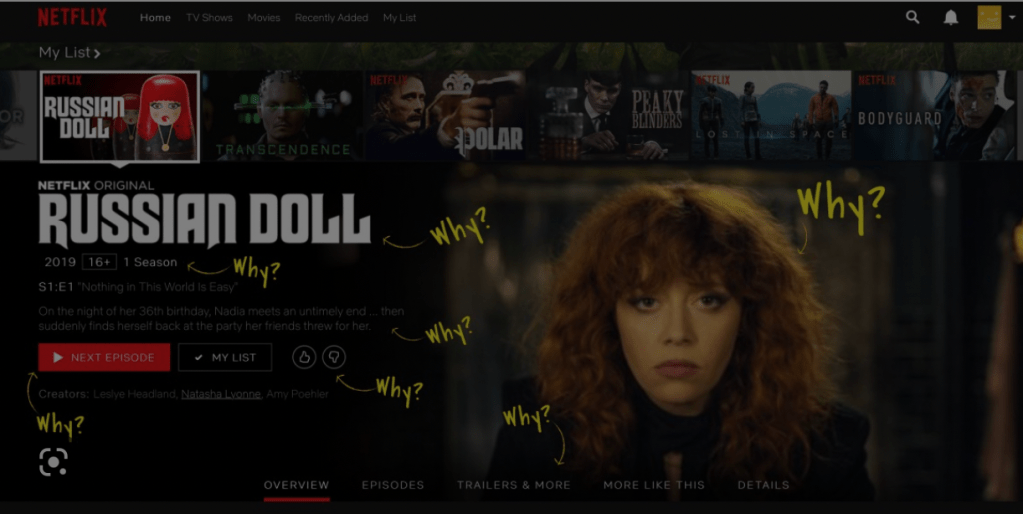
Television could never. As someone who grew up with Netflix or at least started consuming the services of the company at a very young age, I found myself using all of my ‘television time’ on the platform while simultaneously protesting that “Television is dead” as my parents watched regional shows on their telly.
It is then interesting that words such as ‘cinema’ and ‘television’ lost their original meanings and a new technology effectively challenged all aspects of how these mediums operated from the perspective of networks, distribution systems, content arrangements, environments and consumer behaviours.
In this blog, I attempt at decoding Netflix’s UI/UX design in order to inform my own perspective of what has changed in the many eras of television (TVI, TVII, TVIII, TVIV) and how this can be traced through the reactionary product that is Netflix.
Background
Netflix started out as an online DVD rental website which mailed users DVDs of their favourite movies. At the very start itself, Netflix aimed to compete with Blockbuster and not mainstream television. However, as demand grew, Netflix focused efforts on streaming with its first stint in Canada. It is important to note here that while Netflix essentially completed with Video Rental Services, it was also competing for watch time.
Netflix UI/UX (Mobile Interface)
At the top of the screen, you can find the Netflix logo, a button to cast your screen, a search button and your profile. Below it the options to watch TV Shows (what does that even mean?) and Movies, alongside a button for categories that delves deeper into genres. Here we see the clear distinction from television: Options are aplenty (as mentioned by John Ellis while discussing the British TV industry) and the ‘switchability’ between media–using a phone, computer or casting your screen on a telly–are all made available to the user.
Next, we see a visual of a Netflix series that is new on the streaming service or sometimes replaced by one of the Top 10 content watched in a particular country. The user is then shown a shelf of movies to choose from and the options include categories such as ‘Watch again’ and ‘Because you liked’ – this shows how intuitive Netflix can be and how it uses AI to personalise our individual feeds by collecting data on metrics such as: viewing history, genre or category, time of day watched and even similar users’ watching patterns. Netflix communicates the value of its originals by making sure the visuals take up more space on the screen and are bigger in size.
Moreover, Netflix generally makes all episodes available at once encouraging binge-viewing – a phenomenon that couldn’t take place with linear TV programming. At the end of each TV show, the service gives users a 10 second break before automatically moving onto the next episode. The ‘Are you watching?’ feature pops up when Netflix senses no activity from the user in order to save bandwidth for both the user and Netflix.
The plethora of options, the user’s control over their viewing experience, the different media that can be integrated or the phenomenon of binge-watching are all reminiscent of the different aspects of the evolution of television. For example, binge-watching was associated first with DVDs. Options on satellite TV increased year on year and customisation of ‘subscription packs’ was quite prominent during TVIII.
It then stands true that Netflix did not completely reinvent what television is, but is part of a reconception that was already prefigured by the habits linked to DVDs or DVRs, objects that are made obsolete or in need of technological adjustment (Jenner, 2018).
References:
Netflix and the Re-Invention of Television (Jenner, 2018): Retrieved December 1, 2022, from https://ebookcentral.proquest.com/lib/goldsmiths/reader.action?docID=5475331&ppg=19
Vicente, V. (n.d.). Why Netflix Asks “Are You Still Watching?” (and How to Stop It). How-to Geek. https://www.howtogeek.com/685919/why-netflix-asks-are-you-still-watching-and-how-to-stop-it/
Whatley, T. (2021, August 27). How Netflix Creates Immersive Experiences with Exceptional Design and UX. CXL. https://cxl.com/blog/netflix-design/
Kariuki, P. (2021, October 22). How and When Did Netflix Start? A Brief History of the Company. MUO. https://www.makeuseof.com/how-when-netflix-start-brief-company-history/
Written by Ridhima Chatterjee
 Digital Audiovisual Media Class Blog
Leave a comment