by Clara Heras Aguilar
33676766
Stuart Minnis points out an interesting idea related to special effects in science fiction cinema: Most all film viewers are endowed with “instrumental reasoning”, whereby they can tell that such things are not real, even if perceptually they appear realistic.
Sometimes it could be easy to identify: we know that dinosaurs do not run around our cities, or it does not exist anybody whom special power is projecting spider webs. They are just simulations, and in William Brown’s words, “as simulations of reality, digital entities are entirely unreal, even if they look realistic”. As I mentioned, sometimes it is easy to identify reality, but the truth is that sometimes it is not. The Congress, directed by Ari Folman and starring by Robin Wright, might us questioning those instrumental reasoning in this era.
Anthony Wilden’s point of view is that humans digitalize reality, transforming and compartmentalizing it into knowledge or mere data. However, the plot of this film lead us to a pervert and hidden perspective about digitalizing uses nowadays: Robin Wright, who plays a fictional variant of herself, is having a tough period in the Hollywood industry: her career since she is read as an aging actress has been stagnant. But she has been offered a final contract: digitalizing herself. This situation will enable the producer —in this dystopian world, the company’s name is Miramount— to use her digital image since the moment she sells her rights. She promises to never act again. Her future starring plays will be made by digitalized data of herself. Her emotions, decisions, her beauty and youth, now do not belong her anymore.
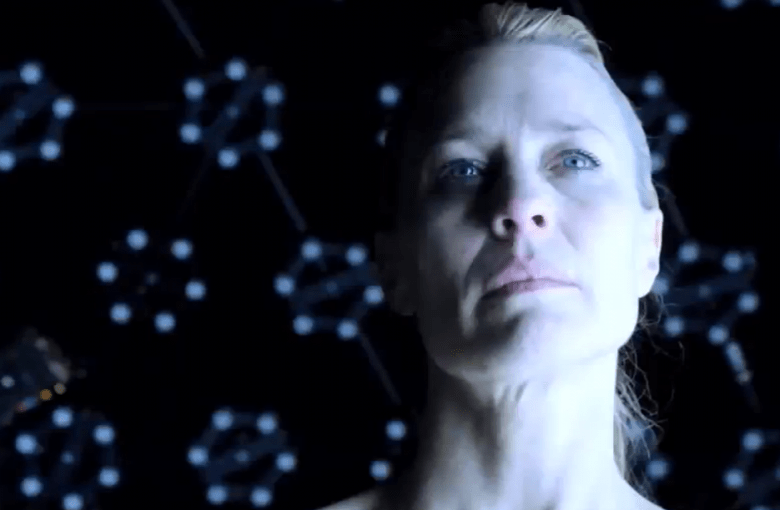
https://www.youtube.com/watch?v=vzBMbAPOq7o
This scenario is brutally developed through this film. The fact that someone could be deprived of their identity leads us to the following possibility: If I am not myself —as we understand—anymore, could I be someone else? Miramount’s world would answer to this question: Yes, you can.
This is the turning point, philosophical and visually speaking: We get immerse, as the main character does, in a kaleidoscopic and animated world in which everybody could be whoever wants to.
https://www.youtube.com/watch?v=8pqzaZcivh4
The Congress, as a post-continuity film does not abandon narrative whatsoever. But as Steven Shaviro says, “it is articulated in a space and time that are no longer classical”. Despite the fact that our “instrumental reasoning” understands the situation presented by Ari Folman is not real, we sometimes doubt. It is not real, but it could be so. The questions raised during this film ring us a bell.
Living under globalized capitalist structures might us think this scenario would become real at some point. If not worst.
References:
·Steven Shaviro, ‘Post-Continuity: An introduction’, Post-Cinema: Theorising 21st Century Film, 51-64
·Brown, William, ‘Digital Cinema’s Conquest of Space’ SuperCinema: Film-Philosophy for the Digital Age (Oxford: Berghahn, 2013).
·Bukatman, Scott, ‘The Ultimate Trip: Special Effects and Kaleidoscopic Perception’, in Matters of Gravity: Special Efffects and Supermen in the 20th Century (Durham, NC: Duke University Press, 2003).
 Digital Audiovisual Media Class Blog
Leave a comment