With the spread of digital media these years, both the production model and consumption behavior has been experiencing transaction in the television industry. This leads to many studies start to challenging the way we understand television and drawing attention on the impact brought by such transaction. Therefore, I would like to focus on the concept of binge-watching introduced by Netflix as a new viewing experience to the audience and critically discuss how it engages with the control and choice relationship between audience and television producer.
According to Jenner (2018), the evolution of television industry has gone through form the era of scarcity with limited channels, the development of network and quality television, to the current shift towards digital that led by online distribution platforms. Although some scholars suggest that such phenomenon would challenge our previous understanding of what is “television”, I’d like to argue that the emergence of Internet distribution TV such as Netflix actually parallel with the current media ecology that involves the convergence of various media channels embedded in our social life. Television is no longer limited to watching certain types of programmes from a device at home but rather accessible across various forms based on our own demand and practiced in an interactive way. This trend becomes particularly obvious if we look at the production model of Netflix, which intentionally releasing the entire seasons of episode at once and makes the content available to global audience at the same time. Moreover, the company also make all its contents available from a library list, abandoning the previous fixed linear schedule. According to Netflix itself, such shift aims at providing more enjoyable and individualized viewing experience compared with broadcast TV by removing the inconvenience brought by advertising and device restriction.
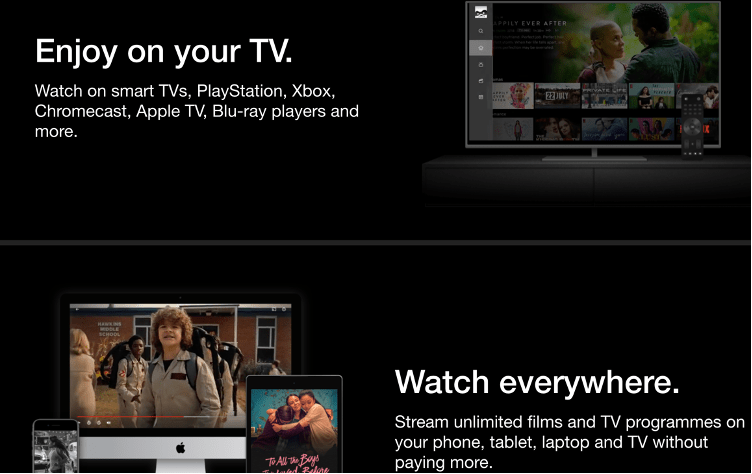
The Home Page of the Netflix Website
Given Netflix’s releasing schedule and marketing strategy, the concept of “binge-watching” as a new form of viewing experience becomes a rising phenomenon among contemporary audience. Theoretically, the idea of watching TV shows anywhere across various devices and individuals have the choice to decide the pace they prefer follows the development of neoliberalism capitalist system, where individuals are able to make their own decision based on personal willing. However, I think the mechanism behind “binge-watching” reveals the fact that the fundamental power and control may still be owned by those Internet distributed TV companies and the audience are manipulated in certain way to believe that they actually hold the control over content choice and viewing pace. For instance, the last scene of Squid Game Episode 4 (as shown below) evidently leaves the result of the tug of war on the cliff unresolved, which designed by Netflix to exploit human being’s psychological

needs of completing things. Some studies also point out that when audience engages in an enjoyable activity such as binge-watching, it triggers a release of dopamine in the brain, which motivates the brain to continue such engagement (Page, 2017). Similar strategy can be observed from Netflix’s recommendation algorithm, which pre-determines the content appeared on each audience’s library list and automatically recommend other shows when one series finished based on the level of relevance defined by computer algorithm. This actually manipulates individuals’ unconscious decision making process and limits our choice in reality.
References:
Mareike Jenner (2018), ‘Introduction: Netflix and the Renvention of Television’, ‘Introduction: Binge Watching Netflix’, Netflix and the Reinvention of Television, pp. 1-31, 109-118.
Unlimited movies, TV shows, and more. (no date) Netflix. Available at: https://www.netflix.com/gb/ (Accessed: November 27, 2022).
Danielle Page (2017), ‘What happens to your brain when you binge-watch a TV series’, Available at: https://www.nbcnews.com/better/health/what-happens-your-brain-when-you-binge-watch-tv-series-ncna816991 (Accessed: November 27, 2022).
Sia (Xinyi JI) – 33729902
27/11/2022
 Digital Audiovisual Media Class Blog
Leave a comment