At first glance, Matthias Stork’s theory of Chaos Cinema seems to be rather accurate given the spatial incoherence and manic free-ranging camera movements we see in the action movies of today. It is this frenetic pace employed by movies such as this shoot-out scene in Domino (2005) that in Stork’s words – “…doesn’t seduce you into suspending disbelief but rather bludgeons you until you give up.”
So what comprises Chaos Cinema and how does David Bordwell’s Intensified Continuity argue otherwise?
Stork argues that Chaos Cinema consists of a barrage of high-voltage scenes that lack spatial clarity. Stork’s theory of Chaos Cinema focuses on four crucial aspects: excessive editing, shaky cameras, loss of spatial coherence and specific contours of the action movement and layout of the action space as secondary to the visceral impact their interplay engenders (M. Stork, 2012).
David Bordwell’s Intensified Continuity on the other hand, suggests that rather than rejecting traditional continuity, a new style has emerged that amounts to an intensification of established techniques. Bordwell defines Intensified Continuity with markers such as rapid editing, bipolar extremes of lens lengths, close framings of dialogue scenes and free ranging camera. Both make valuable points that represent aesthetic configurations of modern cinema. (Bordwell, 2002)
However, it should be noted that Stork himself makes exceptions to his arguments for Kathryn Bigelow’s The Hurt Locker which uses Chaos Cinema to represent the hyper-intensity of combat (Chaos Cinema Part 2, 2:38 – 3:15).
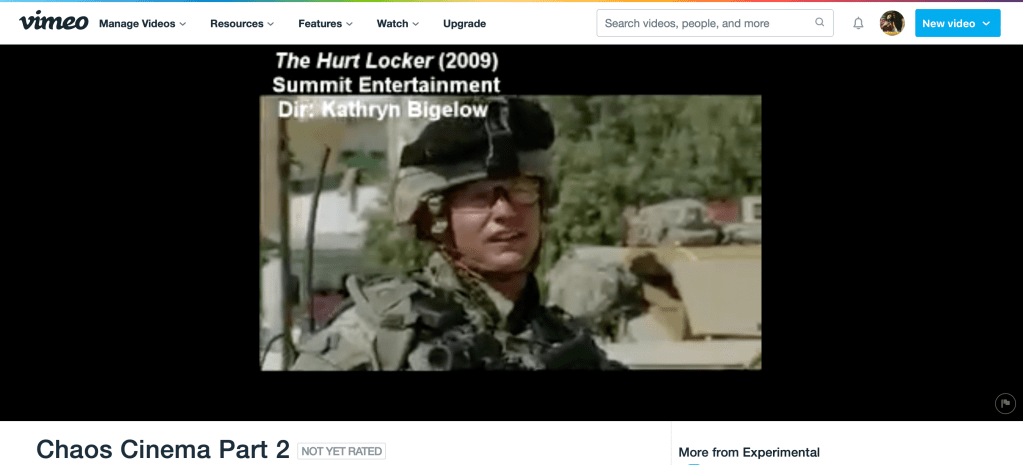
https://vimeo.com/28016704?login=true#
Mad Max Fury Road: Intensified Continuity or Chaos Cinema?
Is Mad Max Fury Road Stork’s worst nightmare come true? A fast-paced film with 2,700 cuts in 120 minutes, or 22.5 cuts per minute, Mad Max Fury Road employs the free-range camera movement abundantly and its staccato editing could easily put the film into the box of Chaos Cinema. Or could it really?
While the techniques may mirror those described in Chaos Cinema, the film uses a variety of different techniques to maintain spatial orientation. Some of these techniques include centered framing, abiding by the 180 degree rule, giving viewers enough spaces or ‘breathing moments’ between action scenes to catch their breath as well as dialogues and eyeline matches that reinforce spatial orientation to make for a film that is frenetic but also spatiotemporally coherent.
In conclusion, there remain a variety of examples that both fit and contradict the theories proposed by Stork and Bordwell. It then becomes a natural imperative to analyze the evolving aesthetic configuration of cinema and to produce literature that maps out this evolution in ways that can lead us to more purposeful yet innovative filmmaking.
References:
Domino (2005) – Final Shootout Scene [HD]. (n.d.). http://Www.youtube.com. Retrieved December 1, 2022, from https://youtu.be/wRsX1vDAOQw
Chaos Cinema Part 2. (n.d.). Vimeo.com. https://vimeo.com/28016704
Mad Max: Fury Road (2015) – The chase begins (1/10) (slightly edited) [4K]. (n.d.). http://Www.youtube.com. Retrieved December 1, 2022, from https://youtu.be/UtjGTrVwRr4
Shaviro, S., & John Hunt Publishing. (2010). Post-cinematic affect. O Books.
Written by Ridhima Chatterjee
 Digital Audiovisual Media Class Blog
Leave a comment