How Euphoria(2019-) breaks away from conventions and stereotypes in casting, production and narrative, and embodies the concept of’ Trans TV’.
According to Michael Goddard and Christopher Hogg (2020,p.256),
- “With the use of word ‘trans’ in ‘Trans TV’ indicating a medium in a process of transformation, and a starting point for reflecting on the emergence of prominent televisual representations of transgender characters, as well as, in some cases, performers, writers and producers.”
The digital streaming platform has brought about a new ‘internet-distributed’ television and a new way of producing and consuming television, giving it more space and opportunities for transformation. Trans TV represents multiple transformations, both in terms of the industrial technology and the viewers’ aesthetic experience. Increasingly, new sexual identities such as homosexuality, non-binary, transgender and other queer figures are being portrayed in television and with different ethnic identities to reflect the diversity of gender and race. Toxic masculinity and heteronormativity are gradually “off the menu”. (Goddard and Hogg, 2018, p.471) These ‘trans’ representations are not only an illustration of inclusivity and progression, but also an impact on the production and viewing experience of television, a transformation in the genre.
The HBO series Euphoria tells the daily lives of a group of high school students, providing a realistic portrayal of their friendships and love life, and focusing on their struggles with sexuality, addiction, abuse, social internet, identities and more. Notably, the trans character Jules in Euphoria is played by real-life trans actress Hunter Schafer, which is certainly a breakthrough in the creation of trans characters from a television production level. This exploration of gender and sexuality not only largely reproduces and respects the real dilemmas faced by transgender people, but also gives the viewer a more authentic viewing experience.
According to Polygon’s interview with Euphoria‘s trans consultant Scott Turner Schofield, “that’s due to showrunner Sam Levinson’s earnest desire to listen to trans individuals and fairly and accurately represent their experiences on screen.” (Haasch,2019)
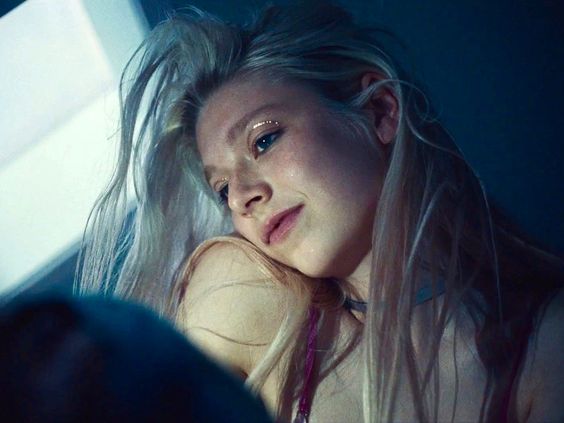
Euphoria‘s exploration of trans roles goes far beyond conventional representation. Its narrative is not limited to just showing the phenomenon of ‘coming out’, but explores other dimensions of her reality. Jules and Rue’s love story shows the audience not only gender diversity, but more generally what it means for teenagers to find themselves and stay true to their hearts. Euphoria doesn’t deliberately emphasize that the confusion and problems Jules faces are all due to her trans identity, in fact it’s only after episode three that Jules claims she is trans. Jules’ story contains both the struggles of trans people and the common problems of teenagers such as dealing with relationships and romance, for example.
In conventional scripts, the only narrative of trans people is about ‘trans sexuality’. But Euphoria‘s presentation of Jules is complex and multidimensional. They do not force trans characters into a narrative of ‘acceptance’. Euphoria doesn’t skimp on creating Jules’ unique charm, and as Rue says “I’ve never met anyone in my entire life like Jules”. According to the article by Jude Dry (2019), Rain Valdez,(a transgender actress, creator of the web series Razor Tongue) states that “Jules is the object of desire for many of the characters in the show, which never happens for trans characters in any show or film.” Trans characters often face rejections, but Jules is undoubtedly a fascinating and attractive figure in Euphoria.
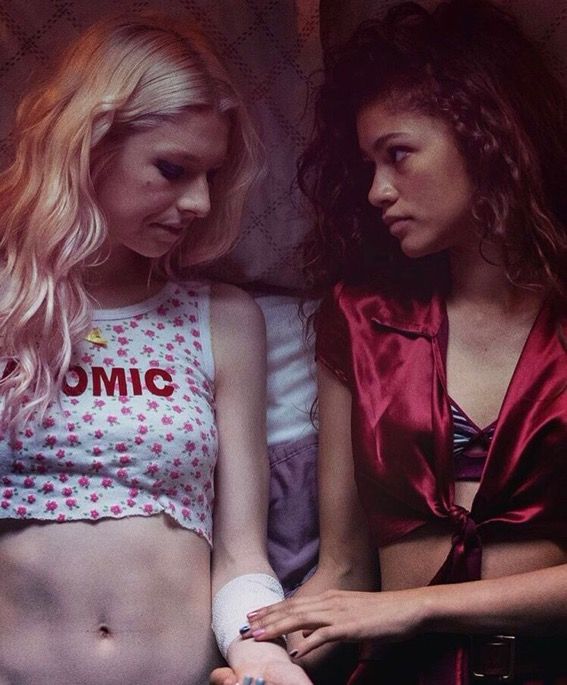
How Euphoria constructs the unique aspects of the trans role is as Hunter said in an interview with COSMOPOLITA, “It’s like, in my life, my transness may affect the way I move throughout the world, but I’m dealing with a whole lot of other shit too.”(Goodman,2019)
References:
- Dry,J. (2019) ‘‘Euphoria’ and the Trans-Amorous Gaze: Why Trans Actresses Love Jules’, IndieWire. Available at: https://www.indiewire.com/2019/08/euphoria-trans-character-actresses-love-jules-hbo-lgbt-1202163347/] (Accessed on: 28 November 2022)
- Goddard, M and Hogg, C. (2018) ‘Introduction: Trans TV as concept and intervention into contemporary television’, Critical studies in television, 13(4), pp. 470–474. Available at: https://journals.sagepub.com/doi/full/10.1177/1749602018798217 (Accessed on: 28 November 2022)
- Goddard, M. and Hogg, C. (2020) ‘Introduction: Trans TV dossier, III: Trans TV re-evaluated, part 2’, Critical studies in television, 15(3), pp. 255–266. Available at: https://journals.sagepub.com/toc/csta/15/3 (Accessed on: 28 November 2022)
- Goodman,J. (2019) ‘Hunter Schafer Swears She’s Not as Cool as Jules on ‘Euphoria’—but We Strongly Disagree’,COSMOPOLITAN. Available at: https://www.cosmopolitan.com/entertainment/tv/a28553983/hunter-schafer-euphoria-interview/ (Accessed on: 28 November 2022)
- Haasch,P. (2019) ‘Euphoria’s trans consultant on why the series tells authentic trans stories’, Polygon. Available at: https://www.polygon.com/interviews/2019/8/10/20792118/euphoria-hbo-trans-actors-jules-scott-turner-schofield-hunter-schafer (Accessed on: 28 November 2022)
By YiXi Zhao (33659283)
First written on 28/11/2022
Re-edited on 30/11/2022
 Digital Audiovisual Media Class Blog
Leave a comment