How ‘Video On Demand’ services can fail to convey a director’s complete intentions.
James Cameron’s ‘Avatar’ premiered in 2009 at IMAX cinemas worldwide. After 10 years in production and a budget of $300m, it became the second highest grossing movie ever. Nine days ago, it re-released on Disney+, a ’video on demand’ subscription streaming service.
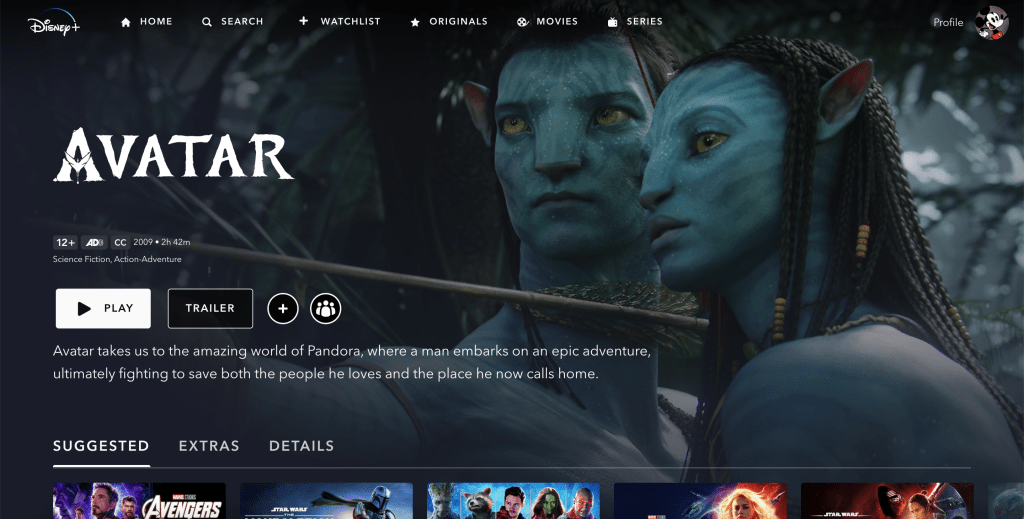
Avatar (2009) now available on the Disney+ menu.
Video on demand (VOD) servers were introduced during the 90’s. They enabled a form of instant video that lets viewers watch a broad range of content wherever and whenever they choose. This phenomenon was called ‘time-shifting’.
VOD evolved into streaming platforms that now dominate the industry, encouraging casual, non-linear viewing practices. Hollywood films can be consumed on a phone whilst commuting, on TV at home, or even on a laptop in lectures instead of taking notes.
Philosopher David Rodowick talks fondly about cinema going in the 70’s, stating “The materiality of the cinematic experience was tangible”. In contrast, his commentary on the digital age is more cynical, saying, “The cultural stature of film has been transformed along with the phenomenology of film viewing” and “The question is not whether cinema will die…rather just how long ago it ceased to be”.
Avatar was intended for cinema viewing. Harnessing dark intimate spaces, surround sound speakers, HD screens and seating arrangements ensures the audience is fully engaged.
In fact, the demand for more screenings of Avatar was recognised through a limited relaunch in theatres earlier this year. Promoting its addition to Disney+ and the much anticipated sequel.
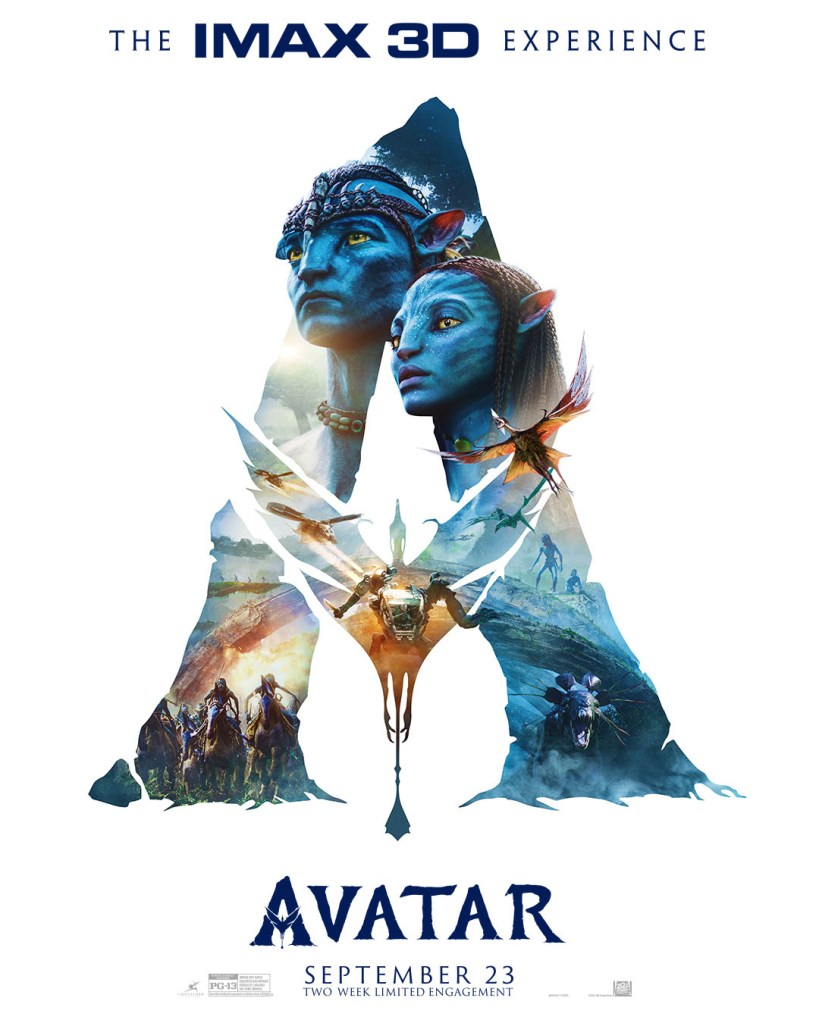
(2022) Poster for Avatar’s limited time re-release into theatres.
Streaming platforms have contributed to eroding the ‘environmental influence’ film makers have on their audience, vastly changing our modes of consumption.
Movies designed for a ‘tangible’ cinema setting are viewed with far less immersion. Any production can be consumed non-linearly and via multiple devices in any setting. Creating a gap between the director’s original intentions and the audience’s experience.
“The conversion or reduction to the digital of almost every iota of human existence would seem to reduce art and entertainment…to the ether.” (Denson & Leyda, 2016)
Drew Cahane – 33607240
References:
- Barnes, J. (2022). “Avatar needs so much IMAX film it’s unusable if it falls on the ground”. The Digital Fix. [online] Available at: https://www.thedigitalfix.com/avatar/imax-film-unusable
- BBC (2018). “Netflix’s history: From DVD rentals to streaming success”. BBC News. [online] Available at: https://www.bbc.co.uk/news/newsbeat-42787047.
- Denson, S. and Leyda, J. (2016). “Perspectives on Post-Cinema: An introduction”, in Post-cinema: Theorizing 21st-century Film. REFRAME Books, 2016, pp. 1–19. Available at: https://reframe.sussex.ac.uk/wp-content/uploads/2019/05/POST-CINEMA_LO_RES.pdf.
- The Guardian (2009). “Avatar: James Cameron’s 3D picture has its world premiere”. The Guardian. [online] Available at: https://www.theguardian.com/film/gallery/2009/dec/11/avatar-premiere
- Rodowick, D.N. (2007) “What was cinema”, in The virtual life of film. Cambridge, Mass: Harvard University Press, pp. 25–88. Available at: https://gold.idm.oclc.org/login?url=http://hdl.handle.net/2027/heb.08243.
- Salazar, S. (2022). “Don’t Stay Blue, Avatar Is Back on the Streaming Queue”. Vulture. [online] Available at: https://www.vulture.com/article/avatar-disney-plus-after-theatrical-re-release.html#:~:text=Update%2C%20November%2021%3A%20After%20a
 Digital Audiovisual Media Class Blog
Leave a comment