Daniela M. Schültz argues that the appropriation of literature fiction plays an essential role in Quality TV. (Schlütz, 2016, p. 101) For TV, the literary adaptation and auteur’s art cinema both carry an association of quality. There is no doubt that television Hannibal (since 2013) is a successful case adapted from one of the well-known horrible fiction– Thomas Harris’ Red Dragon in 1981. This blog tends to discuss the identity of the TV auteur or a fannibal, then the adaption strategies that affect fans’ aesthetics. Later defined this category of televisions as “televisual palimpsest” that make changes to fit contemporary media phenomena. When it comes to adapted televisions, one of the integral groups of the audience we would discuss is the fan of fiction, especially during the tendency to attach importance to the niche market. Their preference plays a key role in the word of mouth of television. Generally, those works showing respect and fitting the original text are likely to win fans’ love, while the spread of quality fan works could also be a significant channel for promotion.
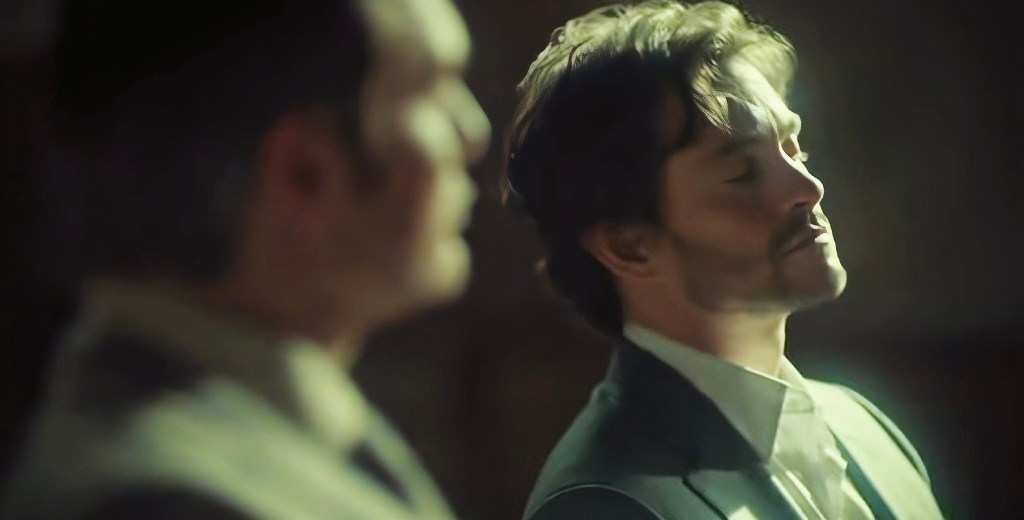
Fuller announced his fannibal (a fandom portmanteau for “fan of Hannibal”) identity self-reflectivity, and he is hired to create adaptions of the text that he himself has fannish adoration. Furthermore, Fuller claimed that there exist some parallels between Hannibal and other fanfictions. However, later argued that considering the features of fanfiction which is “amateur, noncommercial works, Hannibal is more an adaption television which applied the strategy of fans’ aesthetic perspective than equal to a “fan work”.(Later, 2018)
Hannibal’s elaborate editing style shows similarity to the fanvid’s preferred style which is nonlinear and of musicality. There’s a common example is Love Crime as the final ending song (season 3), the images are in accordance with the lyrics and melody, simultaneously applying a mass of slow motions scenes, the character’s gaze and the lyrics implicating homoerotic, which is distinct fans-aesthetic. What’s more, in fanfictions, it’s not something new that fans tend to repurpose and arrange the source texts to create new scenes. Inspired by that, Fuller sets new contexts for lines taken from the earlier published Hannibal and assigns those to different characters.
Above all, the adaption of television Hannibal through blurring the boundaries between TV auteur and fans, fanfiction and official works, the range of that would be defined by contemporary quality television. (Later, 2018)Thus, Fullers’ evolutionary adaption from the perspective of fans is a new aesthetic practice with the purpose of fitting the transformation of post-cinematic.
Reference
Later, N. (2018) ‘Quality Television (TV) Eats Itself: The TV-Auteur and the Promoted Fanboy’, Quarterly Review of Film and Video, 35(6), pp. 531–551. Available at: https://doi.org/10.1080/10509208.2018.1499349.
Schlütz, D.M. (2016) ‘Contemporary Quality TV: The Entertainment Experience of Complex Serial Narratives’, Annals of the International Communication Association, 40(1), pp. 95–124. Available at: https://doi.org/10.1080/23808985.2015.11735257.
Balanzategui, J. (2018) ‘The New Quality Crime Drama in the TVIV Era: Hannibal, True Detective, and Surrealism’, Quarterly review of film and video, 35(6), p. 657. doi:10.1080/10509208.2018.1499341.
Lu Chang 33743573
 Digital Audiovisual Media Class Blog
Leave a comment