The cinematic scene has shifted within its technology from analogue to digital, changing the structure of film and television. This transformation is characterized by important discussions, technical advances, and changing perspectives.
Critics universally agree that the introduction of digital technologies has significantly changed both film and television, affecting audience consumption habits and the processes involved in production and exhibition (Manovich, 2001).
Lev Manovich’s viewpoint introduces the concept of a shift from narrative logic to a “database” logic in audio-visual media (Manovich, 2001). This supports that there has been a separation from the linear narrative to a more data-based framework. To illustrate, “The Matrix” (1999) is a clear example of this. The film’s narrative structure, which is renowned for its non-linear storylines, shows the spirit of the data-based framework, offering visual proof of the evolution of cinema.
Sean Cubitt’s idea of “post-cinema” challenges traditional narratives (Cubitt, 2005).This concept urges us to consider how cultural forms are being restructured by looking at media in the framework of cultural forms. In “The Matrix,” this challenge materializes in a cinematic landscape where spatialization takes precedence, giving rise to visually beautiful and spatially dynamic scenes that redefine traditional norms.
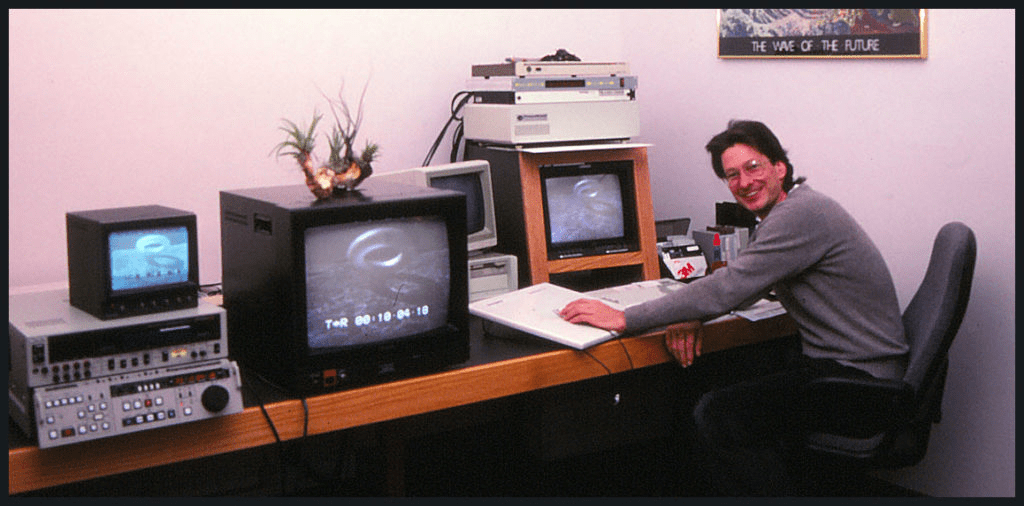
Computer animation in the 1980’s.
David Rodowick’s chronological exploration identifies pivotal milestones in the digital cinematic journey (Rodowick, 2007). These range from the establishment of a computer animation research division by Lucasfilm Ltd. in 1979 to the successful utilization of high-resolution digital cameras in the late 1980s. “The Matrix” seamlessly aligns with these milestones, embodying the consistent use of Digital Image Processing and Synthesis during the transformative 1980s.
In conclusion, the cinematic journey from analog to digital unfolds as a riveting exploration, seamlessly fusing nostalgia with innovation. As cinema continues to reinvent itself in the digital era through the interplay between the old and the new, understanding this dynamic and ever-evolving art form remains crucial (Manovich, 2001; Cubitt, 2005; Rodowick, 2007).
By Olivia Camille Lynn
References
Manovich, L (2001), The Language of New Media, MIT Press, Cambridge. Available from: ProQuest Ebook Central. (13 October 2023).
Cubitt, S. (2005) in The cinema effect. Cambridge, MA: MIT Press, pp. 217–244.
Rodowick, D.N. (2007) ‘The virtual life of film’, in The Virtual Life of Film. Harvard University Press, pp. 25–88.
 Digital Audiovisual Media Class Blog
Leave a comment