If we look into the transformations that have been made throughout the media industry, we can see that the most notable one is Netflix, by how it allows us to interact with content. According to Mareike Jenner (2018), we have again entered a phase of television, referred to as “TVIV” or the fourth stage of television. In this stage, relatively new content distributors like Netflix or Amazon have become even newer producers.
Amanda Lotz (2017), on the other hand, sees this as a new ‘post-network’ era, revolutionizing television. Here, television has managed to surpass the once-traditional structure, opening the doors for content distributors to become producers.

Boundaries are not merging by accident; rather, it is a response to a generation actively seeking information that suits their tastes. Leading to a representation of how individual identities and the need for enjoyment have become one. To add on, the development of digital technology has increased the viewer’s power to ignore network scheduling and allowed new avenues for non-network production (Lotz, 2017). Jenner, in contrast, underscores the technological convenience provided by digital development, expanding the convenient use of television.
Lotz mulls over the efficiency of digital transmission, which expanded choice for viewers, while Jenner highlights the introduction of paid-for video on demand (VOD) on the part of cable providers, pointing to a future where viewers select desired content from a menu, rather than follow any linear programming.
In short, Netflix creating a new space within television, due to the change from what we know as television, and not just a component of the television networks. Both Jenner and Lotz agree on the change, however, Jenner focuses on the new content distributors becoming producers, while Lotz emphasizes on the implications that come with a post-network era.
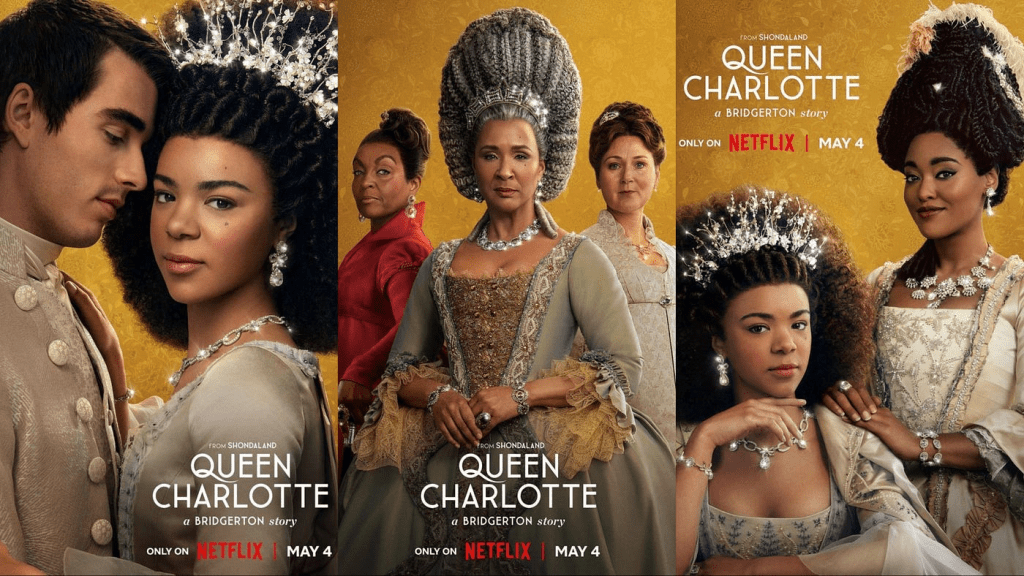
As a result, Netflix has led to a massive change in how we watch television. As we can see with new shows like Queen Charlotte in the world “Bridgerton”, we as viewers can decide when we want to immerse ourselves in this historical world. Moreover, Queen Charlotte is a clear example of Netflix’s transformation to cater to individual tastes by creating more diverse content.
By Olivia Camille Lynn
References
Amanda Lotz (2017), ‘Theorizing the Nonlinear Distinction of Internet-Distributed Television’, Portals: A Treatise on Internet Distributed Television
Mareike Jenner (2018), ‘Introduction: Netflix and the Renvention of Television’, ‘Introduction: Binge Watching Netflix’, Netflix and the Reinvention of Television, pp. 1-31, 109-118.
 Digital Audiovisual Media Class Blog
Leave a comment