” That is what you think interactive videos are going to be like, somebody going, “Is it going to be this door, or this door? Which one is it going to be?” We were keen so that it carries on beyond that point, that people carry on talking, the edit carries on going, it keeps cutting from camera to camera when you are making a choice, so it doesn’t feel like everything stops and it is waiting around for you.”-Colin Ritman

Fionn Whitehead in Black Mirror: Bandersnatch. | Netflix
With the continuous evolution of technology, the nature of movies is also undergoing revolutionary changes, building a new cultural and technological system. In this system, technical form and sensory structure became more closely linked, bringing about a cinematic revolution that transcended traditional notions of continuity and representation.
On Netflix, the show has no progress bar and consists of countless episodes. Every time the viewer makes a choice, options will appear below the video, and the next story will be promoted based on the choice, just like playing a famous Japanese game. Each different choice triggers a different plot direction.
“Black Mirror” is a film revolution, leading us into a post-film era that is both highly critical and creative. This interactive film is not only a visual and emotional journey, but also a subversion of traditional film forms. Interactivity is at its core, a dialogue between the audience and the film, where the audience becomes a co-creator of the story. This is not only a breakthrough in the form of post-film technical expression, but also an era in which technology and audience interaction change the way film is made, and traditional linear narratives become a thing of the past.
It creates a range of non-representational image types that transport the viewer into a world of possibilities. From virtual reality to time and space dislocation, the sense of transcendence experienced by the audience is no longer the picture of a traditional movie, but an exploration of a multi-dimensional, non-linear visual world. Audiences experience anxiety, the importance of choice, and the challenge of moral decision-making in the film. This sensory experience is not only created by the movie, but also reflects the complexity of ethics and technology in the real world, allowing the audience to think about the ethical issues of today’s society in the virtual experience.
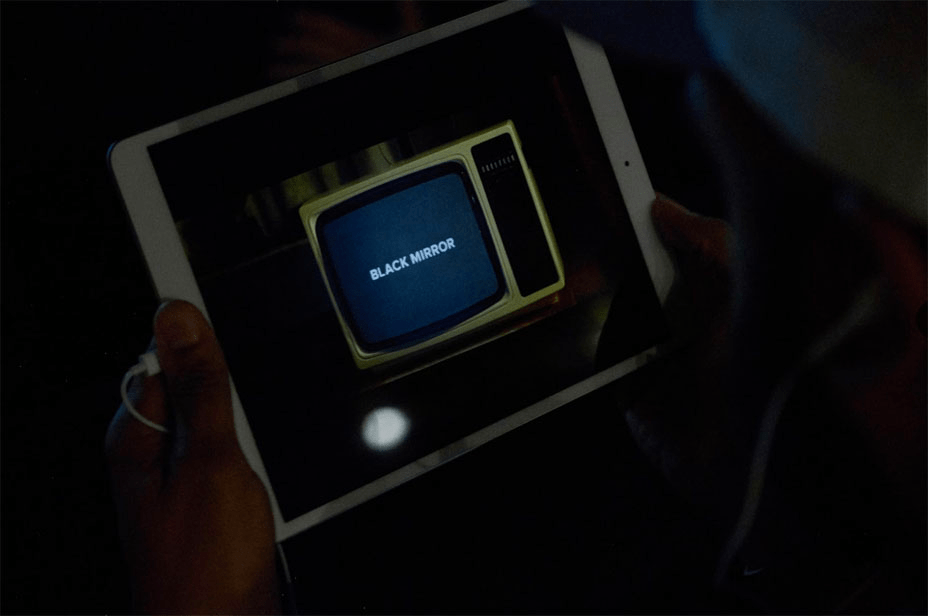
The film critically reflects on the cultural model of the post-film era. Audience choices reveal the realities of separatism, as well as the significant ethical and technological challenges facing society. The film is also an expression of digital realism, integrating virtuality and reality, presenting artificial intelligence and technology to explore human perception, and questioning the boundaries between reality and virtuality
By Qing Sun, BA Media and Communication
Reference list
- Wilkinson, A. (2018) 3 non-spoilery things to know before you watch black mirror: Bandersnatch, Vox. Available at: https://www.vox.com/culture/2018/12/28/18158908/black-mirror-bandersnatch-1984-no-spoilers-netflix-data (Accessed: 25 October 2023).
- Strause, J. (2023) ‘Black Mirror’ interactive film: Inside the 2-year journey of ‘Bandersnatch’, The Hollywood Reporter. Available at: https://www.hollywoodreporter.com/tv/tv-news/black-mirror-bandersnatch-netflixs-interactive-film-explained-1171486/ (Accessed: 25 October 2023).
- Bryan, S. (2019) Here is everything you need to know about ‘Bandersnatch,’ by the creators themselves, BuzzFeed. Available at: https://www.buzzfeed.com/scottybryan/oral-history-bandersnatch-black-mirror (Accessed: 25 October 2023).
- K, M. (2018) Why Black Mirror’s ‘Bandersnatch’ really is the ‘grimmest’ episode yet, Medium. Available at: https://kirkwoodmegan1.medium.com/why-black-mirrors-bandersnatch-really-is-the-grimmest-episode-yet-2f53da81f8fa (Accessed: 25 October 2023).
 Digital Audiovisual Media Class Blog
Leave a comment