In the 21st century, ‘on demand’ viewing has become one of the most popular practices in terms of television viewing patterns we see today. By ‘on demand’, I’m mainly referring to internet-distributed television such as Netflix, Amazon Prime, etc. which has been made popular through the elimination of “time specific viewing” and a “linear schedule”, signalling a shift away from what we know as traditional television patterns. (Lotz, 2017). ‘On demand’ tv can be considered to be a type of viewing practice inspired by early DVD box sets, which was largely associated with the elimination of time specific content (only available at set times during the week), and a freedom of choice in content (allowing viewers to pick and choose that they wanted to watch, rather than being bound by the constraints of linear tv).
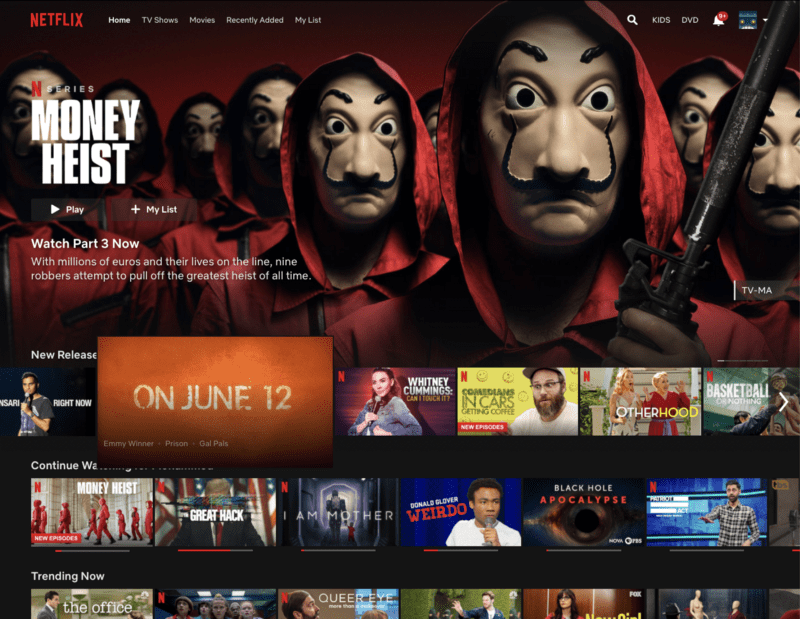
For example, the above image shows Netflix’s home interface, which not only categorises shows and movies based on their genre, but also by what’s trending or what you’re currently watching. Netflix is a prime example of ‘on-demand’ viewing as it contains a plethora of content which is easily categorised, contains no ads, and allows for a non-linear viewing experience, so audiences can have all the content they desire, without the hassle that traditional tv brings.
However, ‘on-demand’ viewing is also often associated with binge-watching (a process commonly linked to internet-distributed television like Netflix). Netflix’s algorithm consists of an “entrance flow” typically consisting of recommendations that Netflix provides (allowing you to “enter” the flow), and an “insulated flow”, which can be promoted by things like episodes playing automatically after one another (essentially keeping you trapped in the flow) (Mareike, 2018: 23). Although viewers have the chance to click off the show to avoid playing another episode, as well as choose things out of the “recommended” category, they are ultimately sucked into this “binge culture” that on-demand viewing promotes.
By Emilia Woznicka,
Media Communications and Cultural Studies
Bibliography:
Jenner, M. (2018) Netflix and the Re-Invention of Television, Springer International Publishing AG, Cham. Available from: ProQuest Ebook Central. [30 October 2023].
Lotz, A.D. (2017) Portals: A Treatise on Internet-Distributed Television. Available at: https://quod.lib.umich.edu/m/maize/mpub9699689/ [30 October 2023].
 Digital Audiovisual Media Class Blog
Leave a comment