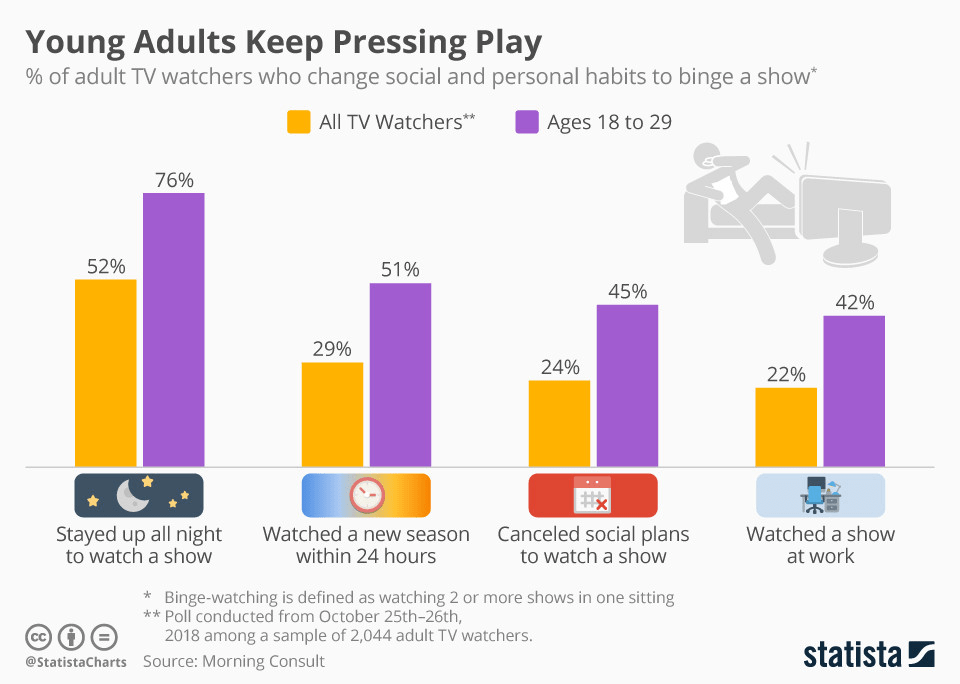
Netflix and binge-viewing have become synonymous as the platform gave a way to access seasons of TV shows at once, creating binge-watching into a ‘mainstream’ practice for media enthusiasts (Jenner 2017). It became a common phrase within US media outlets in 2013 – with headlines in Forbes, Wired and The Atlantic.
This rise in non-scheduled television could be seen as liberating for audiences as Netflix makes episodes easier to catch and interrupts the conventional ways of watching television, allowing audiences to stick with the flow of a season of episodes instead of an individual viewing.
This can be seen in the release of ‘Squid Game’ in 2021, which according to Netflix estimates that 66% of viewers, equivalent to 87 million people, finished the series in the first 23 days. The Korean drama was the top most-tweeted about television show of the year, according to Variety, creating an exciting event that everyone wanted to be a part of.
However, the amount of choice in on-demand TV shows today can be seen to create even more competition for creators, with Netflix beginning to release seasons in parts instead of at once, as seen in the release of season 4 of Stranger Things in 2022. This could suggest that Netflix is feeling the loss of excitement for new episodes, which could be a result of the removal of anticipation and the togetherness created when viewers all watch the episode at the same time. The ‘isolated’ viewer experience along with binge-watching can create a feeling of escapism which lasts hours at a time, leaving an overall feeling of fatigue for the viewer.
Post by: Lilly Khaokham
Jenner, Mareike. Netflix and the Re-Invention of Television, Springer International Publishing AG, 2018. ProQuest Ebook Central,
Shaw, Lucas. Netflix values its megahit show Squid Game at $900m, 2021.
 Digital Audiovisual Media Class Blog
Leave a comment