The paradigm shift from traditional television to OTT entertainment has transformed our consumption habits. It has even introduced new terms like “binge-watch”, which was the Collin’s English Dictionary’s word of the year in 2015, into our daily vocabulary.1 Netflix, a pioneer in internet subscription services for television content, engineered the ‘season dump’ model, where instead of waiting weekly for a new episode, an entire season would be available in one go. A recent and popular example of this model is the live-action version of One Piece, the top-1 selling manga worldwide,2 which became the most-watched Netflix series in 84 countries when released, dethroning Stranger Things season four.3 The season-dump model, alongside Netflix’s ‘queue’ and ‘auto-play’ features, encouraged binge-watching habits, “It constructed a sophisticated algorithm to nudge viewers towards specific choices; and it published content online on the same date in all countries where it is available”.4
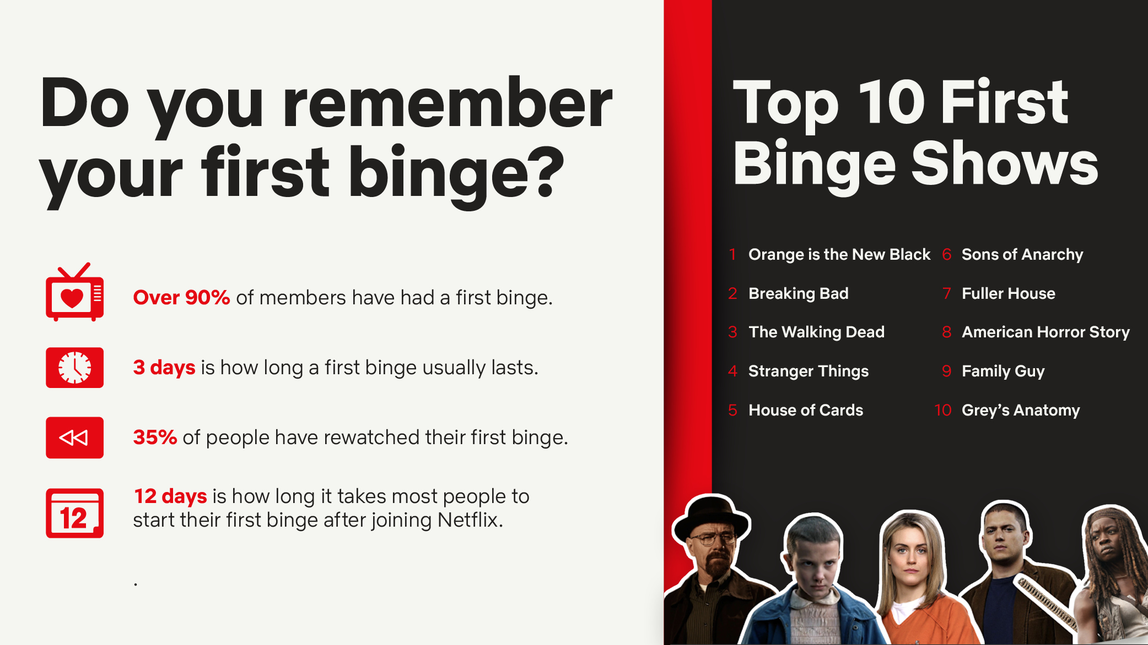
Binge-watching has slowly become the norm for consuming content; 73% of US viewers say they binge-watch digital video content. Of this, 90% are millennials and 87% are Gen-Z.5 Our binge-watching pseudo-addiction can be attributed to our brain’s response to excessive media consumption. Neuronal pathways release dopamine, the pleasure chemical, which reinforces continued engagement in binge-watching content or – in other words – it feels good so we keep doing it. Moreover, spending hours of our lives immersed in TV show characters and plots line fuels this behaviour; “Our brains code all experiences, be it watched on TV, experienced live, read in a book or imagined, as ‘real’ memories… We get drawn into story lines, become attached to characters and truly care about outcomes of conflicts.”6
Unfortunately, binge-watching does have unhealthy effects; binge-watchers report higher levels of stress, anxiety, and depression.8 This behaviour could also lead to sleep deprivation.9 In many ways, binge-watching is similar to ‘revenge bedtime procrastination’;10 which refers to the behaviour of overworked individuals sacrificing sleep in order to have some element of personal time and enjoyment, despite knowing the repercussions of doing so. Binge-watching provides us with a mind-numbing window to escape from the day’s qualms and societal pressures, by tapping into another realm for hours. Cultural anthropologist Grant McCracken finds a correlation between the rise of binge-viewing and our desire to escape 7-second-long social media posts as well, stating, “TV viewers are no longer zoning out as a way to forget about their day, they are tuning in, on their own schedule, to a different world.”11
By Nikita Cecil [33656165]
- News, B. (2015) Binge-Watch is Collins’ dictionary’s word of the year, BBC News. Available at: https://www.bbc.co.uk/news/entertainment-arts-34723515 (Accessed: 01 November 2023). ↩︎
- Hale, A. (2023) 20 best-selling manga of All time (& how many copies were sold), CBR. Available at: https://www.cbr.com/best-selling-manga-how-many-copies/#one-piece-eiichiro-oda (Accessed: 01 November 2023). ↩︎
- Stolworthy, J. (2023) Netflix shares why One piece success is particularly ‘amazing’, The Independent. Available at: https://www.independent.co.uk/arts-entertainment/tv/news/netflix-one-piece-live-action-series-b2407756.html (Accessed: 01 November 2023). ↩︎
- Jenner, Mareike. Netflix and the Re-Invention of Television, Springer International Publishing AG, 2018. ProQuest Ebook Central, https://ebookcentral.proquest.com/lib/goldsmiths/detail.action?docID=5475331. ↩︎
- Spangler, T. (2017) Binge boom: Young U.S. viewers gulp down average of six TV episodes per sitting, Variety. Available at: https://variety.com/2017/digital/news/binge-viewing-tv-survey-millennials-1202013560/ (Accessed: 01 November 2023). ↩︎
- Page, D. (2017) What happens in Your brain when you binge-watch a TV show, NBCNews.com. Available at: https://www.nbcnews.com/better/health/what-happens-your-brain-when-you-binge-watch-tv-series-ncna816991 (Accessed: 01 November 2023). ↩︎
- Time (2018) How to look back on your netflix binge-watching history, Time. Available at: https://time.com/5135380/netflix-binge-watch-history/ (Accessed: 01 November 2023). ↩︎
- Karmakar, M. (2015) Viewing patterns and addiction to television among adults who self-identify as binge-watchers, 2015 APHA Annual Meeting & Expo (Oct. 31 – Nov. 4, 2015): Viewing Patterns and Addiction to Television among Adults Who Self-Identify as Binge-Watchers. Available at: https://apha.confex.com/apha/143am/webprogram/Paper335049.html (Accessed: 01 November 2023). ↩︎
- Exelmans, L. and Van den Bulck, J. (2017) ‘Binge viewing, sleep, and the role of pre-sleep arousal’, Journal of Clinical Sleep Medicine, 13(08), pp. 1001–1008. doi:10.5664/jcsm.6704. ↩︎
- Liang, L.-H. (2022) The psychology behind ‘revenge bedtime procrastination’, BBC Worklife. Available at: https://www.bbc.com/worklife/article/20201123-the-psychology-behind-revenge-bedtime-procrastination (Accessed: 01 November 2023). ↩︎
- Coppola, J. (2020) The science behind why we binge-watch, Wistia. Available at: https://wistia.com/learn/marketing/science-behind-why-we-binge-watch (Accessed: 01 November 2023).
↩︎
 Digital Audiovisual Media Class Blog
Leave a comment