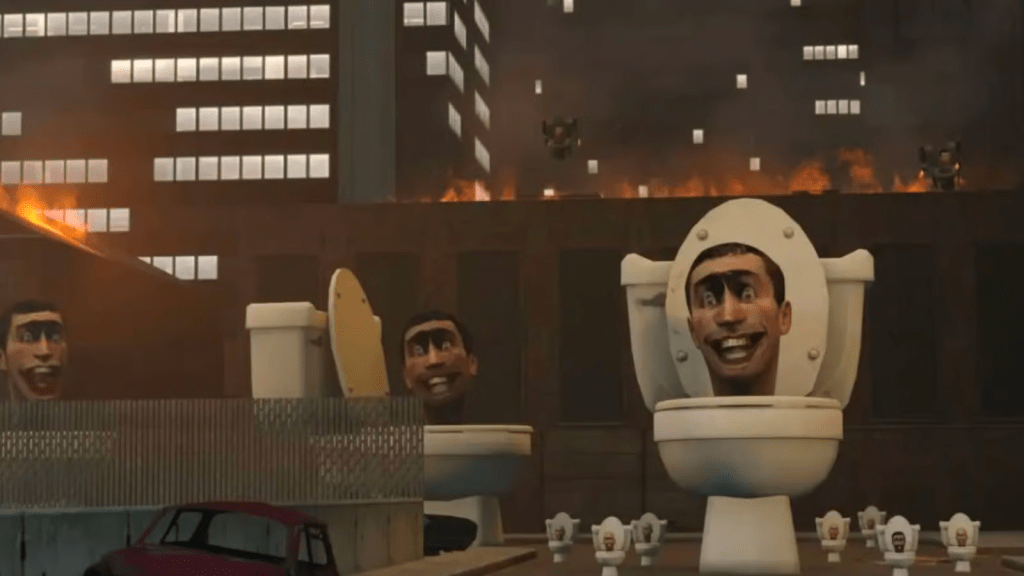
Skibidi Toilet is a massively popular web-series of Youtube 3D animated videos created by self-taught animator Alexey Gerasimov. Contrary to its innocuous, silly-sounding name, the series is chock full of nightmarish, grotesque visuals: contorted humanoid faces abruptly leap out at the camera (these are the titular main characters of the series), waging a war against massive robots that resemble Michael Bay’s Transformers – except with devices like speakers and monitors for heads. It has seen unprecedented growth on YouTube: the channel has 33.9 million subscribers and more than a billion views.
The series is a perfect example of Stork’s conception of chaos cinema – in fact, it is chaos cinema in its purest, most extreme form. Stork defines chaos cinema as an extension of Bordwell’s notion of intensified continuity, asserting that while mainstream film technique used to pride itself on clear narrative continuity, developments in the film industry throughout the 21st century have reflected a trend towards filmmaking that is increasingly fractured and fragmented. Technique-wise, this comprises the use of rapid editing, bipolar extremes of lens lengths, and a free-ranging camera – all of which prevent the audience from accurately positioning themselves in time and space, while simultaneously evoking a primal fear in the viewer. (Stork, 2011; Shaviro, 2016)
Skibidi Toilet makes use of all of these highly jarring, disconcerting techniques – and while mainstream cinema might have used these chaos cinema techniques exclusively in climactic fight scenes or explosion scenes to temporarily disorient the viewer, Skibidi Toilet is wholly and utterly chaotic in its very existence – here, filmic chaos does not serve a narrative purpose, in fact Skibidi Toilet has no clear narrative running through the hundreds of videos in the series: the only constants in the world of Skibidi Toilet are haunting, grotesque faces, inexplicable violence, an overwhelming sense of terror.
CW: Gruesome imagery, violent and shocking content
These videos and their massive popularity feed into a culture of complete ‘illiteracy’ as Stork (2011) says – we see this coming to fruition in the onslaught of completely meaningless slang that exists in an endless cycle of self-referentialism. The very word ‘skibidi’ has taken on a meaning (or lack thereof) of its own, and exists alongside other essentially meaningless phrases like ‘fanum tax’ and ‘grimace shake’: see this Tiktok of a man stringing slang phrases together to form a completely unintelligible sentence.
Many of us were hesitant to accept Stork’s pessimistic view of chaos cinema, arguing that his apparent loyalty to the conventions of cinematic/narrative rules was dogmatic. But if Skibidi Toilet is the path that we’re going down, perhaps he was right. The popularisation of an utterly debased series like Skibidi toilet paints a picture of a possible future where attention spans are so short that conventional narrative structures lose all of their impact and relevance to our society.
Instead, we devolve into a society that thrives off purely visceral entertainment; cinema no longer exists as a means of storytelling but a mere tool to shock our dopamine-addicted minds into feeling something, anything. The very same cinematic techniques and effects like montage, camerawork and the CGI/tools that film critics once defended (claiming that they would open up a world of immersive storytelling) will perhaps eventually become coopted by a culture of degeneracy and profligacy.
By Yanning Tan, BA Media and Communications
References:
- Denson, S., Leyda, J. and Shaviro, S. (2016) ‘Post-Continuity: An Introduction’, in Post-cinema: Theorizing 21st-Century film. Falmer: REFRAME Books.
- Greig, J. (2023) Skibidi toilet: The terrifying new creatures haunting the internet, Dazed. Available at: https://www.dazeddigital.com/life-culture/article/60336/1/skibidi-toilet-slenderman-youtube-tiktok-demon-internet-evil (Accessed: 02 November 2023).
- Stork, M. (2011) Chaos cinema part 1, Vimeo. Available at: https://vimeo.com/28016047 (Accessed: 02 November 2023).
 Digital Audiovisual Media Class Blog
Leave a comment