In 1985, Auguste and Louis Lumiere held what is recognized as the first commercial film exhibition, which marked the first time that film entered the public eye. The appearance of the film establishes the connection between the self and the virtual world and understands the past or future world through another dimension. Has the emergence of new media re-established this connection? Or does it deepen the bond?
To know this problem, we first need to understand the difference between new media and conventional media and the relationship between post-cinema and analog film. The essential difference between new media and conventional media is that new media is the translation of all existing media into numerical data accessible for computers. “The result is new media: graphics, moving images, sounds, shapes, spaces and text which become computable, i.e. simply another set of computer data.” (Manovich, 2002). Based on the developments of digital media technology, post-cinema is a new production mode that is different from traditional film production in terms of shooting, production, distribution form, viewing pattern, and narration.
Today, I would like to discuss the reasons for the formation of non-linear narrative structure in post-film, its influence on post-cinema, and the reconstruction of human ideology. With the advancement of digital technology, the process of film editing can become more efficient and flexible. Different from the traditional physical film processing, the new editing method can completely rely on the operation of the computer, and the editor can immediately access all the editing materials, and make modifications. This flexibility greatly broadens the malleability of film creation, and the creation of the plot can completely break away from the continuous narrative framework. The first film to feature a non-linear narrative structure that predates digital media technology, Citizen Kane explores the life of Charles Foster Kane through a series of flashbacks and the perspectives of different characters, a structure that was considered revolutionary at the time. The film begins with Kane’s death and then reveals his complicated character and experiences through different periods in his life. The film Citizen Kane featured many creative innovations, such as deep-focus photography, special effects with miniature models, and non-linear narrative structures. These technologies were later further developed in the era of digital media, where digital media technologies such as computer-generated imagery (CGI) and digital post-production borrowed and developed the technical concepts of traditional films.
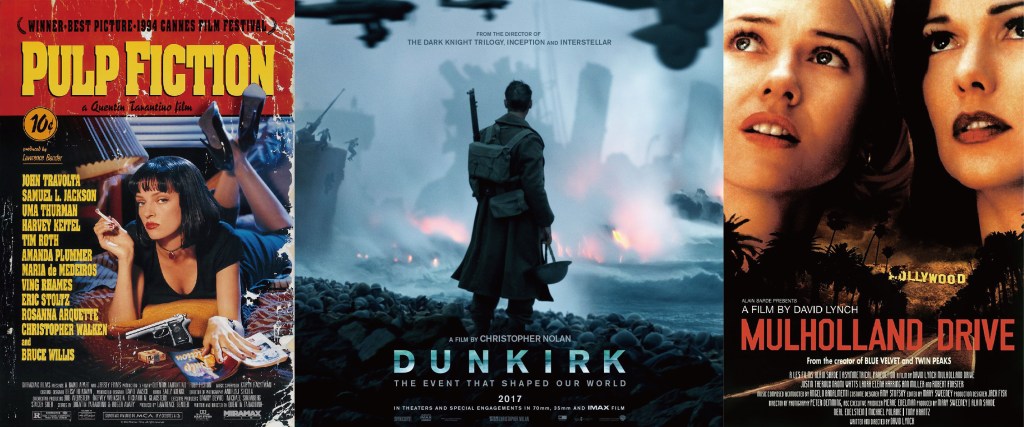
Different from the past, filmmakers in the age of digital media have created a large number of films with more complex and brilliant non-linear narrative structures, such as Quentin Tarantino’s Pulp Fiction, Christopher Nolan’s Dunkirk, and David Lynch’s Mulholland Drive. The new path of film narrative has influenced human ideology in many ways. First, it breaks the time order and causality of the development of things and it deconstructs the continuous narrative, it makes the audience aware of the various possibilities of reality. Then non-linear narrative emphasizes the subjective perspectives of different characters, highlighting the individual’s memory of events and understanding of the story, and even reviewing the story from a marginal perspective, to question and evaluate the mainstream ideology. Finally, the non-linear narrative structure promotes the interaction and participation of the audience. The audience is no longer a passive recipient of information, but an active participant in the construction of meaning. The non-linear narrative structure creates opportunities for creators to reflect and explore social reality for the audience at the same time.
Reference:
Manovich, L. (2002) The language of new media. Cambridge, USA: The MIT Press.
Rodowick, D.N.(2007) The virtual life of film. London, England: Harvard University Press
Denson, S. and Leyda, J.(2016) Post-Cinema: theorizing 21st-century film [ebook]. Falmer: REFRAME Books
Welles, O.(dir.) (1941) Citizen Kane [film]. RKO Radio Pictures
Tarantino, Q.(dir.) (1994) Pulp Fiction [film]. Miramax Films
Nolan, C.(dir.) (2017) Dunkirk [film]. Warner Bros. Pictures
Lynch, D.(dir.) (2001) Mulholland Drive [film]. Universal Focus
By Shuangshuang Ma 33748491
 Digital Audiovisual Media Class Blog
Leave a comment