
artsofthought.com (2018)
“Chained to the wall of a cave all their lives, facing a blank wall, [those who live in the cave] watch shadows projected on the wall from objects passing in front of a fire behind them […] The shadows are the prisoners’ reality, but are not accurate representations of the real world. The shadows represent the fragment of reality that we can normally perceive through our senses, while the objects under the sun represent the true forms of objects that we can only perceive through reason.”
Ferguson 1922, Plato’s Simile of Light
Plato’s socratic dialogue Republic (514a–520a, Book VII) first discussed the ‘Allegory of the Cave’, succinctly described by Ferguson (1922) in his literary analysis Plato’s Simile of Light (continued). Part II. The Allegory of the Cave. While Socrates dictates that philosophers are those who desire to leave the cave in coming to understand the shadows as the indirect image of reality -while the rest of the cave’s inhabitants face no such desire – a post-modern reading of Plato’s allegory might see today’s proverbial “projected shadows” as representing the cultural shift toward artificial aesthetics.
According to David Rodowick, these aforementioned artificial aesthetics present in digital images are no longer anchored in the indexical realism that grounded the ontology of analogue photography, and therefore lose their powers to represent both reality and duration convincingly (Rodowick 2007:13).
This theory of indexicality claims that digital processes are merely a mimicry of filmic, analogue ones, that now “deeply recalcitrant cultural norma of depiction” despite a lack of necessity (Rodowick 2007). Practical effects previously used in creative processes have been largely sidelined in favour of intangible, artificial aesthetics, most obvious in the example of CGI (Denson & Leyda 2016). As such, Rodowick argues that this shift from analogue to digital has caused a loss of ‘analogy and indexicality’, providing viewers and users with a decisively obscured post-modern ontology of images.

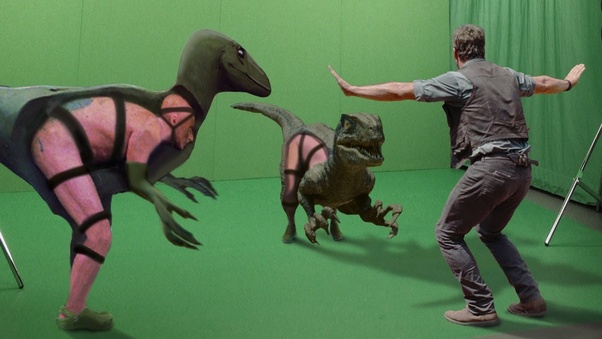
(left) Sir Ian McKellen in The Hobbit: An Unexpected Journey (2012), (right) Chris Pratt in Jurassic World (2015)
Focal depth, framing, and editing are technical imperatives within film’s material form, but are now only used in digital post-cinema out of habit. In placing these digitised methods of artistic production at the precipice of the creative hierarchy, all other methods of practice become undermined. This results in cultural artefacts ignoring and lacking the ‘qualia’ described by Manovich (2002).
These aspects have led a large portion of post-modern film in the direction of purposelessness. As digital technologies now afford creators the freedoms to create virtually anything that can be imagined – to an arguably high degree of uncanny realism – much of the purpose of filmic story telling through the visual arts has become lost in the pursuit of visual spectacle.
Arguably CGI remediates photographic and cinematic media, yet does still challenge the rule-bound ,conventional expectation of metaphysical consistency. Objects and forms become subject to mutation, as they are able to stretch, dissolve, and morph into other forms (Denson & Leyda 2016).
This shift from practically capturing indexical reality through shooting and recording staged events as they occur in the material world, to digitally generating scenes designed to mimic physical reality, has marked a distinct shift in wider culture towards replacing photographic, analogue techniques with digital, non-indexical methods; Directly undermines the importance both provide to one another.
Movies such as ‘Interstellar” (2014) and ‘Gravity’ (2013) are emphatic and are regarded by some as hyper-architectural constructions of reality.
Despite Rodowick’s position remaining that these forms of representing types of reality create ontological complexity as we struggle to define what is even real, the humanity age question of whether one can ever truly trust what they define as reality persists.
Blending and intertwining forms of creation without placing them in an unnecessary hierarchy, something that both Rodowick and his critics fail to do, allows for a wider understanding and consideration for individuals’ own constructions and engagements of ‘realism’.
– Red Burgess –
References
S. Ferguson (1922) Plato’s Simile of Light (continued). Part II. The Allegory of the Cave. The Classical Quarterly, 16: 15-28.
D. N. Rodowick (2007) The Virtual Life of Film. Harvard University Press.
Plato (520) Republic. Book VII.
S. Denson, & J. Leyda (2016) Crazy Cameras, Discorrelated Images, and the PostPerceptual Mediation of Post-Cinematic Affect. Post-Cinema: Theorising 21st Century Film.
L. Manovich (2002) What is New Media?. The Language of New Media, 18-61.
 Digital Audiovisual Media Class Blog
Leave a comment