In the year 2000, Robert Stam established a dedicated section within the book titled “Film Theory: An Introduction” to encapsulate the notion of “post-cinema” by integrating digital theory and new media. This endeavor marked the formal theoretical conceptualization of the foregoing ionized idea. According to Robert Stam, the theoretical foundation of “post-cinema” can be attributed to Henry Jenkins’ “Digital theory” as discussed in his book. The concept of post-cinema is characterized by its inherent ambiguity. The term “it ” can encompass various aspects within the realm of film, including but not limited to the use of special effects, the emergence of novel movie formats, and the utilization of alternative viewing devices distinct from conventional ones.

After I reviewed the relevant literature, I felt that post-cinema was quite ironic. By watching the YouTube video “The Evolution of Visual Effects” mentioned in the module, you can see that in the early days, in order to express meaning, movies would use real props and materials to create real scenes, even if they looked fake. But with the development of technology, the use of green screens, and the development of editing software. Filmmakers found better ways to make images more realistic. I use the video of YouTuber Ben Moran as an example. In the video, you can see that he used Blender (3D software) to create a virtual scene so that the real scene and the virtual world can be combined to achieve a very real and beautiful effect. Then if we think back to the entire history of film production you will find out. Filmmakers are using computer technology to create the most realistic virtual scenes, allowing viewers to experience incredible “reality”. This sounds ironic. In order to achieve the most realistic effect, the most virtual technology must be used. Rodowick mentioned in his book “The Virtual Life of the film” that “Having a modular structure composed of discrete elements whose values are highly variable, They strive to be more spatially similar and more replete with spatial information than photography itself”, spatial Construction is the basis for giving the video a sense of realism, but to a computer, everything is virtual. Its understanding of space depends on the coding provided by humans, but it is more than that. Rodowick also mentioned that the key point of reference now will be to mental events – not physical reality molded to the imaginary, These created scenes and images can simulate reality (gravity, friction, causation) to the greatest extent while also overcoming them. But these real virtual scenes are actually calculated by computers, not humans. Aylish Wood mentioned that much of the actual work of the animation is conducted by automatic algorithmic activity which the animator simply monitors to remove the obvious traces of its automatic nature. Humans are using these kind of software to create virtual reality.
The notion of film is progressively losing its distinct boundaries. The proliferation of technology has led to the gradual erosion of certain elements that were formerly unique to the realm of cinema. For instance, in the once exclusive domain of movie theaters, special effects such as explosion effects and face-changing effects, may now be replicated using a cell phone and corresponding software. While the portrayal of special effects in films may be more fantastical than their real-life counterparts, this suggests that the accessibility of special effects has expanded beyond the realm of cinema.
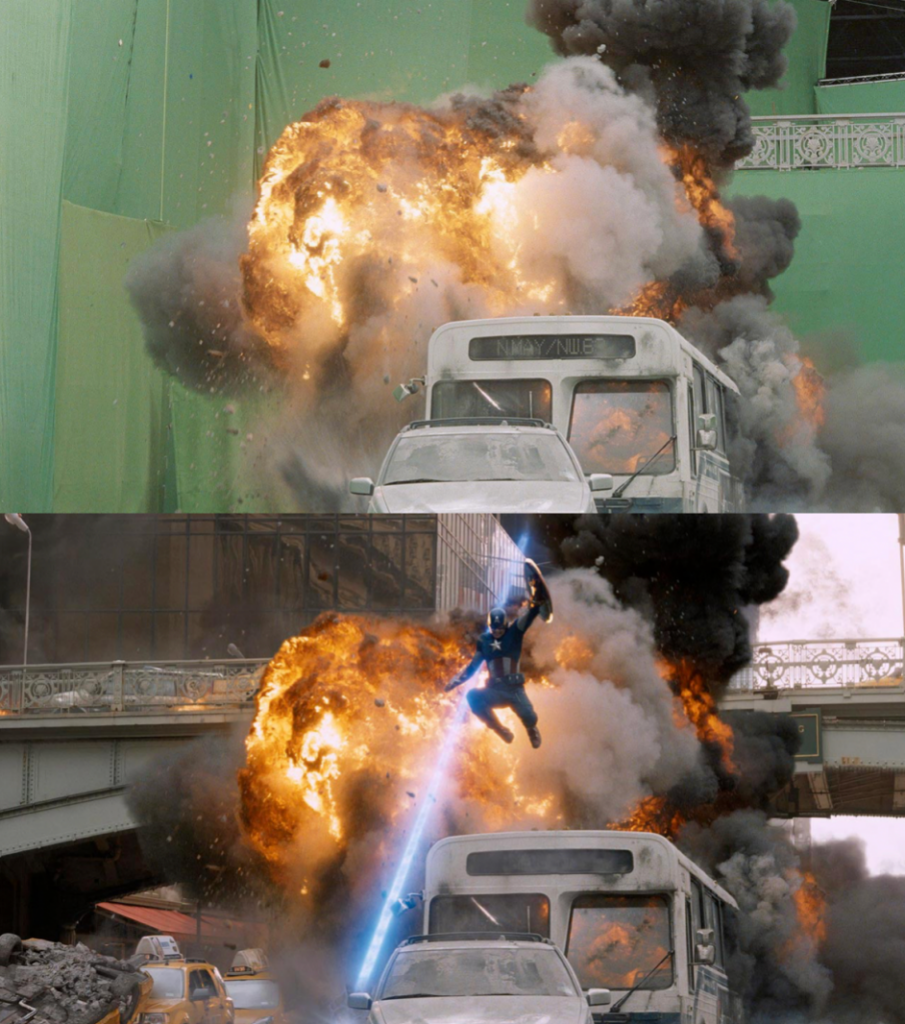

from Yuxiao Miao
 Digital Audiovisual Media Class Blog
Leave a comment