Steven Shaviro is an American academic writer and cultural critic whose work showcases the shift into post-cinematic cinema from traditional cinema, forming new waves of reaction, in which he suggests it creates the ‘structure of feeling’ (2010). Now film has switched heavily over to television with new formulas and layouts, new reactions and affect to these new products have spawned. Ideas of new media and new formats of ‘digital productions’, find now television has involved new realms which aren’t like traditional cinematic mediums, in terms of technology, narrative development and character presentation.
Love Island UK, the British reality dating show, as we know it was first broadcasted on ITV2 on the 7th June 2015. The premise of the show follows new hot, flirty, singles who jet off to Majorica villa to find love and win a huge cash prize of £50,000.

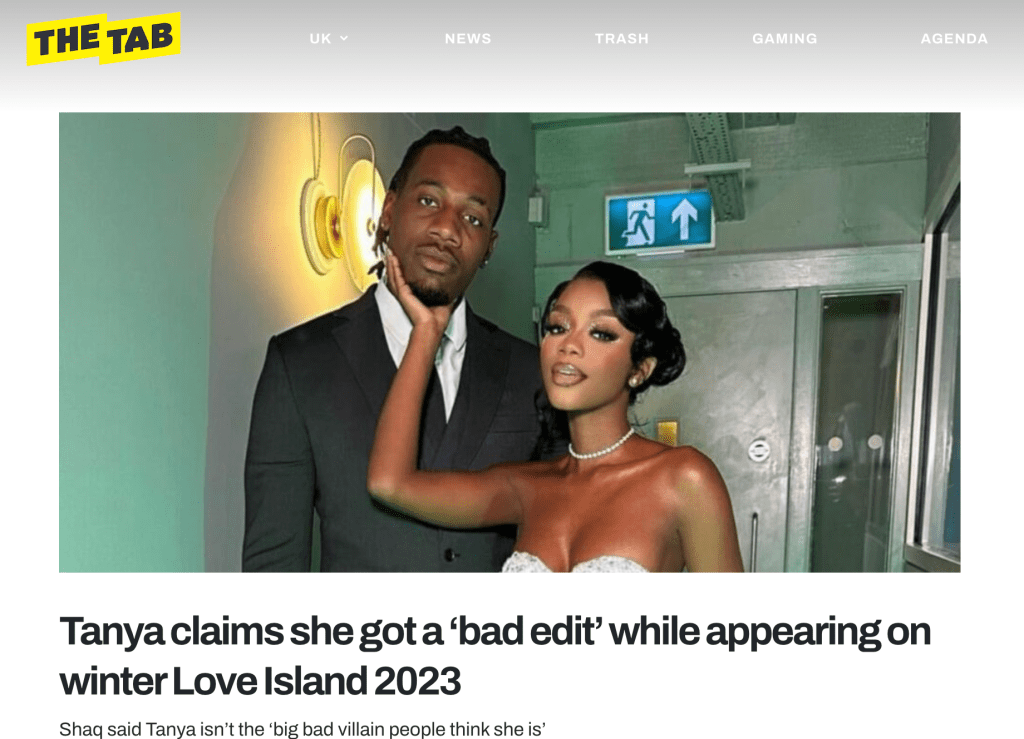
The ideology of post-continuity is significant in Love Island, in an era of ‘digital cinema’ where we have lost the ontological loss of indexical realism, we don’t follow a linear narrative of events to create tension and suspense. We can see in Love Island that the filmmaking has changed from an ‘analogue process to a heavily digitalised one’ through the show being heavily produced (Sharviro, 2010). Throughout the hour episode, we watch clips which are made for us to think happened in chronological order, yet have been edited and manipulated to dramatise viewer reaction, twisting reality. These technological techniques are used to formulate different characters in the villa, e.g. as the hero or the villain of the series, to create mass reaction by the public to therefore go onto social media to hash out their thoughts.
This is important for a reality show like Love Island as we live in a ‘culturally dominant’ sphere, as to keep relevant, the show capitalises off viewer affect. Love Island is a ‘machine for generating affect’, by surprise dumping for your favourite islander off the island or a new bombshell breaks up a strong couple, because the producer’s main goal is social production and wide circulation and distribution of the show to make an economic profit. Furthermore, affect is the underlying experience of feeling which Love Island utilises through the use of chaos cinema. For example, Love Island recouplings are extremely suspensive segments of the show, which are heavily edited and use dramatic non-diegetic sound to leave audiences sitting on the edge of their seats. These montage sequences being used to intensify the show reiterate post-continuity cinema has no rules or limits, and can follow any structure that they want.
In addition, the gamification of television is displayed in Love Island where the islanders fate is in the audience’s hands. Through voting for your favourite couple to stay in the villa, to social media reactions, all directly affect the show’s storyline. In Shaviros Four Diagrams, gamification is the tendency for television to be more ‘game-like’, taking a neoliberal/ capitalist stance that life can be imagined as a competitive game. With new paradoxes opening up and traditional lines of film narrative being blurred, we can understand Sharviros work as a reflection of what it feels like to live in the twenty-first century and predict how far technology, financial flows, media ecologies and control can affect film and television experience.
References:
Shaviro, S. (2010) ‘Post-Cinematic Affect: On Grace Jones, Boarding Gate and Southland Tales’, Winchester
Written by Emma Murphy 33693622
 Digital Audiovisual Media Class Blog
Leave a comment