As we learned in Week 8, music videos can be described as fertile ground for exploring the interdependent structures of race, sexuality, and gender (Railton & Watson, 2012). Watching a music video is more akin to a puzzle-solving process than simply enjoying the music, with the creative team hiding a great deal of metaphor or innuendo in a few minutes of video for political or commercial purposes. For example, in the 1983 single “Sweet Dreams (Are Made of This)” by the British duo Eurythmics, a music video that is now described as “time-transcending and era-spanning,” female singer Annie Lennox appears with short reddish-orange hair and a man’s suit. The video is predominantly surrealistic, easily reminiscent of David Lynch’s filming style, the gender-blurring image of the performance made the song a huge success. The BBC suggested the video completely broke the mold for female pop singers. (Sweet Dreams (are made of this) 2023) Lennox’s image of her holding a whip made the interpretation of the work at the time lean in the direction of SM, but she said that this was a misunderstanding and that they were simply expressing their anger at leaving their original band. Nonetheless, this video remains an early music video’s successful attempt at a transgender genre.

(Eurythmics, Annie Lennox, Dave Stewart – Sweet Dreams (are made of this) (official video) 2009)
In MUSIC VIDEOS AND THE POLITICS OF REPRESENTATION, the author ARGUES the unfair position of black women in music videos, such as the fact that they are often portrayed as oddities that appeal to white audiences (Railton & Watson, 2012). This made me notice the lack of Asian characters in European and American music videos, and whether they are also suffering from ignorance or stereotyping. Although the popularity of k-pop in recent years represents a seemingly growing acceptance of East Asian characters. However, borderline ambiguous cultural appropriation and the absence of relevant roles are still common. For instance, Nicki Minaj’s MV Your Love, which the media claimed contained elements of both China and Japan (Vibe, 2019), was easy for East Asian viewers to spot in the video’s revamping of traditional clothing and the intermingling of silks representing China and actors in Japanese dress, which makes one ponder which regional culture she was trying to express.
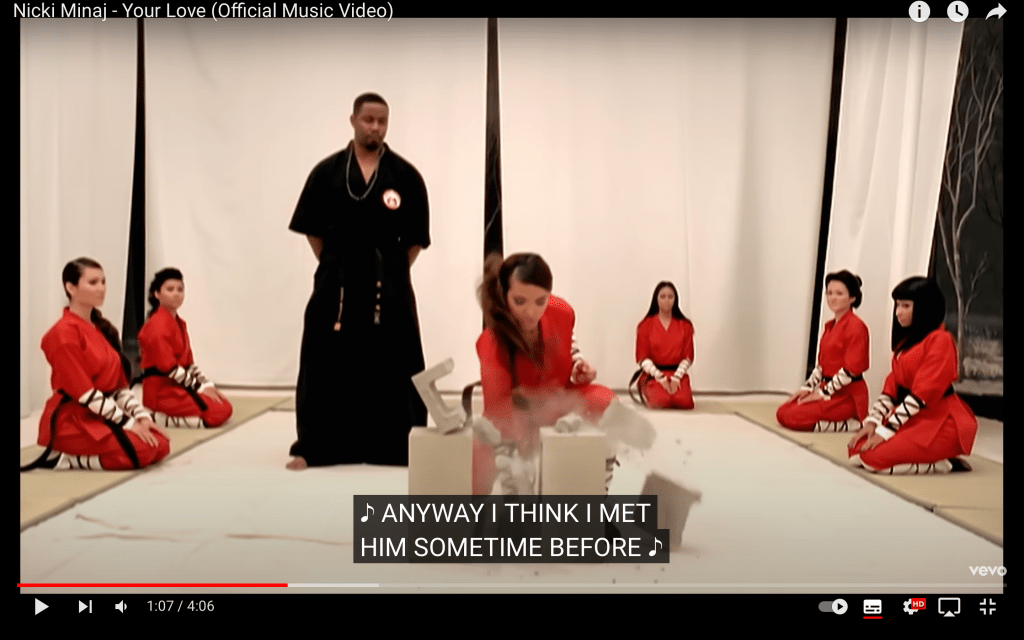
(Nicki Minaj – Your Love (official music video) 2010)
In addition to the issues I’ve raised above, there’s a lot to be said about music video’s representation of race and gender. In Asian music videos for K-pop, J-pop, C-pop, white people appear far more often than black people. And of course, these issues don’t cancel out the progress music video has made in recent years.
Reference
Railton, D. and Watson, P. (2012) Music Video and the politics of representation. Edinburgh: Edinburgh University Press.
Vibe (2019) 5 times Nicki Minaj’s videos referenced Asian culture, VIBE.com. Available at: https://www.vibe.com/features/lists/nicki-minaj-videos-asian-culture-585015/ (Accessed: 24 November 2023).
Sweet Dreams (are made of this) (2023) Wikipedia. Available at: https://en.wikipedia.org/wiki/Sweet_Dreams_(Are_Made_of_This) (Accessed: 24 November 2023).
Eurythmics, Annie Lennox, Dave Stewart – Sweet Dreams (are made of this) (official video) (2009) YouTube. Available at: https://youtu.be/qeMFqkcPYcg?si=mvT5MISq0rzU2mB8 (Accessed: 24 November 2023).
Nicki Minaj – Your Love (official music video) (2010) YouTube. Available at: https://youtu.be/pSFyrrhKj1Q?si=9XZA_vJNkt7Zo7fT (Accessed: 24 November 2023).
Written by: Siyi Liu
 Digital Audiovisual Media Class Blog
Leave a comment