Many theorists considered the development of music videos purley as a “marketing tool”, arguing that they divert attention away from the actual music and “desensitised some listeners to music as a purley aural pleasure” (Arnold et al, 2017: 4-5). Radio, in particular, was faced with a lot of uncertainty as audiences were clear of its visual limitations and so began to crave this new visual element, seemingly forgetting the true nature of music. However, although it was first considered competition to radio both financially and artistically, music videos began to evolve into a kind of harmony with the music that they were created for, becoming almost an enhancement to their aural counterpart.
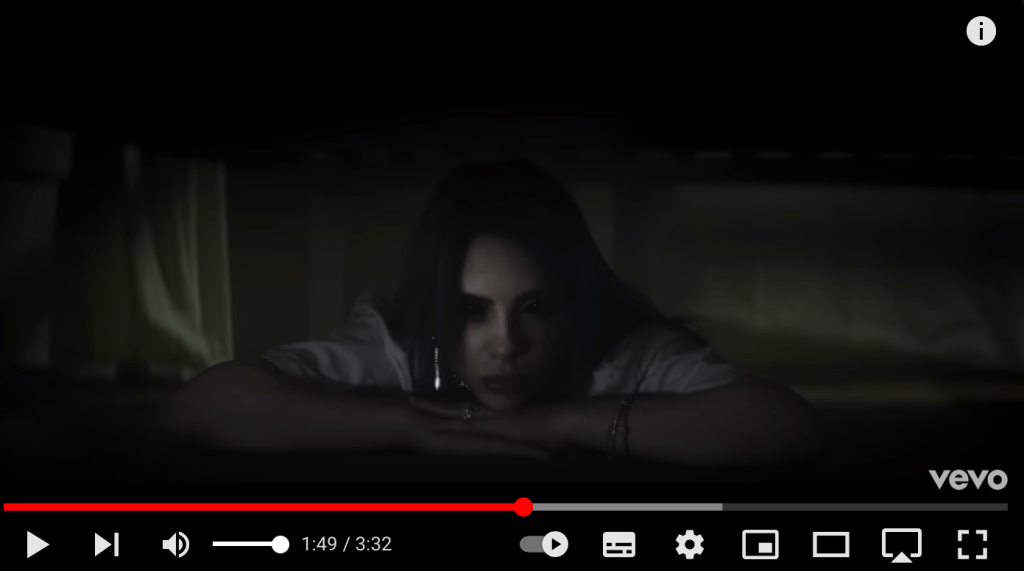
Take Billie Eilish’s, ‘Bury a friend’, as an example. The audio itself is quite artistic, with sound effects, lyrics, melody, etc., being used to create a very dark, grungy sound. From the song alone, audiences are able to imagine a narrative and analyse the songs aural elements even without the need for any kind of visual elements. However, it can be argued that the music video adds another layer of meaning and visual stimulation, which essentially enhances the song both with all the sound effects the audience can hear, and in its lyrical value. Vernallis (2013: 221), says that music video performance might provide us with the “same amount of intimacy and realism as cinema”, which I would say is evident in ‘Bury a friend’. From the costumes, lighting, camera angles, and overall performance, to the audio itself, both mediums work together to evoke specific emotions within the audience. By itself, the song is able to create a very dark and unsettling atmosphere, however the music video adds an additional cinematic element which emphasises the lyrics and the underlying metaphors which some audiences may not have considered before, essentially making the song more compelling. With the music video, the lyrics become ‘real’, and audiences are able to visualise the artists intentions and potentially feel the same emotions as they did with the song itself.


By Emilia Woznicka
BA Media and Communications
Bibliography:
Arnold, G., Cookney, D., Fairclough, K. and Goddard, M. (2017a). Introduction: the Persistence of the Music Video Form from MTV to Twenty-First-Century Social Media’,. In: Music/video : histories, aesthetics, Media. New York, NY: Bloomsbury Academic.
BillieEilishVEVO (2019). Billie Eilish – Bury a Friend. YouTube. Available at: https://www.youtube.com/watch?v=HUHC9tYz8ik [Accessed 26 Nov. 2023].
Vernallis, C. (2013). Unruly Media. Oxford University Press.
 Digital Audiovisual Media Class Blog
Leave a comment