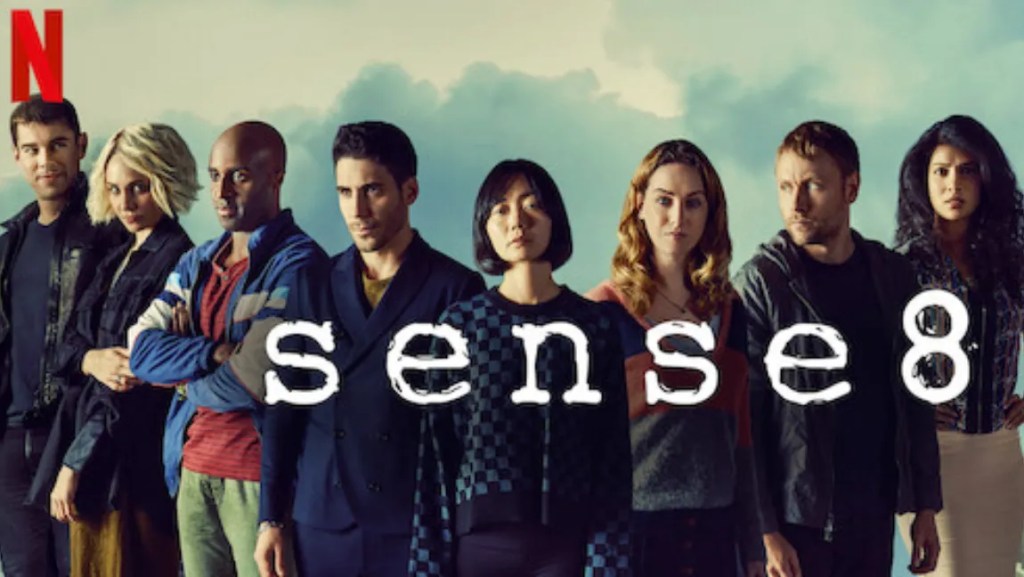
“Sense8” explores topics as diverse as politics, gender, religion, and culture, with a special emphasis on human connection. Each of the eight protagonists faces personal challenges and conflicts while having to unite against the enemies who seek to capture and kill them. It is worth mentioning that the Wachowski sisters, who serve as screenwriters in “Sense 8”, use the theme of gender identity imagery in this work, and the new technology and economic model of Internet distributed television provide a broader space for development.
The innovation of cross-cultural narrative:
The story of “Sense8” features eight protagonists in different parts of the world, with very different cultural backgrounds and living environments. This setting itself is a challenge to the traditional TV narrative mode. Amy Villarejo in her paper “Jewish, Queer-ish, Trans, and Completely Revolutionary: As mentioned in Jill Soloway’s Transparent and the New Television, this global narrative is realized, showing how Internet television is reshaping our understanding of television aesthetics (Villarejo, 2016).

Visual aesthetics:
In terms of aesthetics, “Sense8” is very distinctive in its use of color, with each scene full of bright and expressive colors. For example, from the lively streets of Mumbai to the modern metropolis of Seoul, the color palette of different locations reflects the cultural characteristics and emotional atmosphere of each place. This rich color is visually striking and deepens the audience’s understanding of the emotional state of each location and character. In terms of visual presentation, “Sense8” also cleverly incorporates multiple cultural elements. This is not only reflected in the design of clothing, architecture, and props, but also in the visual symbols and images in various cultural backgrounds. It is a cross-cultural visual fusion that not only enriches the visual experience, but also reflects the global perspective and inclusiveness of the series.

Technological innovation:
A collective birthday celebration scene in the drama integrates the birthday celebrations of the eight protagonists through innovative editing techniques. This technological innovation not only demonstrates the flexibility of Internet-distributed TV in narrative, but also provides a new visual experience for the audience. In their editorial work “Sense8”: Transcending Television, Deborah Shaw and Rob Stone say that each episode of “Sense8” is a challenge and innovation to traditional television storytelling (Shaw & Stone, 2021).

Reference:
Villarejo, A. (2016). Jewish, Queer-ish, Trans, and Completely Revolutionary: Jill Soloway’s Transparent and the New Television. Film Quarterly, 69(4).
Shaw, D., & Stone, R. (Eds.). (2021). Sense8: Transcending Television. London; New York: Bloomsbury.
By: Yi Wang 33789183
 Digital Audiovisual Media Class Blog
Leave a comment