Since the creation of the music video in 1894, the visual medium has become a canvas for portraying social commentary. These “machineries” and “regimes of representation”, as defined by Stuart Hall(Railton, 2011), now extend beyond marketing and aesthetics to influential tools in shaping societal narrative and identities. This exploration allows us to delve into the realm of music videos, exemplified by “This Is America” by Childish Gambino, to dissect the methods used to convey social critique and how they contribute to the ongoing discourse surrounding cultural representation.
Released in 2018, Gambino, known as Donald Glover, uses powerful visuals to explore themes of gun violence, systematic racism and the distraction of entertainment amidst chaos. Glover, both performer and co-director, is seen dancing throughout a large industrial area surrounded by school children
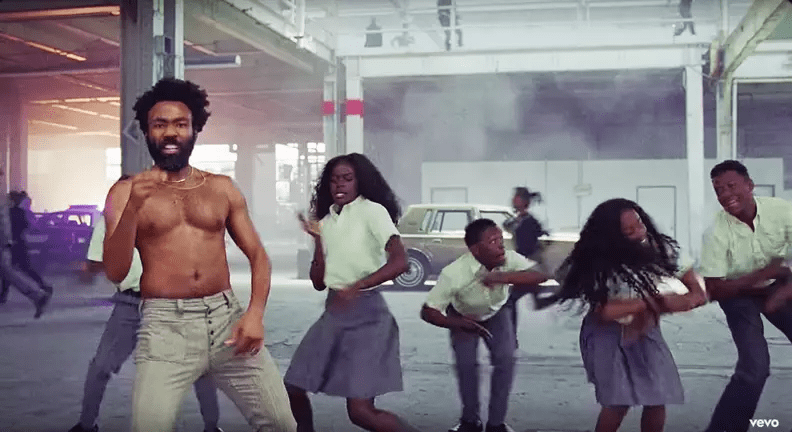
who are all unfazed after he shoots a man in the head. The music video transitions through the juxtaposition of upbeat, carefree dancing with darker undertones of chaos unfolding in the background and various shootings. The children serve as

reminders that “our normalization of racist violence has come at the cost of not only black lives, but black innocence” (Johnson, 2018). This is used to critique societal ignorance to systematic issues whilst being distracted by entertainment and serves as a profound commentary on the state of the nation of America. The camera then pans to a choir who also get shot which could also mirror the 2015 Charlston shooting in which nine African American people were shot in a racially motivated hate crime in their church. This is a poignant reminder of the persistent racial injustices in America and highlights the urgency of the devastating consequences of hatred in the nation.
This music video aligns with the notion of music videos as political statements as Glover deliberately engages with societal critiques in the form of art. It stands as a compelling testament showing that the power of music videos isn’t solely for artistic expression and commodification, but also as a powerful tool for challenging societal issues on cultural representation and the need for change.
By Dzesika Olenberga 33710608
Bibliography
Railton, D. (2011). Music Video and the Politics of Representation. Edinburgh: Edinburgh University Press.
Johnson, T. (2018). Donald Glover’s ‘This Is America’ Is a Nightmare We Can’t Afford to Look Away From, RollingStone
 Digital Audiovisual Media Class Blog
Leave a comment