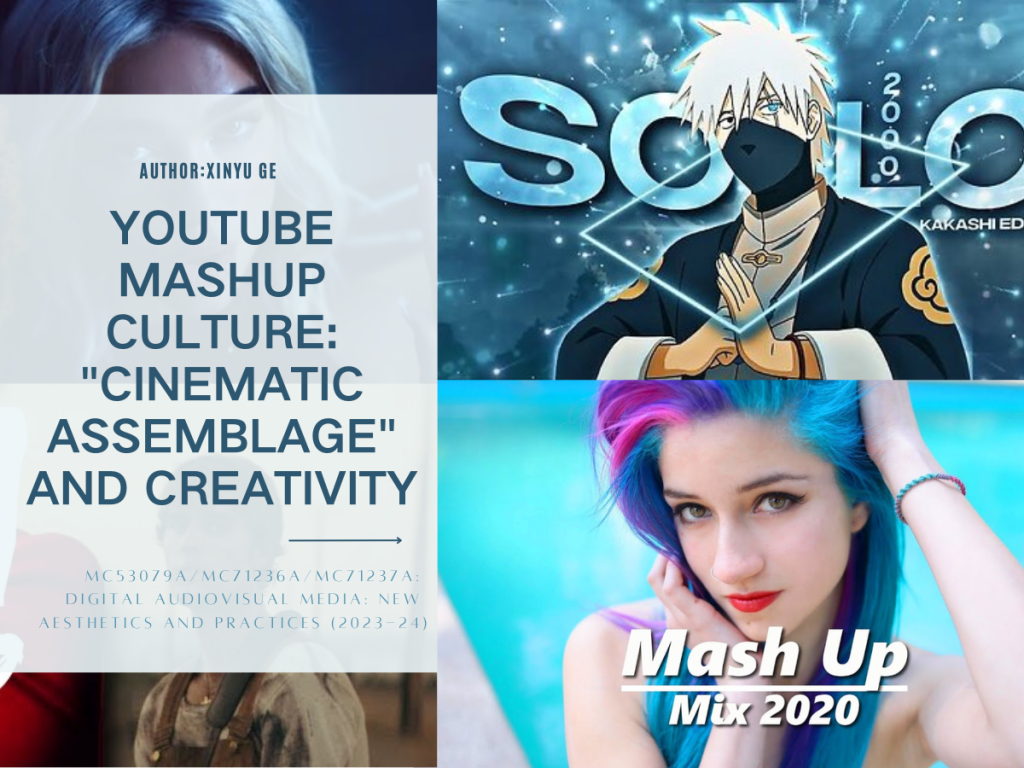
I am a person who rarely uses YouTube because I was born in a country that does not support the use of this software. But there are a lot of “movers” who move YouTube videos to websites that I can see. Mash-up videos are one of the genres I watch the most, and that was my introduction to YouTube creation. However, I still think I missed out on the golden age of YouTube. Mash-up culture is simply understood as mixing and editing, and this form is used more when making stage (singer, idol, dancer) videos, film videos, game/anime clip videos, and secondary creative stories. In a genre of things that did not exist before the internet age, photos and videos labelled as “strangely satisfying” are both exceptionally weird and wonderful (Faramarzi, 2018).
On YouTube, there are different quality videos, and sometimes the viewer is free to choose the quality of the video, such as 480p, 720p, 1080p, and so on. These hybrid videos are not consistent with narrative and video formats such as short films, feature films, or TV series. It’s hard to define the duration of YouTube’s most popular videos, they are completely different depending on the length of the content.
I don’t think that the culture of mashups is a single short video genre; it is often seen as a collection of short video genres with similar styles. In a mashup video, the distinctive subject matter is often what the creator is trying to convey. Creators will group footage through a decided theme, taking the source material from one or more film, television, or music productions, often using key moments from the original footage. At the end of each year, there is an annual on-screen video mashup on YouTube, and @Pteryx Videos is one of the YouTubers who produces these videos.
The unique audio-visual style consists of a very high edit rate, simple and powerful lines, dynamic music, cool special effects, and fast transitions, and the audio-visual elements are often montaged to create a coherent effect. This is very popular in anime mashup video (AMVs), with some viewers stating that such videos even satisfy some of their favourite jamming feelings.
Subjective intervention by the creator, who widely appropriates material from one or more different film and television texts and whose subjective intentions are realised through a high degree of hybridisation of audiovisual elements. For example, Vimeo user Cut to Black edited 108 TV shows, films, and viral dance videos to explain the COVID-19 (Perry, 2020) that everyone is experiencing in 2020. coronavirus) that everyone will be experiencing in 2020. The video is set to the tune of Robin Thicke’s ‘Blurred Lines’ and mixes and matches completely different videos to make up the video he wanted to make. The video was released in 2020 and already has 629k views.
In closing, the culture of mashups is that, as a visual medium that functions as a combination of viewer enjoyment, emotional resonance, and the expression of self-opinion and value recognition, mashups are already an integral part of the Internet video content ecosystem.
Author : Xinyu Ge
Idea base on Week 8: YOUTUBE AESTHETICS, ASSEMBLAGES AND DIY PRACTICES
Bibliography:
Faramarzi, S. (2018) The odd psychology behind oddly satisfying slime videos, WIRED UK. Available at: https://www.wired.co.uk/article/oddly-satisfying-videos-explained-psychology-youtube.
Perry, T. (2020) Someone cut together an absolutely epic covid-19 rapid-fire mashup of 108 movie and TV clips, Upworthy. Available at: https://www.upworthy.com/108-rapid-fire-pop-culture-clips-coronavirus .
 Digital Audiovisual Media Class Blog
Leave a comment