Post-cinema, a theoretical norm indicating new forms, developments, and issues of 21st-century cinema, also carries the significance of changes in film narrative. Digital technology enables filmmakers to combine various media elements such as animation, games, and social media, creating narrative styles and viewing experiences. Post-cinema is a term used to explore “how … “21st-century media help to shape and reflect new forms of sensibility” (Denson and Leyda, 2016).
Everything Everywhere All at Once is one work of the post-cinema era, demonstrating the profound impact of digital technology and new media on the art of cinema. The film dares to innovate in technology and narrative and explores emotional and sensory experiences, providing audiences with a unique viewing experience. The film mainly focuses on family conflicts and is set in a multiverse that challenges binary mores. It fully uses digital technology and visual effects to create a dazzling multiverse. These effects greatly enhance the film’s visual impact and expand the boundaries of its narrative, allowing the audience to experience different views and values of tremendous diversity visually.
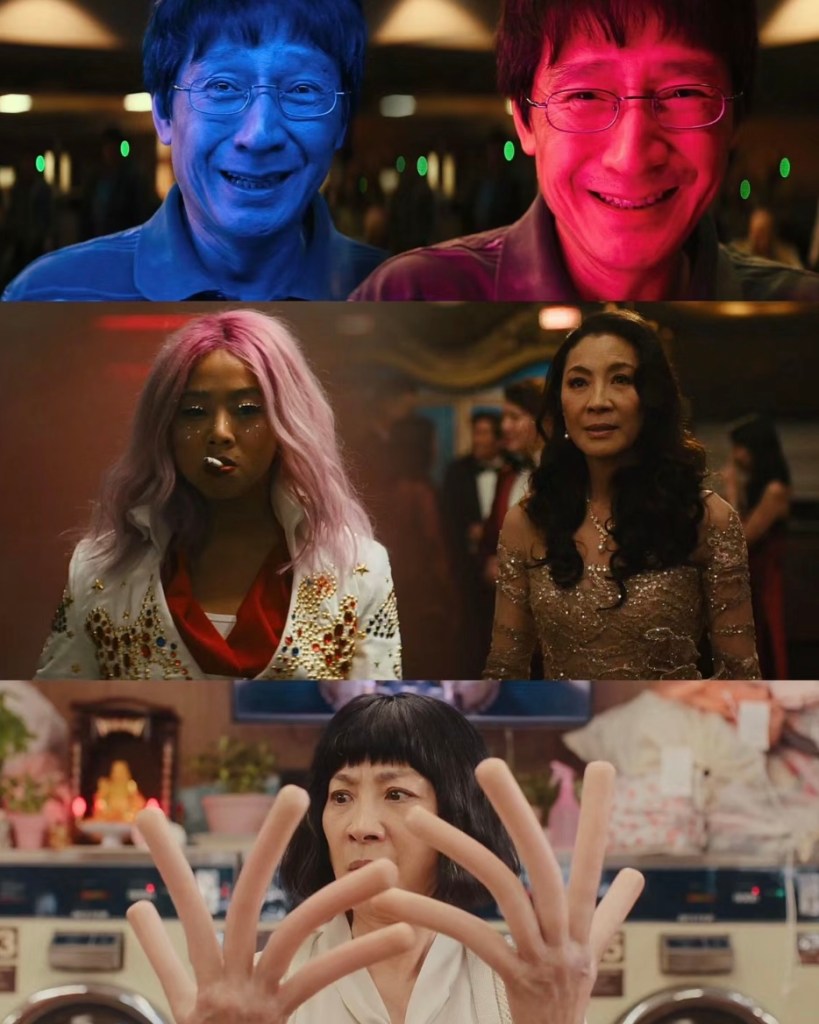
The film consists of various media elements, such as animation, comics, and video games; it breaks the traditional single-media film form, allowing audiences to immerse themselves in a rich and diverse media environment. A unique visual style and a set of narrative techniques are applied; it conveys a specific “structure of feeling” in which every image and scene is created through visual elements such as color, light, and composition to create a particular emotional atmosphere. When facing multi-universe and complex emotional relationships, the characters express themselves emotionally and are erratic due to their inner struggles. The delicate emotional portrayal and genuine expression enable audiences to resonate with its characters deeply. These include what Bordwell has called “intensified continuity” (Bordwell, 2002) and Steven Shaviro has referred to as “post-continuity” (Shaviro, 2010): the idea that images no longer fully follow the rules of classical cinema editing and composition.
Reference
Bordwell, D. (2002). Intensified continuity visual style in contemporary American film. Film quarterly, 55(3), 16-28.
Denson, S., & Leyda, J. (2016). Perspectives on Post-Cinema: An Introduction.
Shaviro, S. (2010). Post cinematic affect. John Hunt Publishing.
By: Tianyu Zhang 33784928
 Digital Audiovisual Media Class Blog
Leave a comment