Digital technology has changed cinema such that the ‘D-word’ has now become an inescapable element of moving image technology (Enticknap 2005: 202). The shift from traditional to digital cinema resulted from changes in realism and the emergence of new image technologies. The post-cinematic perspective challenges people to think about the affordances (and limitations) of the emerging media regime not simply in terms of radical and unprecedented change but in terms of the ways that post-cinematic media are actively engaged in reshaping our inherited cultural forms, our established forms of subjectivity, and our embodied sensibilities.’ (Denson& Leyda, 2016) (Denson & Leyda, 2016) This active role of post-cinematic media in reshaping cultural forms underscores the dynamism of the current media landscape. Many Hollywood movies exhibit this characteristic, such as ‘Doctor Strange.’

“Doctor Strange” is a film of advanced in digital technology and visual effects, creating a magical world full of fantastic colors. CGI is well illustrated by way of mirrored dimensions and spatially distorted effects; virtual reality technology presents audience a surreal visual spectacle. This non-indicative form of digital media powers the film, enabling it to transcend the limitations of traditional photographic techniques and present more vivid and complex scenes.

In addition, “Doctor Strange” embodies post-continuity characteristics, and the narrative structure is no longer restricted in the traditional logic of time and space. It breaks the continuity of space and creates a relativized time and space, making the audience experience a non-linear and multidimensional narrative mode during viewing (Shaviro, 2016).
The film conveys a specific “structure of feeling”. Its unique visual style and narrative techniques are two key factors in achieving this. Each picture and scene create a specific emotional atmosphere. Composition of color, light and shadow enables the audience to deeply feel the characters’ inner world and emotional changes. This perceptual structure not only enhances the narrative effect of the film but also enables the audience to empathize with the characters emotionally (Pisters, 2012).
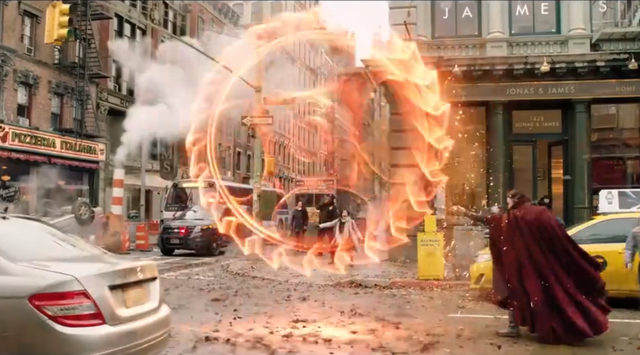
However, the limitation of the emerging media system lies in the theory that although post-continuity narrative techniques and chaos cinema enhance the visual impact, they may also lead to confusion in the audience’s narrative understanding. The audience is confused by the shocking visual effects rather than the story plot, leading to the narrative’s fragmentation and a sense of spatial chaos, where the spatial relationships between characters and objects become unclear. This can disrupt the audience’s ability to follow the story. The charm of superhero movies is that the grand special effects are limited to this, which may make the audience feel too unreal and lack of reality.
Reference
Enticknap, L. (2005). New Moving Image Technologies. Moving Image Technology, 202-31.
Denson, S., & Leyda, J. (2016). Perspectives on Post-Cinema: An Introduction.
Shaviro, S. (2016). Post-continuity: an introduction.
By:Tianyu Zhang 33784928
 Digital Audiovisual Media Class Blog
Leave a comment