Cinema and television have undergone a profound transformation with the shift from analogue to digital technologies, altering how stories are produced, exhibited, and consumed. While some critics debate the depth of this change, most agree it has significantly redefined the medium’s capabilities and aesthetics. This evolution can be explored through two landmark films: Blade Runner (1982) and Jurassic Park (1993), which represent pivotal moments in this transition.
Blade runner exemplifies the analogue era, relying heavily on tactile methods like miniature models, matte paintings, and practical effects to create its dystopian, cyber punk world. The film’s visuals are deeply tied to what David Rodowick calls the “indexical” qualities of analogue media – where physical traces of reality are embedded in the medium itself (Rodowick, 2015). In contrast, Rodowick argues, digital media lose this ontological connection, as their representations are constructed from data, not physical impressions.
Jurassic Park straddles the boundary between these eras, combining animatronics with groundbreaking CGI. Steven Spielberg’s dinosaurs represent a turning point, as they were some of the first photorealistic digital creations to inhabit a live-action setting. Lev Manovich situates such transformations within the framework of “new media,” which maintain elements of older forms while reimagining them (Manovich, 2002). For instance, CGI in Jurassic Park transforms the analogue-based techniques of stop-motion into dynamic, data-driven imagery.
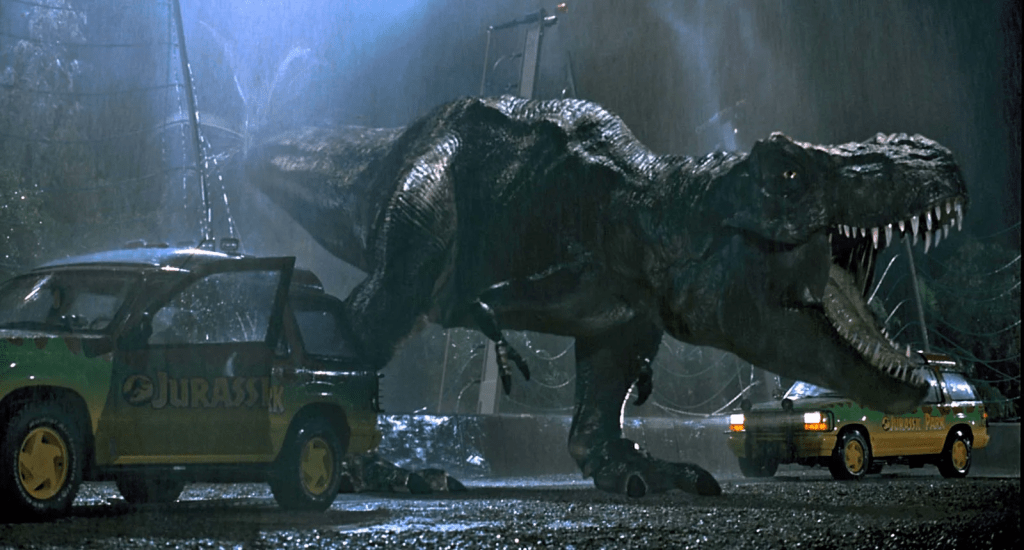
Manovich also highlights a shift from narrative to “database logic” in digital media, foreshadowed by montage pioneers like Dziga Vertov. While Blade Runner relies on linear storytelling, the possibilities offered by digital tools in Jurassic Park hint at a more modular, database-like construction of cinematic worlds.
Ultimately, these films reveal how analogue’s authenticity and digital’s boundless flexibility offer contrasting, yet complementary, approaches to storytelling, reflecting broader cultural shifts in media consumption and production. Together, they mark a pivotal moment in cinema’s ongoing evolution.
Post by: Karoline Brandslet
Manovich, L. 2002, ‘What is New Media’, The Language of New Media, pp.18-61
Rodowick, D. N. 2015, , ‘What was cinema’ The Virtual Life of Film pp 25-88
Jurassic Park (1993) Dir. Steven Speilberg, USA.
Blade Runner (1982) Dir. Ridley Scott, USA.
 Digital Audiovisual Media Class Blog
Leave a comment