In Mareike Jenner’s TVIV (fourth stage of television), Netflix is no longer just a distribution platform outsourcing cinema, it now has the power to produce it. An example of a Netflix Original would be the historical drama television show, The Crown. Reaching 60 episodes in 6 seasons, The Crown looks at the British monarchy and a fictionalized interpretation of real events within its modern history.
Not only does the length of this series play to the strength of the Netflix binge but this show is also an example of non-linear television viewing, as Netflix advertises the series before creating a “season dump”. This term means the immediate availability of a full set of episodes to be watched, or ‘binged’ all in one sitting. Having abandoned the concept of linear television and the model of the weekly episode Netflix creates content that can be watched at a viewer’s leisure. The content held by Netflix becomes more appealing than broadcast, as they have “A great big world in here” meaning within their library.
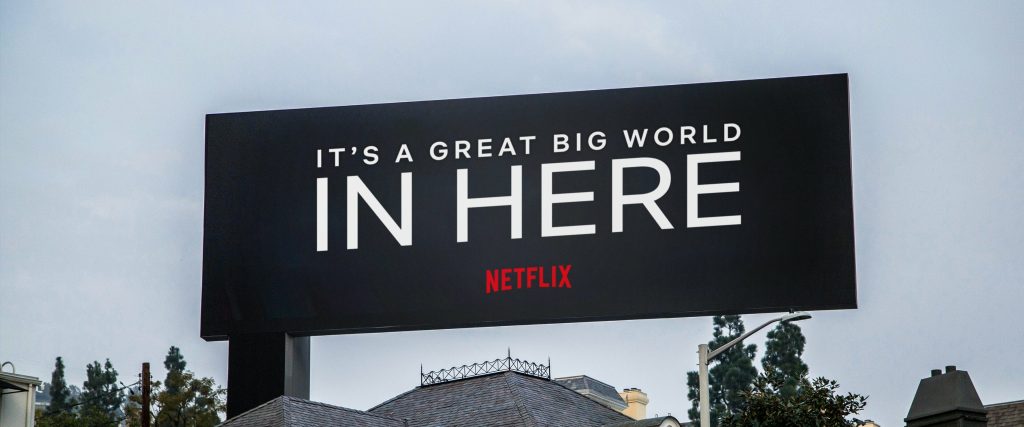
Advert for Netflix’s subscription implying large quantity of film/TV
Netflix is one of the post-network Internet television distributors. Their series shows what Amanda Lotz meant when claiming the post-network condition would be interoperational and efficient. In the case of series like The Crown, the series can be seen on any digital technology and is one of many choices that broadcasters couldn’t offer. The series is known as ‘bingeable’ as it contains characters of people now past, specifically Princess Diana. The character’s tranformation from sweet and naive to self-aware and brave creates a narrative within the series that makes viewers need to know what comes next. The episodes are also structured on cliffhanger which leads to Netflix giving 5 seconds to ask if you want to watch the next episode, encouraging binge-watching.

the button to next episode giving 5 seconds to decide
Bibliography:
Cass, Kiera. The Crown. HarperCollins, 2016.
Lotz, Amanda D. “Television Outside the Box: The Technological Revolution of Television.” The Television Will Be Revolutionized, 2nd Edition, NYU Press, 2014, pp. 53–94. JSTOR, http://www.jstor.org/stable/j.ctt9qfwq5.7. Accessed 21 Oct. 2024.
Mareike Jenner. Netflix and the Re-Invention of Television. Cham Springer International Publishing, 2018, pp. 109–18, ebookcentral.proquest.com/lib/goldsmiths/detail.action?docID=5475331. Accessed 21 Oct. 2024.
By: Costanza Maria Santacroce
 Digital Audiovisual Media Class Blog
Leave a comment