Bullet Train
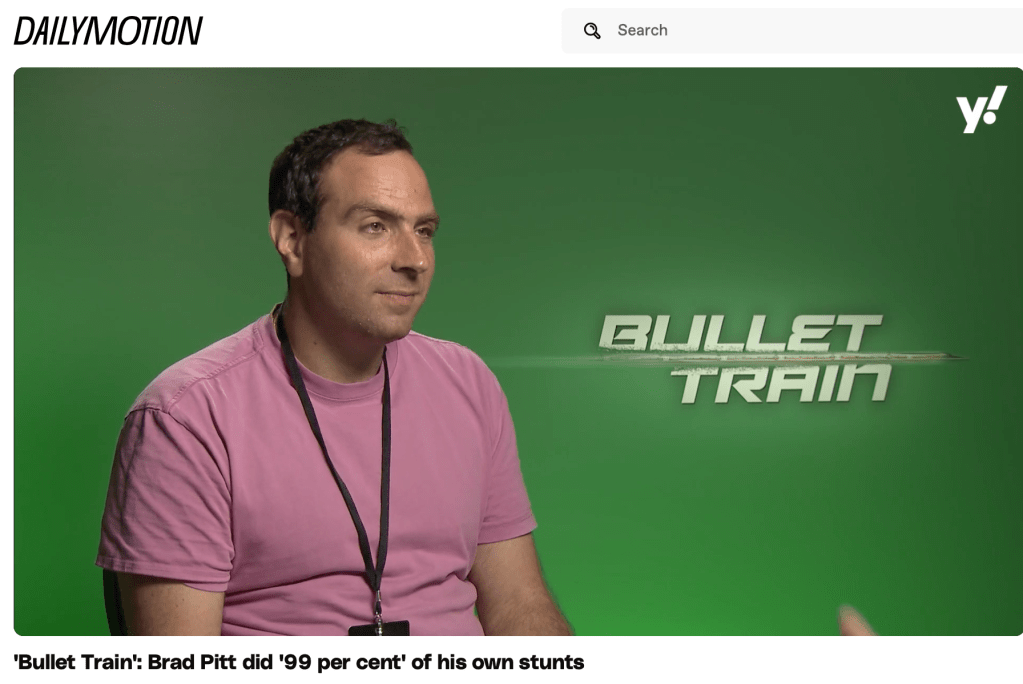
‘Bullet Train’ (David Leitch, 2022), is a 2022 movie about five assassins on a bullet train with connected missions. The Film is full of action, including a sword fight, a train crash, and a battle with a rigged gun. Very famous and well known actor Brad Pitt starred in this film, but his excessive dedication to his role resulted in him performing “99% of all the film’s stunts” (David Leitch on DailyMotion, 2022). Hence, it is to be taken to consideration how this particular instance in the modern world of cinema is to be appreciated.
“The post- cinematic perspective challenges us to think of the ways that post-cinematic media are in conversation with and are engaged in actively re-shaping our inherited cultural forms, our established forms of subjectivity, and our embodied sensibilities.’ (Denson and Leyda, 2016). In today’s day and age, on social media, it is close to impossible to tell what is real and what is not. The technology advancements also bring this notion into cinema, thus, post -cinema. Any stunt is usually perceived as CGI (Computer Generated – Imagery), or green screen. “The index makes that claim [of its connection to reality] by virtue of its privileging of contact, of touch, of a physical connection. The digital can make no such claim and, in fact, is defined as its negation.”(Mary Anne Doane, 2008) Therefore, further emphasising the lack of realism in the film industry today.
Brad Pitt in ‘Bullet Train‘ broke this paradox where today’s cinema is ‘fake’. His dedication to acting in this film through out all aspects, including the dangerous stunts, brought a sense of authenticity back into cinema. “Brad Pitt won the Oscar for Best Supporting Actor by playing stuntman Cliff Booth in Quentin Tarantino’s “Once Upon a Time in Hollywood,” so it’s only fitting he performed nearly all of his own stunts for follow-up project “Bullet Train.” (iMBD, 2022).
However, I can only sit here and ponder how real these stunts really are. Because I am sure the punching was fake, the falling was padded, etc… So within the audience, it is inevitable that the question of what was really real, and how real it was, grows.
- Alessandro A. Conzonato
Bibliography:
David Leitch, 2022, Bullet Train, Sony Pictures
Shane Denson and Julia Leyda, 2016, ‘Perspectives on Post-Cinema: An introduction’, Post-Cinema: Theorising 21st Century Film
Mary Anne Doane, 2008, The Emergence of Cinematic Time: Modernity, Contingency, the Archive, Harvard University
Daily Motion, 2022
iMBD, 2022
 Digital Audiovisual Media Class Blog
Leave a comment