The 2014 film Edge of Tomorrow is a film that is similar to Source Code in many ways. The story is set in a near-future Earth that is under alien invasion, and the main character, Major William Cage (played by Tom Cruise), gradually becomes skilled at fighting the enemy as he dies and is brought back to life in a time loop.

Post-cinematic form/continuity
This film is full of scenes that express what Steven Shaviro calls post-cinematic form/continuity, especially in the battle scenes. In the scene at the beginning of the film, where Major Cage makes an emergency jump from a helicopter, the camera captures the object (Major Cage) from below and above, and during this time the subject is also shown spinning and falling, creating a shot that makes you feel dizzy. The shots are designed to shake the viewer’s sense of physicality, and are even more enhanced in Gravity (Richmond, 2016). The loop scene is also very similar to Source Code, but it is depicted as an image of a hallucination.
All You Need Is Kill
As you can see, this film has many features in common with post-cinema, but also its storytelling is based on a game-like worldview, as Shaviro analyses Gamer (Shaviro,2010). The film is based on a Japanese ‘light novel’ (a novel with illustrations written for young people) titled All You Need Is Kill (2004) written by Hiroshi Sakurazuka. It is clear that the original novel also reflects a game-like worldview.
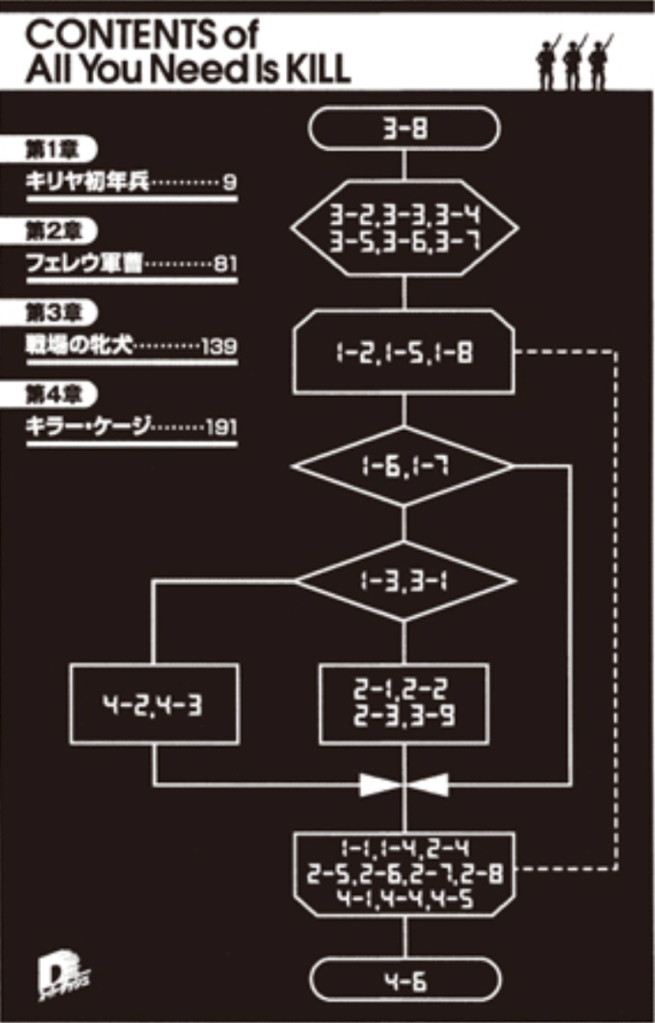
Table of contents that imitates the game’s setting screen (dungeon format) in All You Need Is Kill (p. 7.)
Game-like Realism
Hiroki Azuma uses the concept of ‘game-like realism’ to analyse the original novel as a work with a new style of realism. ‘Game-like realism’ is defined as ‘metanarrative realism’, which doubles the perspective of the player playing the game (external perspective) with the internal perspective of the characters in the diegesis(Azuma, 2007). The protagonist of this work, Major Cage, discovers a strategy for defeating his enemies by repeatedly dying and being resurrected. This is a basic strategy for players of action games (and would also apply to Source Code).
Death and Resurrection
In a work that can be categorised as game-like realism, what does repeated death and resurrection mean? It seems to be a challenge to the view of life and death as a one-off event. The deeply emotional expression of grief and mourning at death (as a scene of mourning by people of African descent in Douglas Sirk’s Imitation of Life) and joy at resurrection (as a scene in which Inger comes back to life in Carl Theodor Dreyer’s Ordet) seen in classical films is almost completely absent. Rather, the repeated deaths of Cage in Edge of Tomorrow are simulated, and they are depicted as affect accompanied by the physical reaction of surprise, as if the player had failed to beat the game.
・References
Hiroshi Sakurazaka, All You Need Is Kill, Tokyo: Shueisha, 2004.
Hiroki Azuma, Ge-mu teki realism no Tanjo: Dobutsuka-suru Postmodern2, Tokyo: Kodansya, 2007.
Scott C. Richmond, Cinema’s Bodily Illusions: Flying, Floating, and Hallucinating, Minneapolis: University of Minnesota Press, 2016.
Steven Shaviro, Post-Cinematic Affect, Washington: Zero Books, 2010.
Written by Takuya Nishihashi(3377985)
 Digital Audiovisual Media Class Blog
Leave a comment