Quentin Tarantino is known for his peculiar style of movies. It can be clearly seen throughout his projects (and said by Tarantino himself in multiple interviews) that he has been inspired by old filmmakers, majorly Sergio Leone for the editing and cinematography of his movies.
In the Post-Cinema era, it can be said that the only focus on movies is not solely the story itself, but the contribution of various elements to help enhance the story and create some sort of affect for the audience. This is done by Tarantino in Django by the use of the cinematography and editing. As Rodowick explains, ‘nothing moves, nothing endures in a digitally composed world… in digital cinema there is no longer continuity in space and movement, but only montage or combination’.
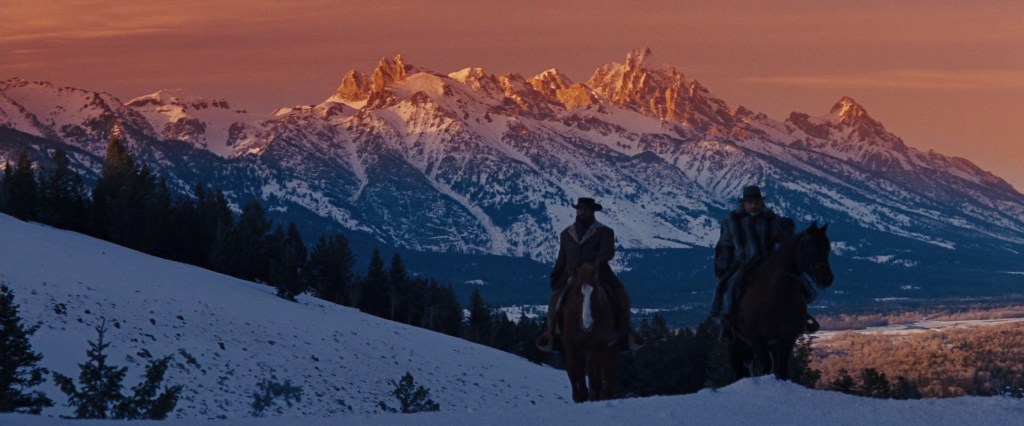
The film features an element (like most of Tarantino’s movies) that Leone also primarily used as a tool to tell a story: music. While in Old Hollywood films music is used mostly as a background, Tarantino puts it upfront, utilising it as a weapon for his storytelling. When Django joins Dr Schultz as a bounty hunter, Tarantino uses the song “I got a name” by Jim Croce. The song has meaning in showing how Django is regaining his identity and has finally achieved some sort of freedom. This is not only shown by the music, but also by the location – as seen in the still, they are nearly always in the mountains or open fields, completely immersed by nature, mirroring the transition of Django going from being enslaved to finally becoming an independent individual.
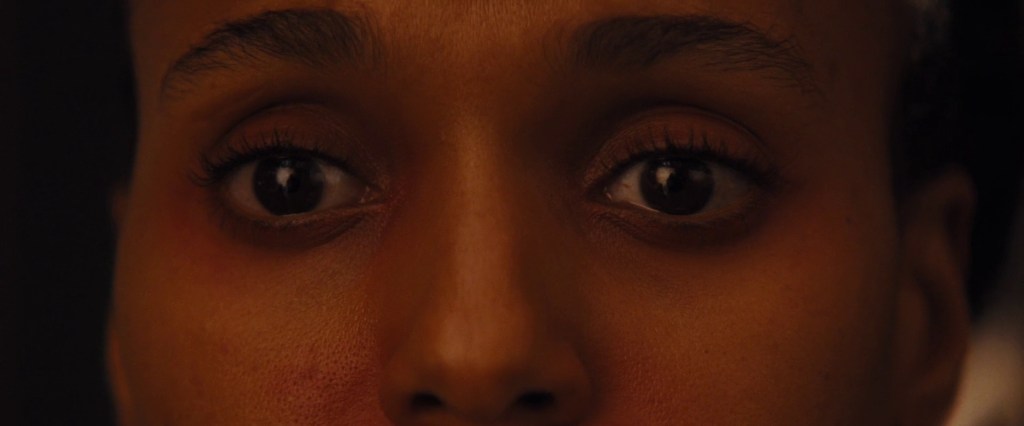
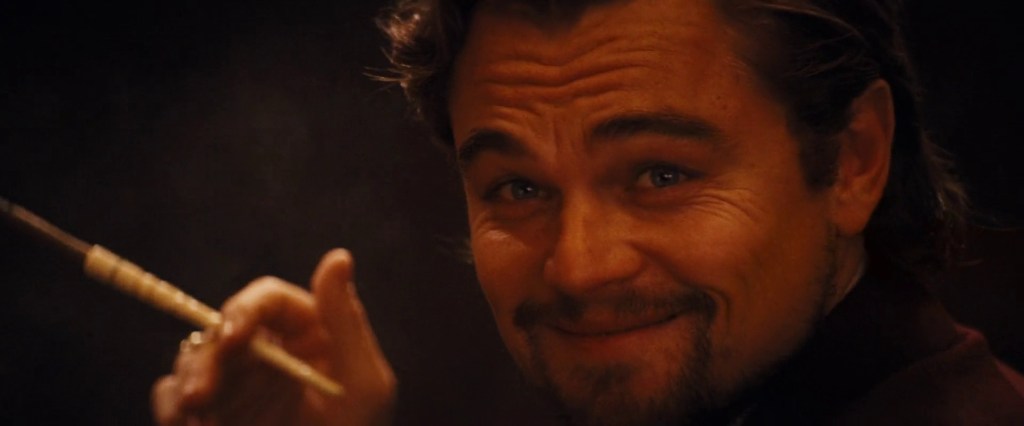
Tarantino also manages to use extreme close ups and tracking shots in the movie to highlight the characters’ emotions and are used in moments of tension and emotional importance.
Tracking shots following the characters (in action sequences particularly) are also used throughout the movie that create a sort of momentum and energy throughout the film for the audience.
The variation of shots, cinematography and music Tarantino uses in the film are part of the digital and post-cinema era. These contribute to a major, in my opinion affect for the audience in that the combination of these elements does not distract from the storyline itself, but rather contributes to the characterisation of the characters and in enhancing meaning and the storytelling, making it even more enjoyable to watch.

Reference List
[FILMGRAB]. (2013). Django Unchained. [online] Available at: https://film-grab.com/2013/05/28/django-unchained/#bwg786/48434 [Accessed 7 Nov. 2024].
Shaviro, S. (2010). Post-Cinematic Affect: On Grace Jones, Boarding Gate and Southland Tales. Film-Philosophy, 14(1), pp.1–102. doi:https://doi.org/10.3366/film.2010.0001.
Taylor, T. (2024). Quentin Tarantino’s favourite film and director of all time. [online] Far Out Magazine. Available at: https://faroutmagazine.co.uk/quentin-tarantinos-favourite-film-and-director-ever/.
Giulia Lanfrancotti 33750235
 Digital Audiovisual Media Class Blog
Leave a comment