In exploring Steven Shaviro’s notion of ‘post-cinema,’ the anime Fate/Zero provides an insightful case study. This work not only demonstrates how technological advances have affected narrative and audience experience, but also how sensory structures have changed under the new ‘cultural-technological regime’(Shaviro 2016).

The combination of technology and sensory structures
In the Fate series, the magnificent battle scenes and exquisite character designs demonstrate the extreme use of modern animation techniques. The high-quality animation and dynamic special effects used in the work create a visually stunning experience, enabling the viewer to experience a ‘kaleidoscope’ of sensations. Rapid editing and smooth movements make the battle scenes seem like a dream, and the audience feels as if they are in the middle of it, experiencing the visual experience of ‘zero gravity’. This discontinuous, non-linear narrative makes the audience not only passively accept information, but also actively participate in the emotional resonance.
Post-Continuity and Chaotic Narrative
Shaviro’s concept of ‘post-continuity’ is fully embodied in Fate. The timeline of the story is not linear, and the relationships between the characters are complex and intertwined, so the audience needs to rebuild their understanding of the story in the fragmented narrative. In Fate/Zero, multiple perspectives surrounding the Grail War alternate, leaving the audience having to quickly adapt to new information and emotions in each episode. This narrative chaos is not disorder, but a new narrative order that encourages the viewer to actively participate and explore the inner worlds and motivations of the characters.
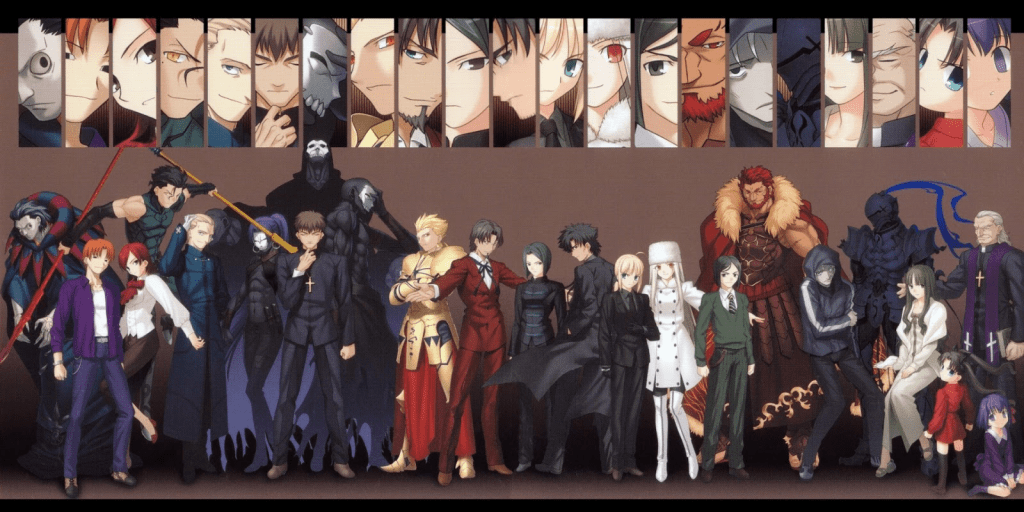
Digital Realism and Neuroimages
Rodowick’s ‘digital realism’ is also evident in the Fate series. With the advancement of technology, the production team was able to achieve more detailed visual effects and complex scene construction. This technological breakthrough not only enhances the overall aesthetics of the work, but also strengthens the audience’s sense of immersion. For example, the use of colourful special effects, rich light, and shadow effects in the representation of magic during battles allows the audience to deeply experience the conflicts and emotions between the characters(Roderick, 2018).
The ‘neural images’ mentioned by Pisters are also reflected in Fate. Each character’s emotions and psychological state are conveyed through subtle expressions and movements, allowing the viewer to not only understand the plot, but to empathise with the character’s heart. Especially in emotionally rich scenes, the combination of images and music allows the viewer to feel the inner struggle and growth of the characters in an instant.
Overall, the Fate series is more than just a wonderful piece of anime; it is also a profound reflection of the multiple dimensions of post-film influence. From technical expressions to new sensory structures, these changes allow viewers to experience more complex emotions and reflections while watching. By analysing this series of works, we are able to gain a clearer understanding of how contemporary animation innovates within new cultural and technological regimes, and how it redefines the relationship between the viewer and the work. In this ever-changing audiovisual environment, Fate demonstrates a combination of emotion, technology, and narrative that provides us with a rich source of reflection and experience.
References
Roderick, N. (2018). How to be a Realist about Similarity: Towards a Theory of Features in Object-Oriented Philosophy. Open Philosophy, 1(1), 327-341.
Shaviro, S. (2016). Post-continuity: an introduction.
MA Donghan
 Digital Audiovisual Media Class Blog
Leave a comment