From the development of digital platforms such as YouTube, everyone has gained the ability to become prosumers and therefore not just digest but create content from the comfort of their own homes. Manovich states ‘”The most important feature of new media is its ability to represent, manipulate, and interact with data in real-time.” (Manovich, 2002). Mr Beast (Jimmy Donaldson) is the biggest example of this as his content has gained him traction of over 332 million subscribers to date. Since the content he produces are extreme challenges such as men vs women survive in the wilderness for $500,000 or I built 100 homes and gave them away, Jimmy redefines the boundaries of content creation online along with mixing cinematic production values with the directness and immediacy of online video, representing a new hybrid form of digital entertainment for millions around the world to enjoy.

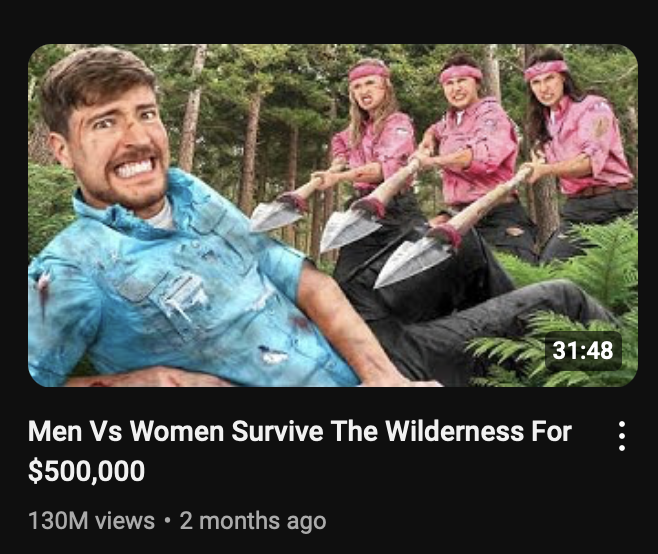
Post Cinema has allowed for boundaries between traditional cinema, television and digital content to be pushed (Denson & Leyda, 2019) as there is a rise in interactive and participatory forms of media on YouTube. Thus giving the ability for creators to merge the gap between traditional media forms and digital shorter form content. Ergo, since YouTube is a participatory platform where users are able to leave likes and comment, it adds an additional level for fans to either join in with the content or feel as part of the process. This is something standard media forms are not able to achieve as there is no participatory layer.
To conclude, YouTube has enabled users to use their phones and become prosumers to create content. For creators such as MrBeast, it opens a door for participatory culture to also be used and to blur the lines between ‘transforming the role of the audience from spectators to participants in the production process’ (Rodowick, 2015) allowing for more reach and more opportunities with fans to become a bigger part of the production process.
Manovich, L. (2002) The Language of New Media. Cambridge, MA: MIT Press.
Denson, S. and Leyda, J. (2019) ‘Perspectives on Post-Cinema: An introduction’, Post-
Cinema: Theorising 21st Century Film, pp. 1-19. Available at: reframe.sussex.ac.uk/wp-content/uploads/2019/05/POST-CINEMA_LO_RES.pdf
Rodowick, D. N. (2015) The Virtual Life of Film. Cambridge, MA: Harvard University Press.
33740443 Fedor S.
 Digital Audiovisual Media Class Blog
Leave a comment