Understanding how a story is narrated is key to interpreting the world around us, as narrative structures provide frameworks that help us make sense of events. According to Bordwell and Thompson, explain that we connect a narrative’s events by cause and effect, time, and space (2008: 76). Director Quentin Tarantino’s non-linear storytelling, famously employed in Pulp Fiction and later in Kill Bill, is a prime example. Kill Bill opens with The Bride (Uma Thurman) narrowly surviving a brutal attack by her former lover, Bill (David Carradine), then jumps ahead to her awakening from a coma, and quickly to her hunt for Vernita Green (Vivica A. Fox), her second target. This sequence, though chronologically out of order, sets up The Bride’s revenge narrative and keeps the audience engaged by moving forward in time and only occasionally stepping back to clarify key events.
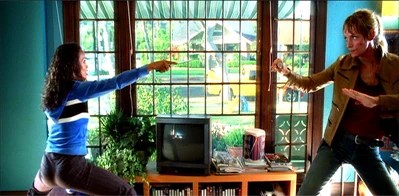
The non-linear structure demands careful attention from the viewer, with visual markers like The Bride’s hit list guiding us through her journey. Tarantino’s approach reveals the layers of The Bride’s revenge in a controlled but chaotic flow, mirroring her emotional turmoil. By delaying the backstory of her trauma until Kill Bill: Vol. 2, the audience can grasp the full extent of her pain and the vengeance driving her. This structure, often seen as Tarantino’s stylistic choice, can also be viewed as a technique, highlighting themes of betrayal and revenge through fragmented storytelling. The scattered yet intentional flashbacks amplify The Bride’s wrath and her relentless pursuit of the Deadly Viper Assassination Squad, culminating with Bill himself. Tarantino, known for this style of non-linear storytelling, creates chaos in the film not only through intense fighting scenes but also through the chaos in following the true plot of the story. His movies put us in the main character’s perspective in a way that cinema’s linear storytelling has never done before. Tarantino’s signature non-linear storytelling style brings chaos to his films, not just through intense fight scenes, but by challenging us to untangle the true message. His movies truly put us in the main character’s perspective in a way that cinema’s linear storytelling has never done before. While there are many ways to experiment with time and space in the film, it’s the unpredictability of his non-linear approach that truly captivates audiences and keeps them engaged from the very beginning.
Credit:
- Roche, David. “Choreographing Genre in Kill Bill Vol. 1 & 2 (Quentin Tarantino, 2003 & 2004).” Miranda. Revue pluridisciplinaire du monde anglophone/Multidisciplinary peer-reviewed journal on the English-speaking world 10 (2014).
- “Blowing the Lid off of ‘Chaos Cinema’: How Action Films Have Changed.” No Film School, No Film School, 13 Jan. 2015,
- Stork, Matthias. Chaos Cinema, static1.1.sqspcdn.com/static/f/707453/23561535/1380258173110/Stork_Final.pdf. Accessed 16 Nov. 2024.
- Langenbahn, Emily. “Kill Bill: Vol. 1 & 2 – a Formal Analysis.” Film Studies 2270 Introduction to Film Studies, 12 Aug. 2014,
- Schasché, Valentina. Non-Linear narrative structure in contemporary cinema. na, 2010.
By Jimena Saavedra
 Digital Audiovisual Media Class Blog
Leave a comment