1. Complexity and Transformation of Narrative Perspectives
Plato believed that narratology, as a discipline, explores the nature, structure, and operational laws of narratives across different media, as well as the narrative competence of both creators and receivers. For instance, if Inception is examined as a narrative text, then Christopher Nolan’s narrative mastery shines through in the film’s intricate handling of its layered narrative structure.
In the transition from textual language to visual and auditory language, the director employs multiple narrative perspectives to enhance the tension and richness of the story. As one scholar noted, “In narrative works, perspectives not only reflect the narrator’s and characters’ knowledge, feelings, and intentions but also mirror the creator’s psychology, perspective, and intent.” Generally, perspectives are categorized as omniscient, limited, and subjective perspectives.
Since the central theme of Inception is “dreams,” the film mainly uses subjective perspectives to illustrate how the protagonist invades others’ dreams to steal secrets. This narrative method corresponds to what Genette described as a classic “narrator-as-observer” viewpoint, providing a rich portrayal of the characters’ lives and their experiences of events. Adopting this viewpoint adds a modernist touch to the film. However, the story does not unfold linearly from this single perspective. For instance, the “memory” sections use limited first-person perspectives. The multi-faceted narrative methods enhance the complexity and depth of the visual narrative, while also challenging audiences to actively engage in analysis and interpretation.

2. Intersection and Divergence of Narrative Structures
In Inception, the overarching mission of “completing the task of planting an idea” is intertwined with the film’s multi-layered “dream worlds,” resulting in unique narrative structures.
In the story of completing the mission, Nolan adopts a traditional cause-and-effect linear structure. Although the film begins without explicitly explaining the reasons behind the protagonist Cobb’s struggles, it dedicates nearly 15 minutes to establishing his background through the failed mission of stealing information. This mission’s failure becomes the narrative trigger, leading to Cobb’s recruitment into a team for the ultimate goal of planting an idea. As the mission unfolds, the storylines gradually expand, and the psychological intricacies of the characters are thoroughly depicted. The three layers of narrative—emotional conflict, logical reasoning, and external tension—progressively intertwine, such as Cobb’s trauma from his wife’s death, his journey to reconstruct her image, and the team’s collaborative efforts in dream infiltration.
The dream structure, or “nested layering,” employs a circular, recursive narrative model. Each dream layer deepens, advancing the task while providing the next level’s foundation. This layering synchronizes plot progression and intensifies the dramatic tension. By the final dream layer, Cobb resolves his grief over his wife’s death, fulfilling the mission and achieving self-salvation. From a storytelling perspective, the cyclical dream worlds emphasize the “compression effect” of time, reflecting how real-world and dream-time overlap. The interplay between simultaneous events across dream levels creates a compelling narrative rhythm.
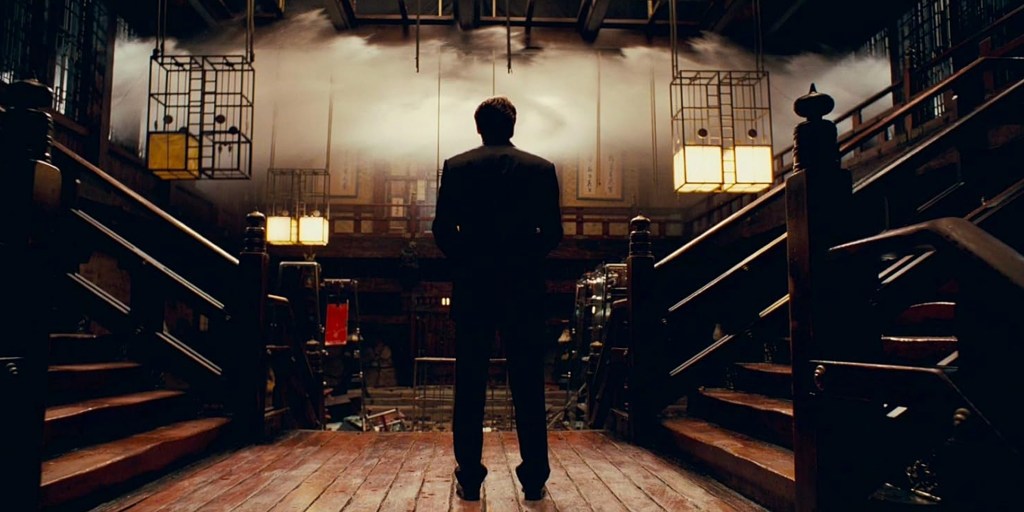
3. Application of “Repetition” as a Narrative Technique
In Inception, the director frequently employs “repetition” as a storytelling device. Originally a musical concept, repetition later expanded into literature and film, where it highlights recurring motifs. The film uses this technique to contrast the dream world and reality, emphasizing the characters’ psychological struggles. The confrontation between Cobb’s guilt and subconscious (embodied by Mal) reflects this repetition. While Mal deepens Cobb’s guilt, she also extends his memories of her. Similarly, the dream world highlights Cobb’s lingering love for his children, reinforcing his inner conflicts.

Ultimately, Cobb reconciles his reality with his subconscious, achieving psychological integration. By navigating the cyclical, spiraling narrative, the audience is left contemplating both the film’s resolution and their interpretation of its meaning.
Reference:
Genette, G. (1980). Narrative Discourse: An Essay in Method. Ithaca, NY: Cornell University Press.
Bordwell, D. (2006). The Way Hollywood Tells It: Story and Style in Modern Movies. Berkeley, CA: University of California Press.
Nolan, C. (2010). Inception: The Shooting Script. San Rafael, CA: Insight Editions.
Page, E. (2011). Understanding Christopher Nolan. Lexington, KY: University Press of Kentucky.
Zizek, S. (2012). The Pervert’s Guide to Cinema. London: Verso.
Wrrite by Zike Ding
Student ID: 33841744
 Digital Audiovisual Media Class Blog
Leave a comment