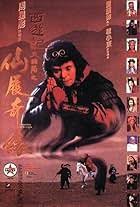
The A Chinese Odyssey series consists of two films, A Chinese Odyssey Part One: Pandora’s Box and A Chinese Odyssey Part Two: Cinderella, produced by Stephen Chow’s Star Overseas company. These classic nonsensical comedies are adapted from Wu Cheng’en’s famous mythological novel Journey to the West.
Upon their release in the early 1990s, these films sparked heated debate, transitioning from being dismissed as “cultural garbage” to being revered as “cultural totems.” Evaluating and analyzing this evolution from a postmodern perspective reveals the unique features of the series.
Postmodernism and Its Features
In 1991, American Marxist critic Fredric Jameson published Postmodernism, or, The Cultural Logic of Late Capitalism, proposing that post-World War II capitalism represents a “late capitalism” phase, with postmodernism as its cultural logic. Jameson highlighted several key characteristics of postmodern culture: the blurring of boundaries between high culture and popular culture, the dominance of visual over linguistic elements, and the shift from depth to surface, resulting in a culture of pastiche and fragmentation. According to Jameson, postmodernism’s defining feature is the “disappearance of distance.”
Deconstruction as a Postmodern Feature
Deconstruction is a hallmark of postmodernism, rejecting authority and centrality while emphasizing differentiation from orthodoxy. In cinematic terms, this means that scenes, compositions, colors, and music carry no fixed meanings, allowing each audience member to derive unique interpretations. This dismantles established standards and creates individualized meaning.

Stephen Chow’s A Chinese Odyssey exemplifies deconstruction, starting with its source material. Journey to the West is one of the Four Great Classical Novels of Chinese literature, widely recognized and celebrated. However, Chow and director Jeffrey Lau took a contrary approach, using a nonsensical comedic style to reinterpret the classic.
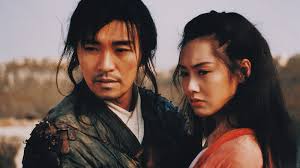
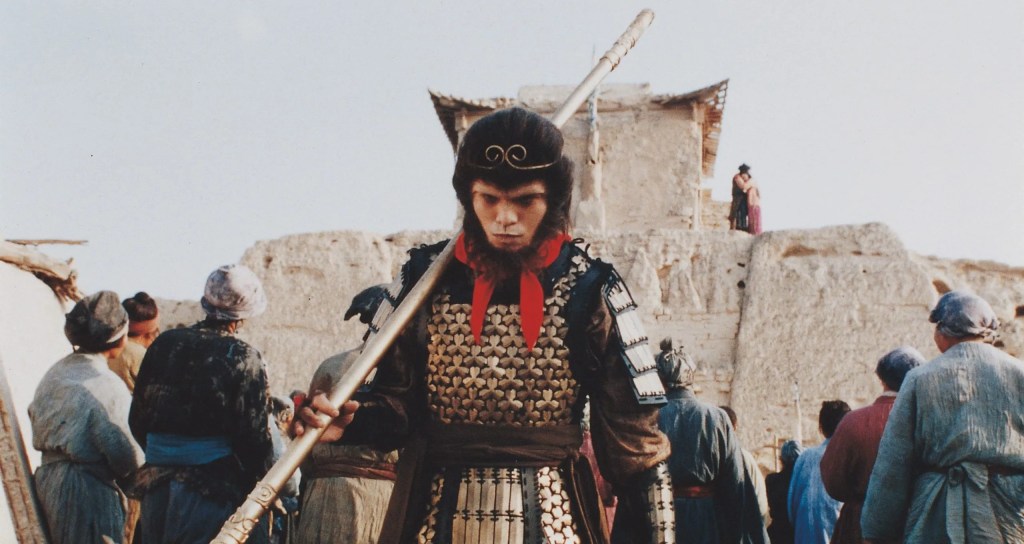
From a narrative perspective, the films subvert the original story of the monk and his disciples journeying westward to fetch sacred texts. Instead, they focus on the love and emotional struggles of the protagonist, Joker, who is revealed to be the Monkey King. This marks a significant departure from the source material.
In terms of character design, A Chinese Odyssey reimagines the monk as a chatterbox with endless witty remarks, a stark contrast to the solemn figure in the original text. Characters such as Bai Jingjing and Zixia are entirely fictional creations. Joker himself, the central character, is depicted as a relatable figure, full of human flaws, representing the “small man” rather than the grand hero of traditional tales. Postmodernism shifts the narrative focus from grand figures to ordinary people, portraying Joker’s insecurities and self-deprecating humor as ways to maintain dignity. Even the magical object “Pandora’s Box” symbolizes postmodern creativity: it enables time travel, a power not even possessed by the Monkey King in the original novel. From narrative arcs to character design and props, the films embody postmodern deconstruction.
Multiplicity and Interpretability
Postmodernism does not aim to convey a specific ideology but encourages audiences to derive their interpretations. Audience feedback becomes an integral part of the film. A Chinese Odyssey premiered in Hong Kong and mainland China on January 21, 1995. Upon release, it was poorly received. The Xi’an Film Studio, which co-produced the film, had doubts about its artistic value, with Zhang Zien, then vice director, dismissing it as “cultural garbage.”
The film’s initial box office failure was partly due to its audience. The main demographic at the time consisted of those born in the 1960s and 1970s, whose traditional views saw the irreverent adaptation of Journey to the West as sacrilegious. However, with the rise of the internet, A Chinese Odyssey became a cultural phenomenon, influencing the vernacular and humor of a new generation. It went from being dismissed as trash to being hailed as a classic of nonsensical comedy, shaping the linguistic and cultural identity of an era. By the late 1990s and early 2000s, film scholars and students from the Beijing Film Academy began reevaluating it as a “postmodern” work and a “cultural totem.” This evolution illustrates the film’s postmodern openness to diverse interpretations and its transformative cultural impact.
Reference:
Yang, Jing. “The Myth of Resilience in Stephen Chow’s Post-CEPA Films.” The Cinema of Stephen Chow (2024): 248.
Jameson, Fredric. “Postmodernism, or the cultural logic of late capitalism.” Postmodernism. Routledge, 2016. 62-92.
Yu, Anthony C. “The Formation of Fiction in the” Journey to the West”.” Asia Major (2008): 15-44.
Wrrite by Zike Ding
Student ID: 33841744
 Digital Audiovisual Media Class Blog
Leave a comment