Lady Gaga’s ‘Telephone’ music video, featuring Beyonce, is a timeless, iconic pop music video released in 2010. It is 9.5 minutes long full of symbolic scenes with themes of hyper-realism and female empowerment throughout. On the whole, it is an audiovisual critique of prominent political and social issues of the time, which still remain relevant today- for example the media, surveillance and the patriarchy.
Mise-en-scene is evident throughout the music video shown through various theatrical elements like vibrant costumes, hyper-feminine outfits and hyper-realistic, saturated backdrops. It is used to display political criticisms in striking ways, like Gaga’s prison outfit- industrial chains around her neck with cigarette-embellished sunglasses- which symbolises rebellion and social entrapment.
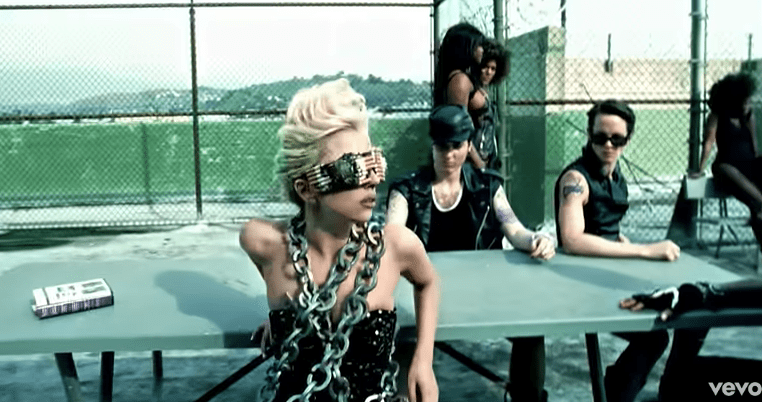
The excessive amount of nudity in scenes represents female liberation whilst critiquing the commoditisation of the female body in the music industry. It reinforces the idea of ‘sex sells’ while reclaiming autonomy and challenging societal norms. Gaga reminds viewers that “fantasies may mimic the teleology of classical narrative, but they need not adhere to it nor its promises of cohesion, coherence and closure”. (Benson-Allott, 2013)
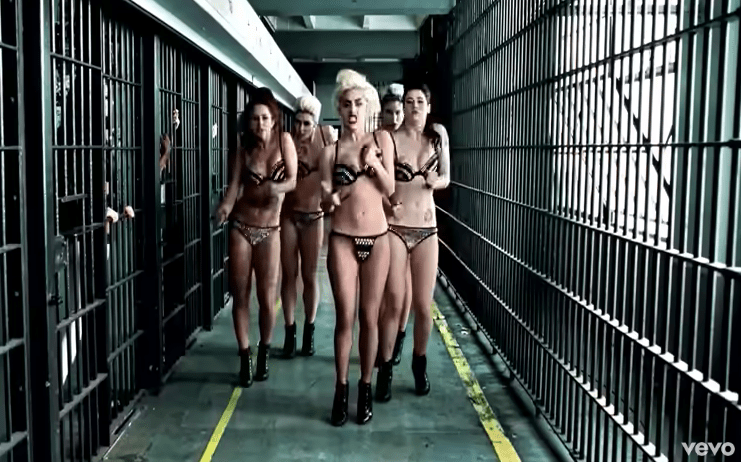
The stark contrast in set design and costumes mirror the tension between conformity and rebellion. This is seen by the dark and gloomy prison walls in the background of Gaga who appears in neon latex outfits, resembling the pop-art movement. The escape from prison shows the journey from confinement to liberation and the fast-paced, disjointed scenes amplify the tone of defiance and female agency. The relationship between sound and image is interesting as the pace of scenes progress from prison until the escape where chaotic visuals and flashes represent the vulture-like paparazzi and critique their invasion of privacy.

This empowering music video incorporates incredible imagery, a powerful narrative while critiquing political interventions, like surveillance and media manipulation. Scenes like these “act as the agent for a series of visual representations involving and stimulating different political interpretations” (Railton and Watson, 2011) To conclude, the combination of cinematic techniques to voice political messages delivers a powerful commentary about female empowerment and social expectations on women.
By: Francesca Rodriguez-Broadbent 33752271
References:
Diane Railton and Paul Watson (2011), ‘Music Video in Black and White: Race and Femininity’, Music Video and the Politics of Representation, 87-107
Caetlin Benson-Alliot (2013), “Going Gaga for Glitch: Digital Failure and Feminist Spectacle in Twenty First Century Music Video”m In: Vernallis, Carol, Amy Herzog, and John Richardson. The Oxford Handbook of Sound and Image in Digital Media. OUP USA, 127-139.
By: Francesca Rodriguez-Broadbent 33752271
 Digital Audiovisual Media Class Blog
Leave a comment