With the spread of digital technology, it has become possible to create music videos in a DIY style, and with music videos now being released on a variety of platforms, they are becoming more sexually and racially diverse. In this post, we will look at “Pendulum” (2014) by FKA Twigs, who is a musician and also creates her own music videos, and compare it with “Papi Pacify” (2013) to see how the motifs of restraint and liberation are expressed in her music videos.
See from 0:25 to 1:36
The kind of performance that Shaviro described as “fairly mild” BDSM in Papi Pasify can also be easily found in “Pendulum”s bondage (Shaviro, p. 63.). However, the crucial difference between “Papi Pacify” and “Pendulum” is that the former depicts interactions between a man and a woman, whereas the latter features only FKA Twigs. Rather, in “Pendulum”, the emphasis is on the loneliness and closed-off nature of the act of binding oneself with one’s own hair. This is clear from the lyrics, which talk about, the disappearance of her own sense of existence (Late I not so present now) and her own loneliness in response to the desire of one’s lover (Come fill your gaps with people…So lonely trying to be yours).
In the scene where she is swallowed up by the inorganic liquid metal, her own assimilation into the liquid metal is expressed using morphing technology, as if she were being swallowed up by her own loneliness. Her physical transformation is neither the complete transformation of the T-1000 into another figures in Terminator 2 (1991) or the multi-racial figures in Michael Jackson’s “Black or White” (1991). Rather, what “Pendulum” expresses is that, as her body (especially her face) dissolves into the liquid metal, her figure itself does not disappear completely. It shows her drowning in the liquid metal, unable to escape from the bonds of her own body.

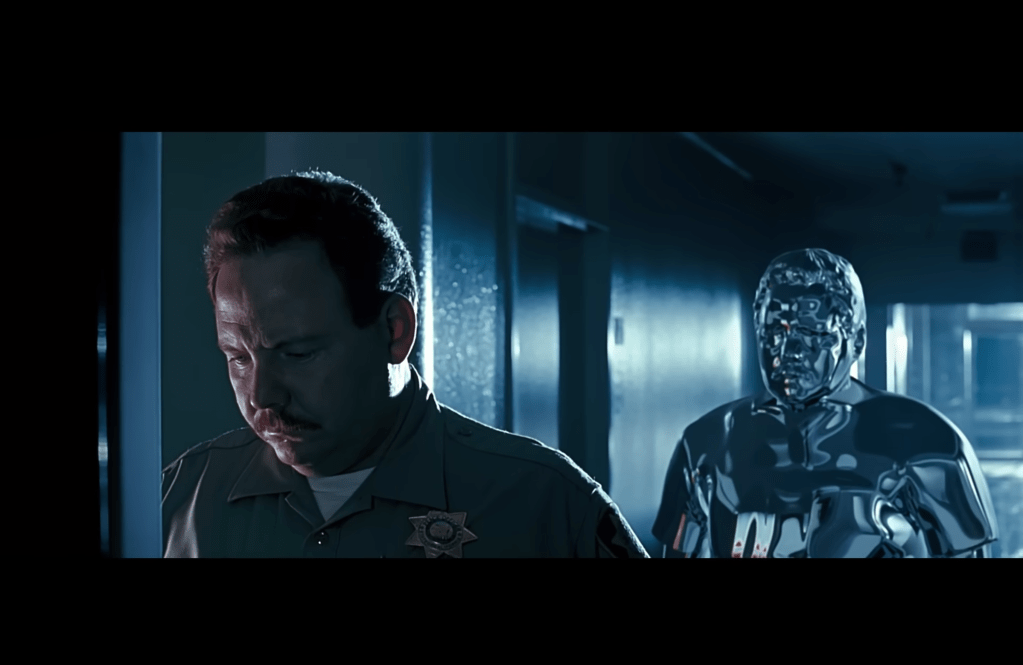
T-1000 in Terminator 2
See from 5:26
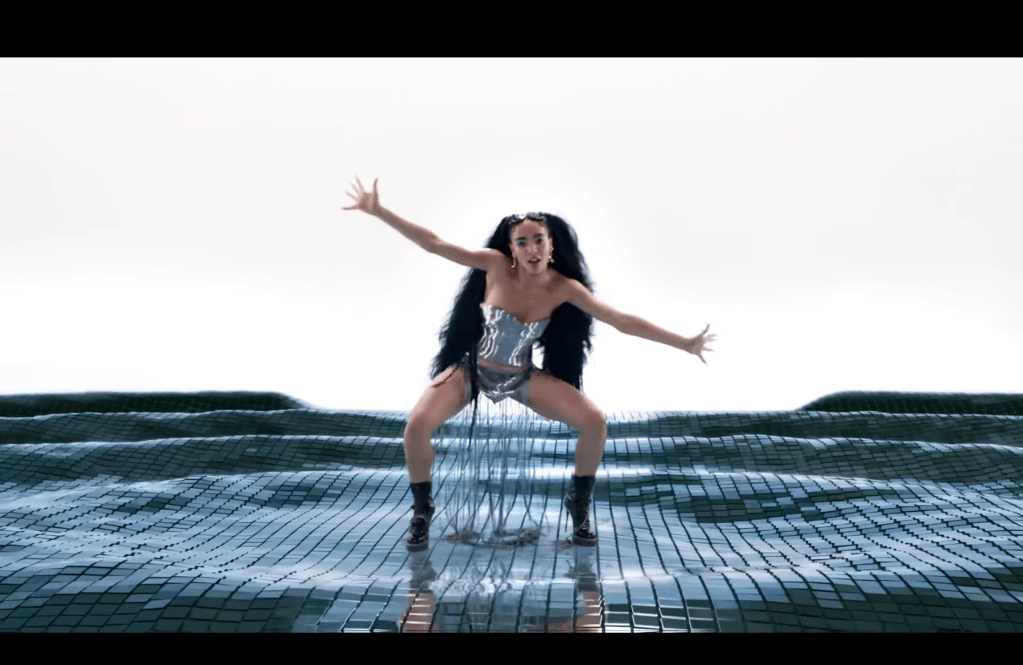
However, in the next shot, as she sinks into the abyss of liquid metal, she is shown as a flesh-and-blood human being. Here, her whole body is shown against a white background and bright lighting, and at the same time her powerful dance is shown, with the camera focusing on her gaze. In a complete change from previous scenes in this video, here she seems to be expressing a kind of liberation from herself. At the very least, here we see a figure that is far removed from the image of the fetishised and dehumanised woman under the gaze of the male (Benson-Allott, p. 131.).

Finally, this motif of self-restraint and liberation can be seen in an even more radical form in more recent music video, “Eusexua” (2024). In this video, FAK Twigs and many other people are shown to be sexually and racially liberated in a disciplined workplace, or in other words, in society, in a sensuous and sensual way.
・References
Steven Shaviro, “Glitch Aeshtetics,” Digital music videos, Rutgers University Press, 2017, pp. 51-75.
Caetlin Benson-Allott, “Going Gaga for Glitch: Digital Failure @nd Feminist Spectacle in Twenty-F1rst Century Music Video,” Carol Vernallis, Amy Herzog, John Richardson eds., The Oxford Handbook of Sound and Image in Digital Media, Oxford University Press, 2013.
Written by Takuya Nishihashi (33777985)
 Digital Audiovisual Media Class Blog
Leave a comment