Ruiyao Zhu-33832865
Advertising is the core means of media profit. In the recent few years, personalization has taken concrete steps to break out from ‘hype’ and found its calling in marketing deployments across B2B and B2C with equal vigor (khandelwal, 2019). With the development of digital technology, streaming media platforms such as Netflix have overturned the traditional TV advertising model that relies on communication through data-driven targeted advertising. Compared with the traditional TV advertising model that focuses on wide coverage, Netflix relies on big data and AI technology to not only improve the accuracy of advertising, but also significantly improve the user experience and demonstrate stronger market competitiveness.
(Chen, 2020)
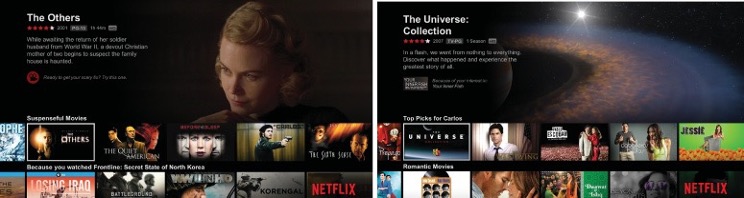
Firstly, Netflix’s utilization of AI has resulted in unparalleled personalization in viewer experiences (Markoni , 2023). The personalized advertising relies on its powerful data collection and analysis. Through users’ viewing history, ratings, search records and other behavioral data, Netflix can build a detailed interest profile for each user. This data-driven advertising model allows advertisers to accurately deliver content to users who are more interested in their products, avoiding the waste of traditional TV “mass communication” resources. For example, if a user often watches fitness-related programs, Netflix may recommend sports brand advertisements to them instead of pushing content irrelevant to their interests. This kind of precise delivery not only improves the conversion rate of advertising, but also significantly optimizes the advertiser’s return on investment.
Secondly, Internet TV is about choice: what to watch, when to watch, and where to watch, com- pared with linear broadcast and cable systems that offer whatever is now playing on perhaps 10 to 20 favorite channels (Gomez-Uribe and Hunt, 2015). Netflix has improved the user’s viewing experience through non-intrusive advertising. In the traditional TV model, advertisements usually appear in the form of inserts, interrupting the program content and easily causing audience thought. Netflix uses advertising forms that are more in line with user experience, such as brand placement or interactive advertising in the drama, so that the advertising content is integrated into the background of the program and reduce the audience’s resistance. Personalized advertising can also enhance the audience’s memory of the brand. For example, Netflix may made the use scenarios of related products in the user’s favorite dramas based on the user’s preferences, which not only strengthens the advertising effect, but also makes the advertisement itself a part of the viewing experience.
(Markoni , 2023)
In addition, Netflix’s global layout further enhances the flexibility of its advertising. Traditional television is limited by regional communication, and it is difficult to achieve cross-cultural advertising precision reach. In contrast, Netflix customizes advertising content according to the language and cultural background of the user’s region through localized data analysis, which can not only meet the needs of international brands, but also help local brands accurately reach the target audience.
Netflix has evolved swiftly and significantly over its two-decade history The service that established itself distributing films on DVD by mail in the United States is now most aptly categorized as a global video service (Lobato and Lotz, 2020). Although Netflix’s advertising model has shown strong advantages, it also faces certain challenges. The issue of privacy protection is the key. Large-scale data collection may cause users to worry about privacy, which requires Netflix to find a balance between data transparency and user trust. In addition, how to avoid excessive commercialization of advertising that affects the attractiveness of its ad-free subscription service is also an issue that Netflix needs to pay attention to.
In summary, Netflix has achieved a comprehensive transcendence of traditional TV advertising through personalized advertising. Its data driven advertising model built on its technological advantages not only improves advertising effectiveness, but also points out the future direction for the development of the advertising industry. With the further development of technology of market competition, Netflix’s advertising model will continue to drive the advertising industry towards personalization and globalization.
References:
Chen, S. (2020). Netflix Marketing Strategy 2021 – Business Model Canvas, Partners and Activities. [online] http://www.digitalphablet.com. Available at: https://www.digitalphablet.com/digital-marketing/netflix-marketing-strategy-business-model-canvas/.
Gomez-Uribe, C.A. and Hunt, N. (2015). The Netflix recommender system: Algorithms, business value, and innovation. ACM Transactions on Management Information Systems, [online] 6(4), pp.1–19. doi:https://doi.org/10.1145/2843948.
khandelwal, A. (2019). How Does Amazon & Netflix Personalization Work? [online] VWO Blog. Available at: https://vwo.com/blog/deliver-personalized-recommendations-the-amazon-netflix-way/.
Lobato, R. and Lotz, A.D. (2020). Imagining Global Video: The Challenge of Netflix. JCMS: Journal of Cinema and Media Studies, 59(3), pp.132–136. doi:https://doi.org/10.1353/cj.2020.0034.
Markoni , C. (2023). Netflix’s AI in Marketing: Personalization, Engagement, Savings. [online] the Al track. Available at: https://theaitrack.com/netflix-ai-marketing/.
 Digital Audiovisual Media Class Blog
Leave a comment