The development of television programs ushered in the “third golden age” of television, this era has changed not only the type of content produced, but also the production, distribution, and consumption mechanisms. Since then, the industry has entered a new phase that Mareike Jenner describes as “TVIV” – the fourth phase of television (Jenner, 2016). In this new landscape, Netflix’s original series Stranger Things is a landmark piece that embodies how streaming services redefine television, combining high production values and Nostalgic intertextuality with nostalgic intertextuality to create an immersive viewing experience for viewers.
Figure 1
Image source: https://en.wikipedia.org/wiki/Stranger_Things
The high production values and nostalgic intertextuality of the “Stranger Things” original series:
Stranger Things is a hybrid show that references elements of 1980s pop culture with supernatural elements and teen drama. Its visual and narrative elements pay homage to classics such as Back to the Future, The Terminator, and Ghostbusters (Figure 2), and the 80s vibe is also reflected in details such as the characters’ costumes and rollerblading activities (Figure 3). It creates a nostalgic atmosphere that deeply appeals to both Generation X audiences who experienced the 1980s firsthand and younger audiences who are attracted by the retro aesthetic.
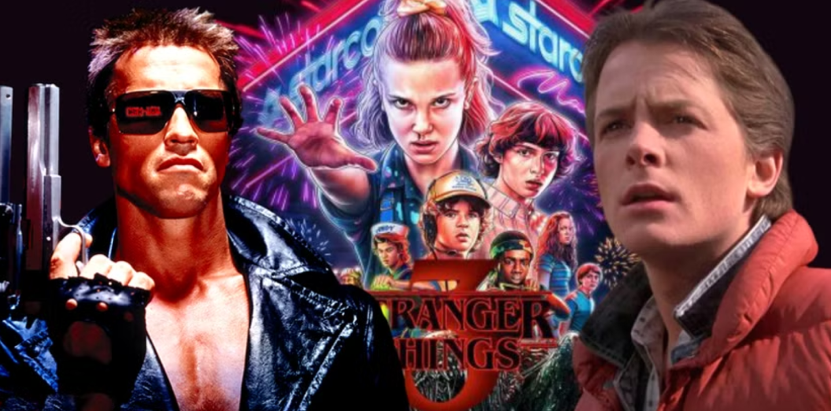
Figures 2
Image source: https://screenrant.com/stranger-things-reasons-show-is-so-popular/

Figures 3
Image source: https://nerdist.com/article/stranger-things-4-pop-culture-easter-eggs/
Another factor contributing to the show’s deep appeal is its use of contemporary production methods to transport viewers to a new enchanted realm. High-quality special effects and rich detailed scenes (Figures 4 and 5), coupled with synthesizer-accentuated special effects sounds, transport the audience into a carefully crafted world.


Figures 4&5
Image source: https://www.animationxpress.com/latest-news/rodeo-fx-reveals-the-visual-effects-behind-the-monsters-of-stranger-things-3/
Netflix’s non-linear accessibility also means viewers can relive past seasons and explore thematic layers at their own pace, increasing audience engagement (Figure 6). This deepens the audience’s connection with the story and the characters and transforms the viewing behaviour into an all-encompassing experience.

Figures 6
Image source: Netflix Stranger things
By combining high production values, nostalgic intertextuality, and a distribution model suitable for carnival, the series provides an immersive experience that caters to the needs of different audience segments (Mollet, 2019).
Reference List:
Diaz, E. (2022). The ’80s Pop Culture Easter Eggs in STRANGER THINGS 4. [online] Nerdist. Available at: https://nerdist.com/article/stranger-things-4-pop-culture-easter-eggs/.
Jenner, M. (2016) ‘Is this TVIV? On Netflix, TVIII and binge-watching’, New Media & Society, 18(2), pp. 257-273.
Mollet, T. (2019). Looking through the upside down: Hyper-postmodernism and trans-mediality in the Duffer Brothers’ Stranger Things. The Journal of Popular Television, 7(1), pp.57–77. doi:https://doi.org/10.1386/jptv.7.1.57_1.
Rudoy, M. (2020). Stranger Things: 10 Reasons Why The Netflix Show Is So Popular. [online] ScreenRant. Available at: https://screenrant.com/stranger-things-reasons-show-is-so-popular/.
Team, A. (2019). Rodeo FX Reveals the Visual Effects behind the Monsters of ‘Stranger Things 3’. [online] Animationxpress.com. Available at: https://www.animationxpress.com/latest-news/rodeo-fx-reveals-the-visual-effects-behind-the-monsters-of-stranger-things-3/
By Yuqing Yin-33750937
 Digital Audiovisual Media Class Blog
Leave a comment