Netflix and Amazon Prime are streaming services that are useful in many ways but they are heavily regulated and tied to capital. Similarly with national large film festivals like those at Cannes and Sundance, they are often exploitative and hierarchical and don’t offer a dialogue between filmmakers, audience and organisers, which in turn suppresses any kind of counter discourses and upholds mainstream and dominant ideals.
When thinking about screen based experiences, it is important to understand how and what one is consuming. Corporate streaming services do not function as archives and therefore are impermanent as they circle through only what is most commerciable. They are about easy consumption, dispersed attention and audiovisual media as a closed process. When one engages with audiovisual work outside of this, films become a living text and consumption becomes about reflection and about challenging the hyper perceptiveness and vacant engagement which one would otherwise live through. I have found various websites and alternative online spaces to stream and download films, which although often consists of shadowbans, buffering, low resolution and crashing which makes film viewing precarious and unpredictable, offers a different kind of fluid perception and chance for performativity and dialogue between spectators and the film.
For example, Solidarity Cinema Archive is an online archive of leftist, political films which show resistance to censorship, ideological hegemony and expanding commodification of film viewing located on the app Plex, which is a streaming service that allows you to organize and stream your collection of movies, TV shows, music, and photos, from a central location. The people behind this are most likely film fans illegally downloading the films in order to give access, which is given by simply sharing the username and password on their website, which in fact includes this quote:


Screenshots from solidaritycinema.com
Other websites include Rarefilmm, which is also a twitter account owned by a man named Jon, who posts links to download the films as well and accepts requests in the comments.
Alternatively, one can go on a website like VK, which is similar to Youtube or Discord but from Russia, meaning there are less, or maybe different, kinds of copyright holders and regulations, so one can find and access almost anything. Often the films on these platforms are low budget, independent, experimental, political, subversive in form and content which reflects what kinds of archives they are as well. Independent films are often still based on familiar paradigms which the film industry constructs, and these filmic experiences a viewer might be interested in having are incompatible with it since they come from informal distribution.
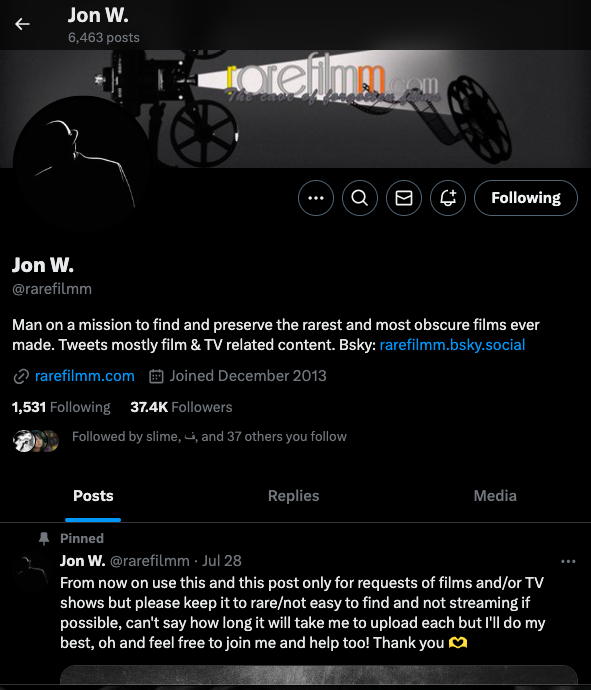
Screenshot of Rarefilmm owner’s Twitter account.
The communities or individuals behind these websites or online distribution are called rogue archivists and techno volunteers in Ann Jamison’s essay “Rogue Archives: Digital Cultural Memory and Media Fandom“, often referring to fan cultures and fan studies, she mentions that these practices are “a rich and varied company of creative countercultural conservation efforts…. devoted to marginalized interests, identities, and populations, these “rogue” archival projects have wrested control of public memory from the staid institutions of state power, transferring and dispersing it among diverse counterpublics”. It is a way to preserve and give access to videos outside of official institutional archives and are made up of amateurs, superfans, hackers and creators of free online tools. This in fact might encourage the viewer to engage in this kind of distribution as well, including myself, and create a personal archive which resists the forces of splitting from your own individual experience and perceptive agency which are behind corporate systems like that of Netflix.
Cami Sarram 33737747
 Digital Audiovisual Media Class Blog
Leave a comment