By Ismail Hadj-Maamar 33738244
Week 1: The Digital Transformation of Cinema and Television
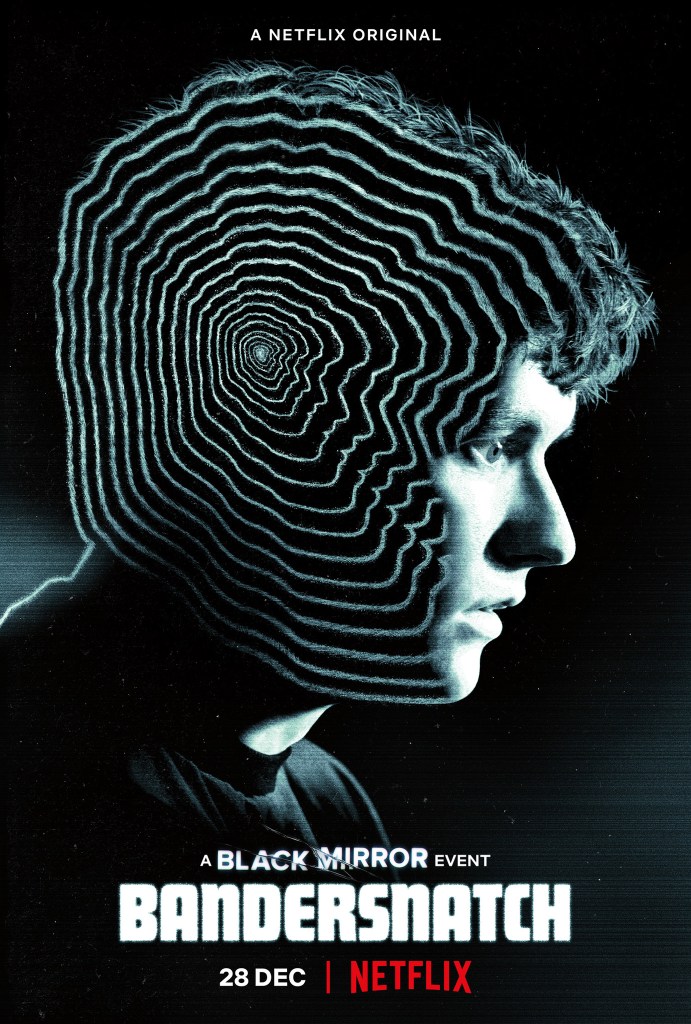
Cinema isn’t what it used to be. It’s no longer about sitting in a theater, letting a story unfold in a straight line. Instead, it’s morphing into something interactive, self-aware, and digitally driven. Take Black Mirror: Bandersnatch (2018), for example. It’s not just a film—it’s a turning point in how we experience storytelling, perfectly capturing what theorists like Manovich, Denson, and Leyda call post-cinema.
Here’s the deal: in Bandersnatch, you’re not just a viewer. You’re the one pulling the strings, making decisions that alter the plot. Lev Manovich would call this “a shift from a fixed cinematic narrative to one that’s modular and variable.” It’s basically cinema meeting video games. But what’s fascinating isn’t just the branching storyline—it’s the deeper message. The film isn’t just using interactivity; it’s commenting on it. At one point, the protagonist realizes he’s being controlled and even names Netflix as his puppet master. That’s next-level self-awareness.
This goes beyond gimmicks. It mirrors the chaos of a digital age where algorithms nudge every decision we make, from what to watch to what to buy. Shane Denson and Julia Leyda describe post-cinema as a “dynamic and processual” experience. Bandersnatch embodies this, showing us how stories now adapt to us, not the other way around. It feels like a metaphor for living in a world mediated by choice overload and digital control.
Aesthetically, Bandersnatch is pure neobaroque. Sean Cubitt’s idea of recursive loops and fragmented narratives comes alive here, drawing us into a maze that makes the medium the star. Every choice, every dead end, forces us to rethink what a story can be.
So, is Bandersnatch the future of cinema? Maybe. It’s a bold reminder that cinema doesn’t have to stay in its lane. It can evolve, adapt, and—most importantly—ask us to take the wheel.
Bibliography
Cubitt, S., 2005. The Cinema Effect. Boston: MIT Press, pp. 217-244.
Denson, S. and Leyda, J., 2016. Perspectives on post-cinema: An introduction. In: Post-Cinema: Theorising 21st Century Film. Available at: https://reframe.sussex.ac.uk/wp-content/uploads/2019/05/POST-CINEMA_LO_RES.pdf [Accessed 27 Nov. 2024].
Manovich, L., 2002. The Language of New Media. Cambridge, MA: MIT Press, pp. 18-61.
Rodowick, D.N., 2015. The Virtual Life of Film. Cambridge, MA: Harvard University Press, pp. 25-88.
 Digital Audiovisual Media Class Blog
Leave a comment