Kanye West’s ‘Runaway’, released in 2010, is a 34-minute visual album that blends music and cinematography to portray themes of romance, race and materialism. Kanye attempts to blur the lines between film, music and art through surreal and symbolic imagery accompanied by a powerful soundtrack that enhances the emotional experience.
Within the visual album, Kanye’s character rescues a mythical creature, played by Selita Ebanks, who has fallen to Earth from an extraterrestrial planet. The creature learns about human nature and tries to conform to her social setting, however questioning society leads the phoenix back to her outer space origins. The storyline’s disjointed structure reflects the protagonist’s emotional turbulence and digital music videos usually embrace fragmentation to convey altering sensory experiences (Shaviro, 2017).
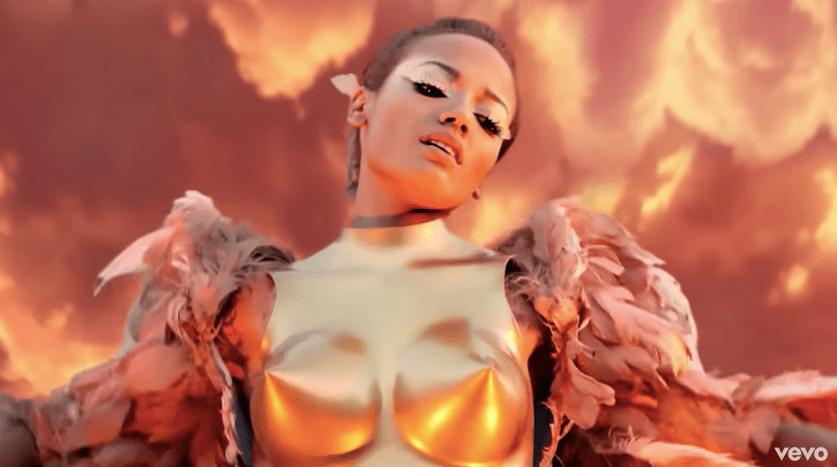
Scene by scene, Kanye cleverly weaves the thematic storyline into each setting; ethereal aesthetics and dreamlike backdrops take homage from traditional film techniques and Kanye’s album, on top, complements each scene’s tone overall.
Kanye’s ‘Runaway’ embodies the fusion of artistic aesthetics and film production while illustrating symbols and representation. Railton and Watson (2011) explore how race and gender are expressed in music videos, focusing on racial and gender coding. Evident in ‘Runaway’, Kanye utilises colour contrasts as a societal metaphor. The mythical creature is dressed in golden feathers while situated in predominantly white settings symbolising marginalised outcasts in a bleak, materialistic society. The contrast reflects Railton and Watson’s ideas of racial coding, where whiteness is positioned as dominant and anything else is seen as disruptive and a nonconformist.

Kanye involves many surreal elements in his visual album from fantastical visuals, ethereal characters and distorted sounds with each playing a role in illustrating the album’s artistic purpose. Incorporating elements from the film industry and applying them to Kanye’s knowledge of the music and fashion industry, allows him to successfully communicate a powerful message through mesmerising art and inspirational music.
References:
Steven Shaviro, (2017), ‘Glitch Aesthetics’, Digital Music Video.
Diane Railton and Paul Watson (2011), ‘Music Video in Black and White: Race and Femininity’, Music Video and the Politics of Representation, 87-107
By Francesca Rodriguez-Broadbent 33752271
 Digital Audiovisual Media Class Blog
Leave a comment