What Netflix is shaping the modern era: The seismic changes happening under our noses
By Leyan Zhang, 33734844
“to look at developments that are so new and unfamiliar that we scarcely have the vocabulary to describe them, and yet that have become so common, and so ubiquitous, that we tend not even to notice them any longer. My larger aim is to develop an account of what it feels like to live in the early twenty-first century. “(Shaviro, S., 2010, p2)Jenner mentioned in her book “Netflix and the Re-Invention of Television”, that according to the history of Netflix, they were a DVD rental company in the early days. Later, they collected audience preferences from the DVD rental business: for example, when audiences chose DVDs, it was because, in the TV III era, the addition of VCR made people able to be viewed regardless of time, location and device. Rather, because these restrictions were lifted, audiences began to shift from reliance on televisions to becoming more curious about content, and the weight of film and television content began to increase. Netflix’s cancellation of advertisements satisfies the contemporary desire of viewers not to be disturbed. What can be said is that in the process of transitioning from TV III to TV IV, Netflix caught on and shaped the same discourse. This article will analyse what Netflix has done based on personal viewing experience. What have we overlooked? What are our concerns?
Changes happen unconsciously. As one of the shapers of post-cinema, Netflix went against the grain and distanced itself from the ideology of TV liveness, choosing the same binge viewing model as DVD. The interactive success of their sites turned themselves into a maze. Here I would like to use a story to better explain this relationship:
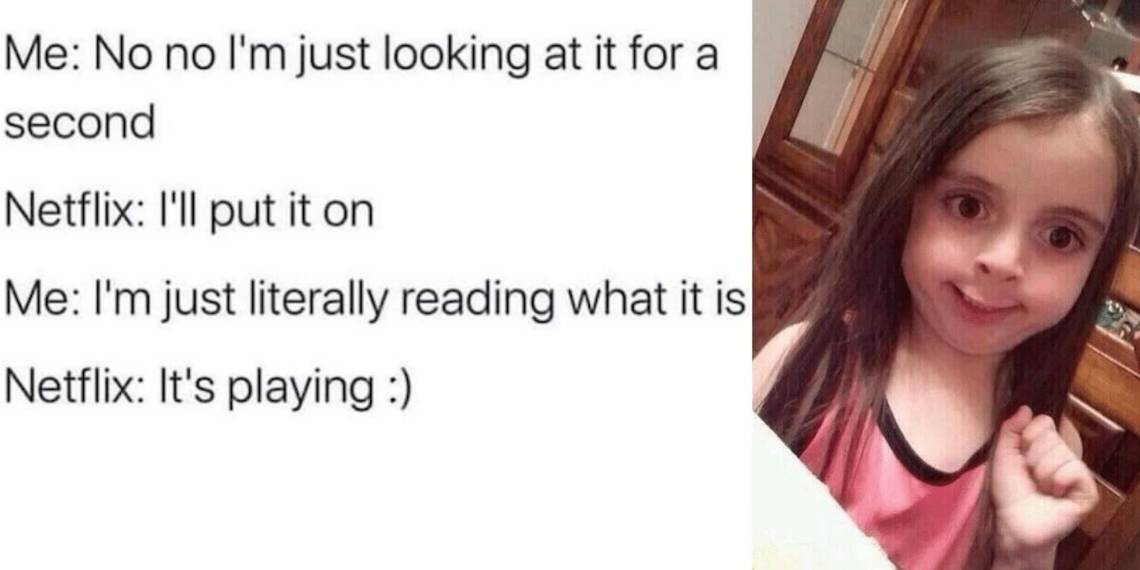
The super-long TV series Shameless enjoys a certain reputation in the TV series circle. I am ashamed to say that I first watched this TV series on a pirated website. Later I learned that it is on Netflix. There is also the copyright for the series, so I decided to go formal (I believe my experience also represents the majority of people). During the viewing process on the Netflix website, each window has a 30-second preview. If you watch it after these 30 seconds without any operations, they will go directly to the episode. There is a silky connection between each series, which makes people want to watch it even more. Even after finally watching it, they will recommend similar series to you that you like. Originally, I only planned to watch it for a few hours, but I didn’t expect that it was already dawn.
Source: https://screenrant.com/funny-relatable-netflix-logic-memes/
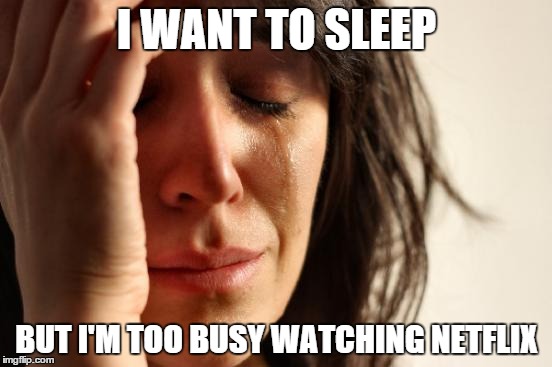
So I opened the social media app and saw that my friend was online and posted an ig story about Shameless. When I took a closer look, I saw that she had watched more episodes than me, and a sense of comparison arose in my heart. Compared with the fixed broadcast schedule of traditional TV series, in the era of Netflix, we have lost synchronicity, but on other social media platforms, we have found each other with the same hobbies. To a certain extent, this means that digital life combined with virtual viewing and other platforms has changed our viewing habits, but we know nothing about it. And next time I will still stay up late watching TV series.
Source: https://imgflip.com/i/qnkjc
Habit frames change as persistence, as it habituates: it is a reaction to change – to an outside sensation or action – that remains beyond that change within the organism. (2016, location 336) (Jenner, M., 2018, p12)
Source: https://www.imdb.com/title/tt14403178/
Whether this kind of change in screenwriting is for commercial selling points to gain a larger audience, or to respond to the call of the spirit of the times, their approach is undoubtedly a reflection of culture and race, gender and orientation, class and social background, and the process of marginalized groups. Very successful. But I started to worry, wouldn’t this reinforce the stereotype? I think of Hollywood’s exaggerated political correctness that has led to heated discussions among some movie lovers. Is it possible that, on the surface, it looks like we have the right to speak and we choose what we want to see, but in fact it is what the platform wants us to see? As an Asian, I am pushed to beef. The platform’s participation is far beyond our imagination. We are like children who finally mastered the remote control during dinner time. After dinner, we held the remote control in our arms and cried and refused to return it, but our parents still We can unplug the TV and control our viewing time. The platform, and especially the relationship here, is very much like the parents in the story. The power relationship becomes blurred here. We are accustomed to personalization spoiling us, and then choose more personalized platforms.
Netflix’s globalization strategy allows each country to have its own version. Another experience is that when I first entered Netflix, the language page displayed was all in Chinese based on the registered account. I clicked on a series that I was interested in. After watching it, when he started to speak Chinese, I didn’t notice anything wrong. It wasn’t until after watching two episodes that I realized that the Western actors in the show did not speak Chinese. There were too many things that we ignored.
Tags: #Week4 #Netflix #Bingeviewing #personalwatchexperience #powertransformation
Author:
Leyan Zhang, 33734844
References
Gibbs, L. (2020). Funniest Netflix Logic Memes Everyone Can Relate To. [online] ScreenRant. Available at: https://screenrant.com/funny-relatable-netflix-logic-memes/ [Accessed 27 Nov. 2024].
Imgflip. (2024). First World Problems. [online] Available at: https://imgflip.com/i/qnkjc [Accessed 27 Nov. 2024].
Jenner, M 2018, Netflix and the Re-Invention of Television, Springer International Publishing AG, Cham. Available from: ProQuest Ebook Central. [27 November 2024].
Lotz, A.D. (2017) ‘Theorizing the Nonlinear Distinction of Internet-Distributed Television’, in Lotz, A.D. Portals: A Treatise on Internet-Distributed Television. Ann Arbor, MI: Maize Books, an imprint of Michigan Publishing.
Shaviro, S. (2010) ‘Post-Cinematic Affect: On Grace Jones, Boarding Gate and Southland Tales’, Film-Philosophy, [online] February 2010. Available at: https://www.euppublishing.com/doi/10.3366/film.2010.0001
http://www.imdb.com. (n.d.). Beef (TV Series 2023– ) – IMDb. [online] Available at: https://www.imdb.com/title/tt14403178/.
 Digital Audiovisual Media Class Blog
Leave a comment